




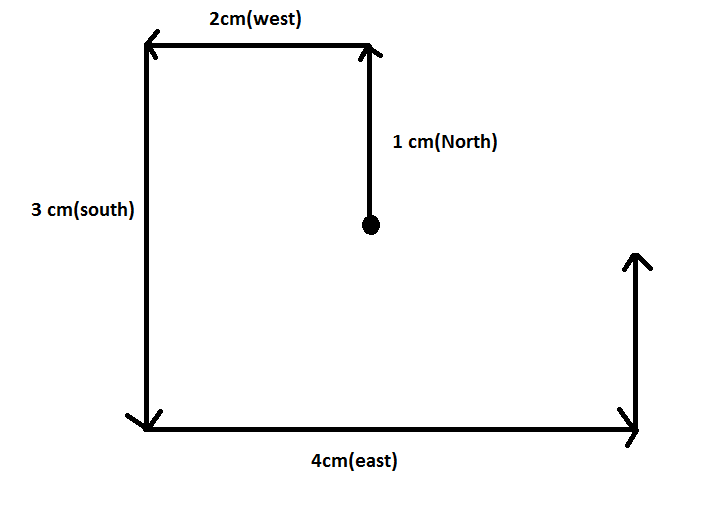
An ant crawls \[1\] cm north, \[2\] cms west, \[3\] cms south, \[4\] cms east and \[5\] cms north and so on, at \[1\] centimeter per second. Each segment is \[1\] centimeter longer than the preceding one, and at the end of a segment, the ant makes a left turn. In which direction is the ant moving \[1\] minute after the start?
A. South
B. North
C. East
D. West
Answer
 Verified
533.7k+ views
Hint: In order to find the answer to the above question, we will use arithmetic progression (AP). It refers to the sequence of numbers such that the difference between the consecutive terms is constant. A diagram can be drawn to clearly understand the question and it will make the question easier to solve.
Formula used:
The formula of arithmetic progression will be used to solve this question.
The formula is: \[{S_n} = \dfrac{n}{2}\left[ {2a + \left( {n - 1} \right)d} \right]\] , in this formula \[a\] refers to the first term of the progression and \[d\] is the difference between the two consecutive terms.
The second formula which will be used to solve this question is of quadratic equations.
\[x = \dfrac{{ - b \pm \sqrt {{b^2} - 4ac} }}{{2a}}\]
Complete step by step solution:
Now we know,
The ant always travels \[\left( {4k + 1} \right)\] cm North, \[\left( {4k + 2} \right)\] West, \[\left( {4k + 3} \right)\] cm South and \[\left( {4k + 4} \right)\] East.
Therefore, the distance travelled by the ant in \[1\] min is \[60 \times 1cm = 60cm\] .
From the above statements we get the following AP: \[1,2,3,4........\]
To solve this arithmetic progression, we will use the formula mentioned above.
\[{S_n} = \dfrac{n}{2}\left[ {2a + \left( {n - 1} \right)d} \right]\] , here \[a = 1\] and \[d = 1\] .
So,
\[60 = \dfrac{n}{2}\left[ {2 \times 1 + \left( {n - 1} \right) \times 1} \right]\]
On cross multiplication, we get,
\[
\Rightarrow 120 = n\left[ {2 + n - 1} \right] \\
\Rightarrow 120 = n\left[ {n + 1} \right] \\
\Rightarrow 120 = {n^2} + n \\
\]
Take all the terms on right side of the equation, we get,
\[{n^2} + n - 120 = 0\]
Now to solve this quadratic equation, we will use the formula, \[x = \dfrac{{ - b \pm \sqrt {{b^2} - 4ac} }}{{2a}}\] , here \[x\] is replaced by \[n\] , \[a = 1,b = 1\] and \[c = - 120\] .
\[n = \dfrac{{ - 1 \pm \sqrt {{1^2} - 4\left( 1 \right)\left( { - 120} \right)} }}{{2\left( 1 \right)}}\]
\[ \Rightarrow n = \dfrac{{ - 1 \pm \sqrt {1 + 480} }}{2}\]
On further solving, we get,
\[ \Rightarrow n = \dfrac{{ - 1 \pm \sqrt {481} }}{2}\]
\[ = \dfrac{{ - 1 \pm 22}}{2}\]
\[ = \dfrac{{21}}{2}\] .
This can be written as \[10\dfrac{1}{2}\] .
We will take \[n = 11\] .
Therefore, \[{a_{11}} = 1 + 10 \times 1\]
\[ = 11\] .
This can be written as \[11 = 4 \times 2 + 3\] .
So, the correct answer is Option A.
Note: To solve such sums related to arithmetic progression (AP), you need to always remember the formula mentioned above for AP, \[{S_n} = \dfrac{n}{2}\left[ {2a + \left( {n - 1} \right)d} \right]\] . In the above solution, we have used a formula, \[x = \dfrac{{ - b \pm \sqrt {{b^2} - 4ac} }}{{2a}}\] , for solving the quadratic equation. This formula helps when the calculations are either long or tricky.
Formula used:
The formula of arithmetic progression will be used to solve this question.
The formula is: \[{S_n} = \dfrac{n}{2}\left[ {2a + \left( {n - 1} \right)d} \right]\] , in this formula \[a\] refers to the first term of the progression and \[d\] is the difference between the two consecutive terms.
The second formula which will be used to solve this question is of quadratic equations.
\[x = \dfrac{{ - b \pm \sqrt {{b^2} - 4ac} }}{{2a}}\]
Complete step by step solution:
Now we know,
The ant always travels \[\left( {4k + 1} \right)\] cm North, \[\left( {4k + 2} \right)\] West, \[\left( {4k + 3} \right)\] cm South and \[\left( {4k + 4} \right)\] East.
Therefore, the distance travelled by the ant in \[1\] min is \[60 \times 1cm = 60cm\] .
From the above statements we get the following AP: \[1,2,3,4........\]
To solve this arithmetic progression, we will use the formula mentioned above.
\[{S_n} = \dfrac{n}{2}\left[ {2a + \left( {n - 1} \right)d} \right]\] , here \[a = 1\] and \[d = 1\] .
So,
\[60 = \dfrac{n}{2}\left[ {2 \times 1 + \left( {n - 1} \right) \times 1} \right]\]
On cross multiplication, we get,
\[
\Rightarrow 120 = n\left[ {2 + n - 1} \right] \\
\Rightarrow 120 = n\left[ {n + 1} \right] \\
\Rightarrow 120 = {n^2} + n \\
\]
Take all the terms on right side of the equation, we get,
\[{n^2} + n - 120 = 0\]
Now to solve this quadratic equation, we will use the formula, \[x = \dfrac{{ - b \pm \sqrt {{b^2} - 4ac} }}{{2a}}\] , here \[x\] is replaced by \[n\] , \[a = 1,b = 1\] and \[c = - 120\] .
\[n = \dfrac{{ - 1 \pm \sqrt {{1^2} - 4\left( 1 \right)\left( { - 120} \right)} }}{{2\left( 1 \right)}}\]
\[ \Rightarrow n = \dfrac{{ - 1 \pm \sqrt {1 + 480} }}{2}\]
On further solving, we get,
\[ \Rightarrow n = \dfrac{{ - 1 \pm \sqrt {481} }}{2}\]
\[ = \dfrac{{ - 1 \pm 22}}{2}\]
\[ = \dfrac{{21}}{2}\] .
This can be written as \[10\dfrac{1}{2}\] .
We will take \[n = 11\] .
Therefore, \[{a_{11}} = 1 + 10 \times 1\]
\[ = 11\] .
This can be written as \[11 = 4 \times 2 + 3\] .
So, the correct answer is Option A.
Note: To solve such sums related to arithmetic progression (AP), you need to always remember the formula mentioned above for AP, \[{S_n} = \dfrac{n}{2}\left[ {2a + \left( {n - 1} \right)d} \right]\] . In the above solution, we have used a formula, \[x = \dfrac{{ - b \pm \sqrt {{b^2} - 4ac} }}{{2a}}\] , for solving the quadratic equation. This formula helps when the calculations are either long or tricky.
Recently Updated Pages
Master Class 11 Computer Science: Engaging Questions & Answers for Success

Master Class 11 Business Studies: Engaging Questions & Answers for Success
Master Class 11 Economics: Engaging Questions & Answers for Success
Master Class 11 English: Engaging Questions & Answers for Success
Master Class 11 Maths: Engaging Questions & Answers for Success
Master Class 11 Biology: Engaging Questions & Answers for Success
Trending doubts
One Metric ton is equal to kg A 10000 B 1000 C 100 class 11 physics CBSE
There are 720 permutations of the digits 1 2 3 4 5 class 11 maths CBSE
Discuss the various forms of bacteria class 11 biology CBSE
Draw a diagram of a plant cell and label at least eight class 11 biology CBSE
State the laws of reflection of light
Explain zero factorial class 11 maths CBSE