




An alkane with molecular formula ${C_5}{H_{12}}$ forms only one monochloro product when heated with $C{l_2}$. The IUPAC name of this compound is:
A. 1,1 dimethyl propane
B. 1,2 dimethylpropane
C. 2,2 dimethylpropane
D. none of the above
Answer
 Verified
618k+ views
Hint: the above process of heating alkane with $C{l_2}$ is called halogenations and since the halogen is Cl, the process is selectively called chlorination.
Step by step answer:Chlorination may be brought about by photo irradiation, heat or catalysts. The extent of chlorination depends largely on the amount of chlorine used. A mixture of all possible isomeric monochlorides is obtained, but the isomers are formed in unequal amounts, due to difference in reactivity of primary, secondary and tertiary hydrogen atoms. The order of ease of substitution is:
Tertiary hydrogen> secondary hydrogen > primary hydrogen
The tertiary hydrogen is replaced about 5 times as fast as primary hydrogen where we know that degree of hydrogen depends upon the degree of carbon they are attachéd to. Since in the question we are given that the given compound will form only one monochloro product, hence the compound has to have tertiary hydrogen in it. Therefore the compound is identified to be neopentane or 2,2 dimethyl propane since it has only one type of hydrogens and which is why it will form only one monochloro product as given below
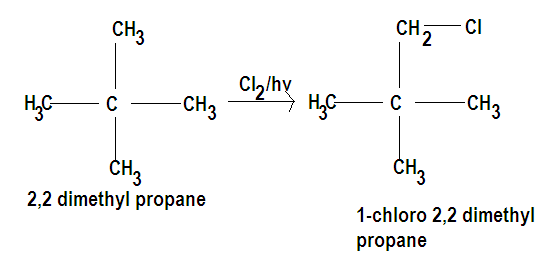
Chlorine gets attached to a tertiary carbon since all the hydrogens are tertiary in the compound therefore only one product gets formed as discussed above.
Hence the correct option is C.
Note: There are three factors that affect the yield of the isomeric products they are:
-Probability factor
-Reactivity of H atom
-Reactivity of X atom in the halogenations reaction, it is maximum for fluorine and does not occur with iodine.
Step by step answer:Chlorination may be brought about by photo irradiation, heat or catalysts. The extent of chlorination depends largely on the amount of chlorine used. A mixture of all possible isomeric monochlorides is obtained, but the isomers are formed in unequal amounts, due to difference in reactivity of primary, secondary and tertiary hydrogen atoms. The order of ease of substitution is:
Tertiary hydrogen> secondary hydrogen > primary hydrogen
The tertiary hydrogen is replaced about 5 times as fast as primary hydrogen where we know that degree of hydrogen depends upon the degree of carbon they are attachéd to. Since in the question we are given that the given compound will form only one monochloro product, hence the compound has to have tertiary hydrogen in it. Therefore the compound is identified to be neopentane or 2,2 dimethyl propane since it has only one type of hydrogens and which is why it will form only one monochloro product as given below
Chlorine gets attached to a tertiary carbon since all the hydrogens are tertiary in the compound therefore only one product gets formed as discussed above.
Hence the correct option is C.
Note: There are three factors that affect the yield of the isomeric products they are:
-Probability factor
-Reactivity of H atom
-Reactivity of X atom in the halogenations reaction, it is maximum for fluorine and does not occur with iodine.
Recently Updated Pages
Master Class 11 English: Engaging Questions & Answers for Success

Master Class 11 Social Science: Engaging Questions & Answers for Success
Master Class 11 Maths: Engaging Questions & Answers for Success
Master Class 11 Biology: Engaging Questions & Answers for Success
Master Class 11 Physics: Engaging Questions & Answers for Success
Master Class 11 Chemistry: Engaging Questions & Answers for Success
Trending doubts
Explain the Treaty of Vienna of 1815 class 10 social science CBSE
What is the full form of POSCO class 10 social science CBSE
Define Potential, Developed, Stock and Reserved resources
The diagonals of a rhombus are 10cm and 24cm Find the class 10 maths CBSE
Fill the blanks with proper collective nouns 1 A of class 10 english CBSE
What planets have no moons Which one has only one moon class 10 physics CBSE