




An alcohol of formula ${{\text{C}}_{\text{9}}}{{\text{H}}_{{\text{12}}}}{\text{O}}$ reacts with ${\text{N}}{{\text{a}}_{\text{2}}}{\text{C}}{{\text{r}}_{\text{2}}}{{\text{O}}_{\text{7}}}$ to form a compound having a formula ${{\text{C}}_{\text{9}}}{{\text{H}}_{{\text{10}}}}{\text{O}}$. The original alcohol might be:
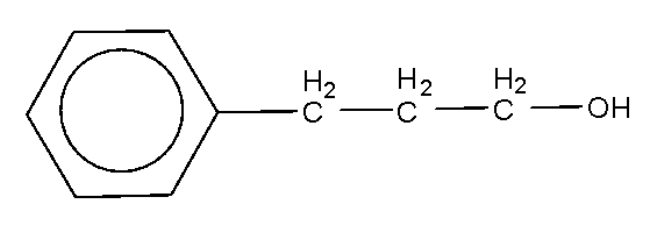
A.
B.
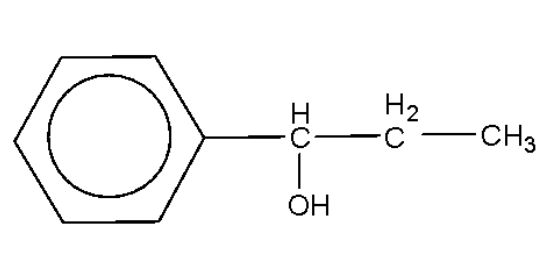
C.
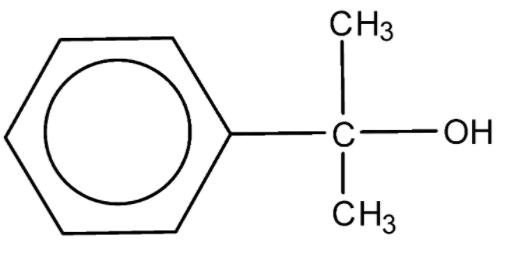
D.
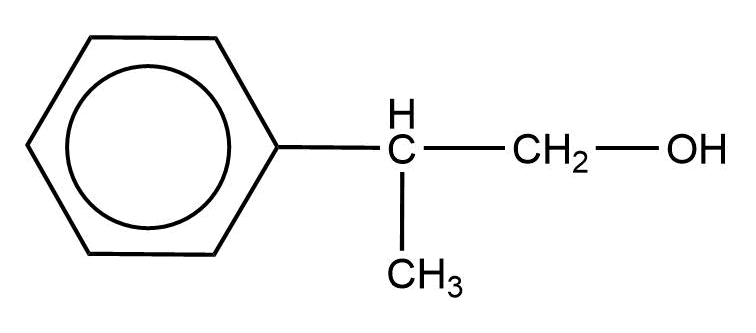
Answer
 Verified
590.1k+ views
Hint: Sodium Dichromate oxidises different organic compounds, under different acidic conditions as it is a strong oxidising agent. Alcohol can oxidise to carbonyl compounds or carboxylic acid.
Complete Step by step solution:
Alcohols are oxidized by oxidising agents like sodium dichromate and potassium permanganate under highly acidic conditions to form aldehydes or ketones. This may be further oxidized to form carboxylic acids. The empirical formula ${{\text{C}}_{\text{9}}}{{\text{H}}_{{\text{10}}}}{\text{O}}$ has six carbon atoms and 5 hydrogen atoms for the phenyl ring, which leaves us with three carbon atoms, 5 hydrogen atoms, and one oxygen atom. In the above options all the options have the said number of carbon atoms, hydrogen atoms, and oxygen atoms.
Among the given options only option B will be oxidized by the sodium dichromate to form the compound with the empirical formula as given.
Hence, the correct option is B.
Notes: Sodium and potassium dichromate are strong oxidising agents that can oxidise alcohols into aldehydes and ketones. Due to the oxidation, the orange oxidising agent turns green due to the formation of the chromic salt. The type of products depends on the type of the alcohol. Primary alcohols give either aldehydes or ketones depending on the reaction conditions. Secondary alcohols are always converted to form ketones by the action of Sodium and potassium dichromate under acidic conditions. While tertiary alcohols are not converted into either alcohols or ketones due to their inability to react.
Complete Step by step solution:
Alcohols are oxidized by oxidising agents like sodium dichromate and potassium permanganate under highly acidic conditions to form aldehydes or ketones. This may be further oxidized to form carboxylic acids. The empirical formula ${{\text{C}}_{\text{9}}}{{\text{H}}_{{\text{10}}}}{\text{O}}$ has six carbon atoms and 5 hydrogen atoms for the phenyl ring, which leaves us with three carbon atoms, 5 hydrogen atoms, and one oxygen atom. In the above options all the options have the said number of carbon atoms, hydrogen atoms, and oxygen atoms.
Among the given options only option B will be oxidized by the sodium dichromate to form the compound with the empirical formula as given.
Hence, the correct option is B.
Notes: Sodium and potassium dichromate are strong oxidising agents that can oxidise alcohols into aldehydes and ketones. Due to the oxidation, the orange oxidising agent turns green due to the formation of the chromic salt. The type of products depends on the type of the alcohol. Primary alcohols give either aldehydes or ketones depending on the reaction conditions. Secondary alcohols are always converted to form ketones by the action of Sodium and potassium dichromate under acidic conditions. While tertiary alcohols are not converted into either alcohols or ketones due to their inability to react.
Recently Updated Pages
Master Class 12 Economics: Engaging Questions & Answers for Success

Master Class 12 English: Engaging Questions & Answers for Success
Master Class 12 Social Science: Engaging Questions & Answers for Success
Master Class 12 Maths: Engaging Questions & Answers for Success
Master Class 12 Physics: Engaging Questions & Answers for Success
Master Class 9 General Knowledge: Engaging Questions & Answers for Success
Trending doubts
One Metric ton is equal to kg A 10000 B 1000 C 100 class 11 physics CBSE
Difference Between Prokaryotic Cells and Eukaryotic Cells
Find the value of the expression given below sin 30circ class 11 maths CBSE
Two of the body parts which do not appear in MRI are class 11 biology CBSE
Draw a diagram of nephron and explain its structur class 11 biology CBSE
10 examples of friction in our daily life