



An airplane is flying with a velocity of $50\sqrt 2 km/h$ in the north-east direction. Wind is blowing at $25\;km/h$ from north to south. What is the resultant displacement?
Answer
 Verified
516.6k+ views
Hint:To find the resultant of the given velocity vectors, we can draw a phase diagram of the two velocity vectors as shown below. Since velocity is a vector component, to add two or more vectors we can use the triangle addition of vectors as shown below.
Formula used:
$\vec{OA}+\vec{AB}=\vec{OB}$, use the diagram below for reference
Complete step-by-step solution:
We know that vectors are quantities, which have both direction and magnitude, thus to add two or more vectors, we use the parallelogram law of vector addition. Or we can also use the triangle law of vector addition, which is a simplified version of the parallelogram law of vector addition .
The triangle law of vector addition states the following:
“when two vectors are represented as two sides of the triangle with the order of magnitude and direction, then the third side of the triangle represents the magnitude and direction of the resultant vector”
Consider the diagram as shown below:
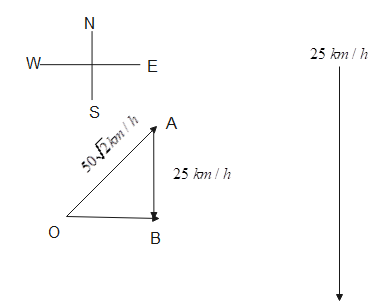
Where, $\vec {OA}=50\sqrt 2km/h$ gives the velocity vector of the airplane , and $\vec{AB}=25km/h$ is the velocity vector of the wind and $\vec {OB}$ is the resultant vector which we need to find.
Then the magnitude of the resultant is given as
$OB=\sqrt{{OA}^2+{AB}^2}$
$\implies OB=\sqrt{(50\sqrt 2)^2+(25)^2}$
$\implies OB=\sqrt { 5000+625}$
$\implies OB=\sqrt{5625}$
$\therefore OB= 75 km/h$
Thus, $\vec{OB}= 75 km/h$ along the west to east direction is the correct answer.
Note: Using parallelogram law of vector addition, we can also subtract two or more vectors. To account for the negative sign, we can invert the direction of the vector with the negative sign and then add them together. Also note that the vectors can be displaced keeping the direction and the magnitude the same.
Formula used:
$\vec{OA}+\vec{AB}=\vec{OB}$, use the diagram below for reference
Complete step-by-step solution:
We know that vectors are quantities, which have both direction and magnitude, thus to add two or more vectors, we use the parallelogram law of vector addition. Or we can also use the triangle law of vector addition, which is a simplified version of the parallelogram law of vector addition .
The triangle law of vector addition states the following:
“when two vectors are represented as two sides of the triangle with the order of magnitude and direction, then the third side of the triangle represents the magnitude and direction of the resultant vector”
Consider the diagram as shown below:
Where, $\vec {OA}=50\sqrt 2km/h$ gives the velocity vector of the airplane , and $\vec{AB}=25km/h$ is the velocity vector of the wind and $\vec {OB}$ is the resultant vector which we need to find.
Then the magnitude of the resultant is given as
$OB=\sqrt{{OA}^2+{AB}^2}$
$\implies OB=\sqrt{(50\sqrt 2)^2+(25)^2}$
$\implies OB=\sqrt { 5000+625}$
$\implies OB=\sqrt{5625}$
$\therefore OB= 75 km/h$
Thus, $\vec{OB}= 75 km/h$ along the west to east direction is the correct answer.
Note: Using parallelogram law of vector addition, we can also subtract two or more vectors. To account for the negative sign, we can invert the direction of the vector with the negative sign and then add them together. Also note that the vectors can be displaced keeping the direction and the magnitude the same.
Recently Updated Pages
Master Class 11 Computer Science: Engaging Questions & Answers for Success

Master Class 11 Business Studies: Engaging Questions & Answers for Success
Master Class 11 Economics: Engaging Questions & Answers for Success
Master Class 11 English: Engaging Questions & Answers for Success
Master Class 11 Maths: Engaging Questions & Answers for Success
Master Class 11 Biology: Engaging Questions & Answers for Success
Trending doubts
One Metric ton is equal to kg A 10000 B 1000 C 100 class 11 physics CBSE
There are 720 permutations of the digits 1 2 3 4 5 class 11 maths CBSE
Discuss the various forms of bacteria class 11 biology CBSE
Draw a diagram of a plant cell and label at least eight class 11 biology CBSE
State the laws of reflection of light
Explain zero factorial class 11 maths CBSE