




An airplane is flying in a horizontal direction with a velocity of $600km/h$ at height of \[1960m\]. When it is vertically above the point $A$ on the ground, a body is dropped from it. The body strikes the ground at point $B$. Calculate the distance \[AB\]
Answer
 Verified
601.8k+ views
Hint: We know that a projectile motion has two components, namely the x and y component. To find the distance along the x-component, the velocity along the x-component is given, so we need the time taken. Since the time taken by the aeroplane along the y-component is equal to the x-component, we can find the time using the height of the aeroplane.
Formula used:
$H=u_{y}t+\dfrac{1}{2}a_{y}t^{2}$ and $x=vt$
Complete step-by-step solution:
Given that the aeroplane is flying at a height $H=1960m$ from $A$, with an initial velocity of $v=600km/h$.
Then, we know that $v=\dfrac{x}{t}$, where $x$ is the distance covered by the body from $A$ to $B$, and $t$ is the time taken to cover the distance $x$. Since the body is dropped from the aeroplane moving with velocity $v=600km/h$, then the body when dropped from the moving aeroplane, will also have a velocity $v=600km/h$.
Given that the aeroplane is flying at a height $H=1960m$ above $A$ and drops a body.
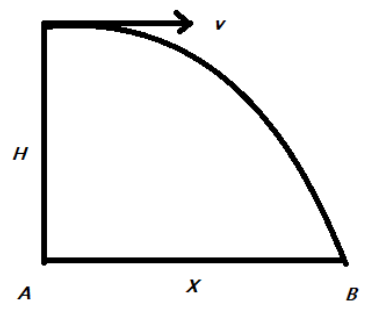
Clearly, here $u_{y}=0$ and $a_{y}=g=10m/s$ where $g$ is the acceleration due to gravitation.
Then, we can say that
$H=u_{y}t+\dfrac{1}{2}a_{y}t^{2}$
Substituting the values we get,$1960=\dfrac{1}{2}10\times t^{2}$
We can find the unknown $t$,
Or $t=\sqrt{\dfrac{1960}{5}}$
Or, $t=\sqrt{ 392}=19.79 sec$
Then, we can say from projectile motion that the distance covered by the body from $A$ to $B$ as $x$, then,
$x=vt$
$x=600\times\dfrac{5}{18}\times19.79=3296.6m=3.29km$
Thus, the distance covered by the body from $A$ to $B$ is \[3.29km\]
Note: We are converting the speed from $km/h$ to $m/s$ by multiplying the speed in $km/h$ to $\dfrac{5}{18}$ for maintaining the units and easy calculations. However, one can convert the time from seconds to hours by dividing the time in a sec by \[3600\]. And it is suggested that the child knows the conversions beforehand.
Formula used:
$H=u_{y}t+\dfrac{1}{2}a_{y}t^{2}$ and $x=vt$
Complete step-by-step solution:
Given that the aeroplane is flying at a height $H=1960m$ from $A$, with an initial velocity of $v=600km/h$.
Then, we know that $v=\dfrac{x}{t}$, where $x$ is the distance covered by the body from $A$ to $B$, and $t$ is the time taken to cover the distance $x$. Since the body is dropped from the aeroplane moving with velocity $v=600km/h$, then the body when dropped from the moving aeroplane, will also have a velocity $v=600km/h$.
Given that the aeroplane is flying at a height $H=1960m$ above $A$ and drops a body.
Clearly, here $u_{y}=0$ and $a_{y}=g=10m/s$ where $g$ is the acceleration due to gravitation.
Then, we can say that
$H=u_{y}t+\dfrac{1}{2}a_{y}t^{2}$
Substituting the values we get,$1960=\dfrac{1}{2}10\times t^{2}$
We can find the unknown $t$,
Or $t=\sqrt{\dfrac{1960}{5}}$
Or, $t=\sqrt{ 392}=19.79 sec$
Then, we can say from projectile motion that the distance covered by the body from $A$ to $B$ as $x$, then,
$x=vt$
$x=600\times\dfrac{5}{18}\times19.79=3296.6m=3.29km$
Thus, the distance covered by the body from $A$ to $B$ is \[3.29km\]
Note: We are converting the speed from $km/h$ to $m/s$ by multiplying the speed in $km/h$ to $\dfrac{5}{18}$ for maintaining the units and easy calculations. However, one can convert the time from seconds to hours by dividing the time in a sec by \[3600\]. And it is suggested that the child knows the conversions beforehand.
Recently Updated Pages
Basicity of sulphurous acid and sulphuric acid are

Master Class 11 Business Studies: Engaging Questions & Answers for Success
Master Class 11 Computer Science: Engaging Questions & Answers for Success
Master Class 11 Economics: Engaging Questions & Answers for Success
Master Class 11 Social Science: Engaging Questions & Answers for Success
Master Class 11 English: Engaging Questions & Answers for Success
Trending doubts
One Metric ton is equal to kg A 10000 B 1000 C 100 class 11 physics CBSE
The largest wind power cluster is located in the state class 11 social science CBSE
Explain zero factorial class 11 maths CBSE
State and prove Bernoullis theorem class 11 physics CBSE
Which among the following are examples of coming together class 11 social science CBSE
Draw a diagram of a plant cell and label at least eight class 11 biology CBSE