




An aircraft is flying at a height of 3400 m above the ground. If the angle subtended at a ground observation point by the aircraft positions 10.0s apart is 30°, what is the speed of the aircraft?
Answer
 Verified
595.8k+ views
Hint: Draw the diagram of the system. Use the simple trigonometric equations to find the distance travelled by the aircraft in the given time. Now, divide the distance travelled by the time of flight to determine the speed of the aircraft.
Formula Used:
We have used the normal trigonometric definition of tanθ
$\tan \theta =\dfrac{height}{base}$
Speed of a particle is given by,
$s=\dfrac{d}{t}$
Where, s is the speed of the particle,
d is the distance travelled,
and t is the time taken to travel the distance.
Complete step by step solution:
First, let’s draw the system as mentioned in the question. The following diagram shows the path of the aircraft and location of the observatory.
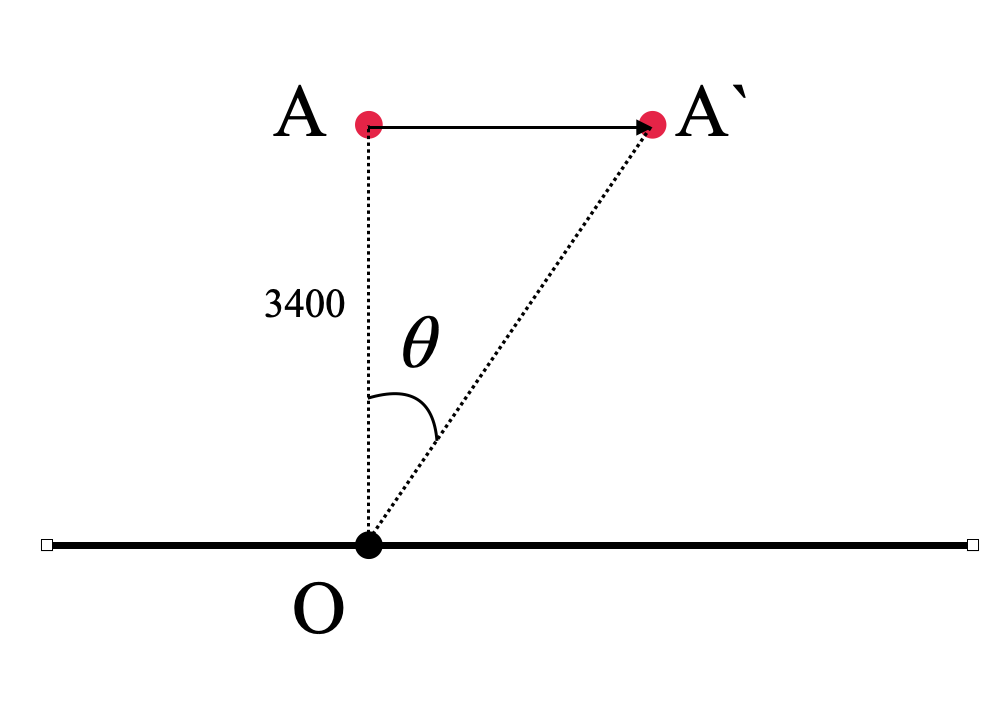
As we can see, the airplane has travelled a distance of AA` in the 10s.
So, we can find the speed of the airplane if we can find the distance AA`.
The height of the airplane’s path is 3400m.
Hence the value of, OA is 3400m.
We know the angle AOA`, which is 30°.
We can simply use the tangent formula to determine the length of AA`.
In the triangle OAA`, using equation 1, we can say that,
$\tan {{30}^{0}}=\dfrac{AA\grave{\ }}{OA}$
$\Rightarrow AA\grave{\ }=OA\times \tan {{30}^{0}}$
$\Rightarrow AA\grave{\ }=3400\times \tan {{30}^{0}}$
$\Rightarrow AA\grave{\ }=1963$
Hence, the length of AA` is, 1963 m.
We can use equation (2) to determine the speed of the airplane.
Now, the speed of the airplane is given by,
$s=\dfrac{AA\grave{\ }}{t}$
$\Rightarrow s=\dfrac{1963}{10}$
$\Rightarrow s=196.3$
Hence the final answer is, 196.3 m/s
Note:
We can assume that the airplane is moving parallel to the ground. Otherwise, we had to take the direction of the airplane into consideration as well. The most common mistake for this kind of question is the absence of diagrams. For a geometrical problem like this, you need to visualize the problem. This will help you in determining the values easily, and you will avoid any unnecessary calculation mistakes.
Formula Used:
We have used the normal trigonometric definition of tanθ
$\tan \theta =\dfrac{height}{base}$
Speed of a particle is given by,
$s=\dfrac{d}{t}$
Where, s is the speed of the particle,
d is the distance travelled,
and t is the time taken to travel the distance.
Complete step by step solution:
First, let’s draw the system as mentioned in the question. The following diagram shows the path of the aircraft and location of the observatory.
As we can see, the airplane has travelled a distance of AA` in the 10s.
So, we can find the speed of the airplane if we can find the distance AA`.
The height of the airplane’s path is 3400m.
Hence the value of, OA is 3400m.
We know the angle AOA`, which is 30°.
We can simply use the tangent formula to determine the length of AA`.
In the triangle OAA`, using equation 1, we can say that,
$\tan {{30}^{0}}=\dfrac{AA\grave{\ }}{OA}$
$\Rightarrow AA\grave{\ }=OA\times \tan {{30}^{0}}$
$\Rightarrow AA\grave{\ }=3400\times \tan {{30}^{0}}$
$\Rightarrow AA\grave{\ }=1963$
Hence, the length of AA` is, 1963 m.
We can use equation (2) to determine the speed of the airplane.
Now, the speed of the airplane is given by,
$s=\dfrac{AA\grave{\ }}{t}$
$\Rightarrow s=\dfrac{1963}{10}$
$\Rightarrow s=196.3$
Hence the final answer is, 196.3 m/s
Note:
We can assume that the airplane is moving parallel to the ground. Otherwise, we had to take the direction of the airplane into consideration as well. The most common mistake for this kind of question is the absence of diagrams. For a geometrical problem like this, you need to visualize the problem. This will help you in determining the values easily, and you will avoid any unnecessary calculation mistakes.
Recently Updated Pages
Master Class 11 Computer Science: Engaging Questions & Answers for Success

Master Class 11 Business Studies: Engaging Questions & Answers for Success
Master Class 11 Economics: Engaging Questions & Answers for Success
Master Class 11 English: Engaging Questions & Answers for Success
Master Class 11 Maths: Engaging Questions & Answers for Success
Master Class 11 Biology: Engaging Questions & Answers for Success
Trending doubts
One Metric ton is equal to kg A 10000 B 1000 C 100 class 11 physics CBSE
There are 720 permutations of the digits 1 2 3 4 5 class 11 maths CBSE
Discuss the various forms of bacteria class 11 biology CBSE
Draw a diagram of a plant cell and label at least eight class 11 biology CBSE
State the laws of reflection of light
Explain zero factorial class 11 maths CBSE