




An aircraft executes a horizontal loop of radius 1.00 km with a steady speed of 900 km/h. Compare its centripetal acceleration with the acceleration due to gravity.
Answer
 Verified
627.9k+ views
Hint: To maintain circular motion of aircraft, we need centripetal acceleration. Use the formula of centripetal acceleration and we know the value of acceleration \[9.8m/{{s}^{2}}\]. To compare centripetal acceleration with the acceleration due to gravity, take ratio of both the quantities.
Complete step by step solution:
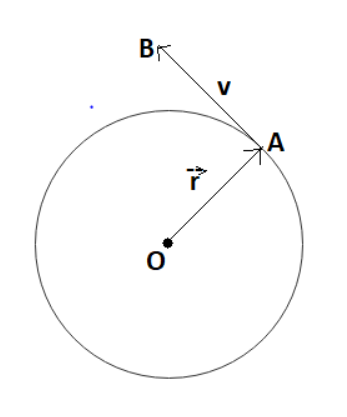
where,
OA= radius of circular loop
AB= tangential drawn to the radius vector
O is the center
We have given that the radius of the circular path is \[1\text{ }km\]. Speed of aircraft is \[900km/s\].
Centripetal acceleration is the acceleration which acts on a particle performing circular motion, which is a long radius of circle and directed towards the center of the circle.
Mathematically, centripetal acceleration is expressed as,
${{a}_{c}}=-\dfrac{{{v}^{2}}}{r}$
Since we are considering only magnitude since we have given speed, not velocity. Therefore take mode of centripetal force and we get,
${{a}_{c}}=\dfrac{{{v}^{2}}}{r}$
Where,
v= speed of aircraft
r= radius of loop
${a}_{c}$= acceleration due to gravity
Convert speed of aircraft in M.K.S system.
\[\begin{align}
& \text{Speed of the aircraft, v=900km/h=900 }\!\!\times\!\!\text{ }\dfrac{\text{5}}{\text{18}}\text{=250m/s} \\
& v=250m/s \\
\end{align}\]
\[r=\text{ }1km=1000m\]
${{a}_{c}}=\dfrac{{{v}^{2}}}{r}=\dfrac{{{\left( 250 \right)}^{2}}}{1000}=62.5m/{{s}^{2}}$
Now we know that acceleration due to gravity is given as
$g=9.8m/{{s}^{2}}$
To compare take ratio acceleration due to gravity and centripetal force. We get,
$\begin{align}
& \dfrac{{{a}_{c}}}{g}=\dfrac{62.5}{9.8}=6.38 \\
& {{a}_{c}}=6.38g \\
\end{align}$
Note: Students should know that to perform circular motion, centripetal force is necessary. To balance this force (so that aircraft shouldn’t fall down and maintain circular path) there must be another force which is known as centrifugal force. Centrifugal force directed radially away from the center of the circle. Because of this force only aircraft is maintaining circular motion.
Complete step by step solution:
where,
OA= radius of circular loop
AB= tangential drawn to the radius vector
O is the center
We have given that the radius of the circular path is \[1\text{ }km\]. Speed of aircraft is \[900km/s\].
Centripetal acceleration is the acceleration which acts on a particle performing circular motion, which is a long radius of circle and directed towards the center of the circle.
Mathematically, centripetal acceleration is expressed as,
${{a}_{c}}=-\dfrac{{{v}^{2}}}{r}$
Since we are considering only magnitude since we have given speed, not velocity. Therefore take mode of centripetal force and we get,
${{a}_{c}}=\dfrac{{{v}^{2}}}{r}$
Where,
v= speed of aircraft
r= radius of loop
${a}_{c}$= acceleration due to gravity
Convert speed of aircraft in M.K.S system.
\[\begin{align}
& \text{Speed of the aircraft, v=900km/h=900 }\!\!\times\!\!\text{ }\dfrac{\text{5}}{\text{18}}\text{=250m/s} \\
& v=250m/s \\
\end{align}\]
\[r=\text{ }1km=1000m\]
${{a}_{c}}=\dfrac{{{v}^{2}}}{r}=\dfrac{{{\left( 250 \right)}^{2}}}{1000}=62.5m/{{s}^{2}}$
Now we know that acceleration due to gravity is given as
$g=9.8m/{{s}^{2}}$
To compare take ratio acceleration due to gravity and centripetal force. We get,
$\begin{align}
& \dfrac{{{a}_{c}}}{g}=\dfrac{62.5}{9.8}=6.38 \\
& {{a}_{c}}=6.38g \\
\end{align}$
Note: Students should know that to perform circular motion, centripetal force is necessary. To balance this force (so that aircraft shouldn’t fall down and maintain circular path) there must be another force which is known as centrifugal force. Centrifugal force directed radially away from the center of the circle. Because of this force only aircraft is maintaining circular motion.
Recently Updated Pages
Master Class 12 Economics: Engaging Questions & Answers for Success

Master Class 12 English: Engaging Questions & Answers for Success
Master Class 12 Social Science: Engaging Questions & Answers for Success
Master Class 12 Maths: Engaging Questions & Answers for Success
Master Class 12 Physics: Engaging Questions & Answers for Success
Master Class 9 General Knowledge: Engaging Questions & Answers for Success
Trending doubts
One Metric ton is equal to kg A 10000 B 1000 C 100 class 11 physics CBSE
Difference Between Prokaryotic Cells and Eukaryotic Cells
Two of the body parts which do not appear in MRI are class 11 biology CBSE
1 ton equals to A 100 kg B 1000 kg C 10 kg D 10000 class 11 physics CBSE
Draw a diagram of nephron and explain its structur class 11 biology CBSE
10 examples of friction in our daily life