




An aeroplane is flying vertically upward. When it is at a height of 1000m above the ground and moving at a speed of 367 m/s, a shot is fired at it with a speed of 567 m/s from a point directly below it. What should be the acceleration of the Aeroplane so that it may escape from being hit?
A. $>5m{{s}^{-2}}$
B. $>10m{{s}^{-2}}$
C. $<10m{{s}^{-2}}$
D. Not Possible
Answer
 Verified
637.8k+ views
Hint: Consider the situation when the aeroplane just saved from the shot. In that case the shot will reach the aeroplane at an exactly same velocity.
Formula Used:
The distance travelled by an object in time t is given by,
$s=ut+\dfrac{1}{2}a{{t}^{2}}$………………………….(1)
We also know the relation,
$v=u+at$…………………………….(2)
The other useful relation is.
${{v}^{2}}={{u}^{2}}+2as$………………………….(3)
Where,
u is the initial velocity of the object,
v is the final velocity of the object,
a is the acceleration of the object
t is the time duration.
Complete step by step answer:
First let us look at the diagram,
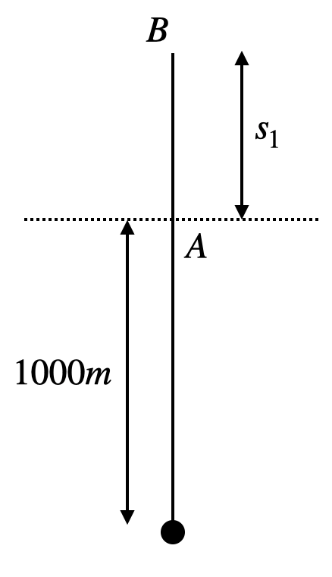
The aeroplane travels from A to B in time t,
And the shot travels from O to B.
We assume that the shot reaches point B at the exact same velocity as of the aeroplane.
Let that velocity be v.
$v=u+at$
Where,
u is the initial velocity of the object,
v is the final velocity of the object,
a is the acceleration of the object
First, let us write the equation (2) for aeroplane,
$v=367+at$
Now, equation (2) for the shot is,
$v=567-gt$.
Comparing these two new equations we get,
$367+at=567-gt$
$\Rightarrow (a+g)t=200$
$\Rightarrow t=\dfrac{200}{a+g}$
So, the distance travelled by the aeroplane is given by,
${{s}_{1}}=(367)t+\dfrac{1}{2}a{{t}^{2}}$
The distance travelled by the shot is given by,
${{s}_{2}}=(567)t-\dfrac{1}{2}g{{t}^{2}}$
Now, from the diagram we can write,
${{s}_{2}}={{s}_{1}}+1000$
$\Rightarrow 567t-\dfrac{1}{2}g{{t}^{2}}=367t+\dfrac{1}{2}a{{t}^{2}}+1000$
$\Rightarrow \dfrac{1}{2}(a+g){{t}^{2}}-200t+1000=0$
Putting the value of t in the equation, we get,
$\Rightarrow \dfrac{1}{2}(a+g){{\left( \dfrac{200}{a+g} \right)}^{2}}-200\left( \dfrac{200}{a+g} \right)+1000=0$
$\Rightarrow \dfrac{1}{2}\dfrac{{{200}^{2}}}{a+g}-\dfrac{{{200}^{2}}}{a+g}+1000=0$
$\Rightarrow \dfrac{1}{2}\dfrac{{{200}^{2}}}{a+g}=1000$
$\Rightarrow a+g=\dfrac{40000}{2\times 1000}$
$\Rightarrow a+g=20$
$\Rightarrow a+10=20$
$\Rightarrow a=10$
Hence, if the acceleration is more than 10 then it will dodge the shot.
So, the correct option is (B).
Note: Drawing a diagram is very important in this kind of problem. This will ensure that you don’t make any computational mistakes. We have considered the velocity of both the objects to be the same. As the velocity of the aeroplane is increasing and the velocity of the shot is decreasing, we made sure that the objects cross this threshold.
Formula Used:
The distance travelled by an object in time t is given by,
$s=ut+\dfrac{1}{2}a{{t}^{2}}$………………………….(1)
We also know the relation,
$v=u+at$…………………………….(2)
The other useful relation is.
${{v}^{2}}={{u}^{2}}+2as$………………………….(3)
Where,
u is the initial velocity of the object,
v is the final velocity of the object,
a is the acceleration of the object
t is the time duration.
Complete step by step answer:
First let us look at the diagram,
The aeroplane travels from A to B in time t,
And the shot travels from O to B.
We assume that the shot reaches point B at the exact same velocity as of the aeroplane.
Let that velocity be v.
$v=u+at$
Where,
u is the initial velocity of the object,
v is the final velocity of the object,
a is the acceleration of the object
First, let us write the equation (2) for aeroplane,
$v=367+at$
Now, equation (2) for the shot is,
$v=567-gt$.
Comparing these two new equations we get,
$367+at=567-gt$
$\Rightarrow (a+g)t=200$
$\Rightarrow t=\dfrac{200}{a+g}$
So, the distance travelled by the aeroplane is given by,
${{s}_{1}}=(367)t+\dfrac{1}{2}a{{t}^{2}}$
The distance travelled by the shot is given by,
${{s}_{2}}=(567)t-\dfrac{1}{2}g{{t}^{2}}$
Now, from the diagram we can write,
${{s}_{2}}={{s}_{1}}+1000$
$\Rightarrow 567t-\dfrac{1}{2}g{{t}^{2}}=367t+\dfrac{1}{2}a{{t}^{2}}+1000$
$\Rightarrow \dfrac{1}{2}(a+g){{t}^{2}}-200t+1000=0$
Putting the value of t in the equation, we get,
$\Rightarrow \dfrac{1}{2}(a+g){{\left( \dfrac{200}{a+g} \right)}^{2}}-200\left( \dfrac{200}{a+g} \right)+1000=0$
$\Rightarrow \dfrac{1}{2}\dfrac{{{200}^{2}}}{a+g}-\dfrac{{{200}^{2}}}{a+g}+1000=0$
$\Rightarrow \dfrac{1}{2}\dfrac{{{200}^{2}}}{a+g}=1000$
$\Rightarrow a+g=\dfrac{40000}{2\times 1000}$
$\Rightarrow a+g=20$
$\Rightarrow a+10=20$
$\Rightarrow a=10$
Hence, if the acceleration is more than 10 then it will dodge the shot.
So, the correct option is (B).
Note: Drawing a diagram is very important in this kind of problem. This will ensure that you don’t make any computational mistakes. We have considered the velocity of both the objects to be the same. As the velocity of the aeroplane is increasing and the velocity of the shot is decreasing, we made sure that the objects cross this threshold.
Recently Updated Pages
Master Class 11 English: Engaging Questions & Answers for Success

Master Class 11 Social Science: Engaging Questions & Answers for Success
Master Class 11 Maths: Engaging Questions & Answers for Success
Master Class 11 Biology: Engaging Questions & Answers for Success
Master Class 11 Physics: Engaging Questions & Answers for Success
Master Class 11 Chemistry: Engaging Questions & Answers for Success
Trending doubts
One Metric ton is equal to kg A 10000 B 1000 C 100 class 11 physics CBSE
Difference Between Prokaryotic Cells and Eukaryotic Cells
Two of the body parts which do not appear in MRI are class 11 biology CBSE
Find the value of the expression given below sin 30circ class 11 maths CBSE
Draw a diagram of a plant cell and label at least eight class 11 biology CBSE
10 examples of friction in our daily life