




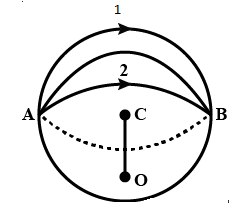
An aeroplane is flying from city A to B along path $1$ . The path $1$ is a circular arc whose centre coincides with centre of the earth. Another aeroplane is flying along path $2$ from A to B. The path $2$ is a circular arc whose centre is at $C$ . $O$ is the centre of the earth. Then,
A. The distance travelled by the ${1^{st}}$ aeroplane is greater than that of the ${2^{nd}}$ aeroplane
B. The distance travelled by the ${1^{st}}$ aeroplane is less than that of the ${2^{nd}}$ aeroplane
C. The displacement of both aeroplane is different
D. None of these
Answer
 Verified
591.3k+ views
Hint: Here we have to analyse the diagram and understand which aeroplane travels in which path and whose centre is the greatest from the arc.
Complete step by step solution:
Given,
An aeroplane is flying from city A to B along path $1$ . The path $1$ is a circular arc whose centre coincides with centre of the earth. The centre for path $1$ is $O$ and the centre for path $2$ is $C$ . Another aeroplane is flying along path $2$ from A to B. The path $2$ is a circular arc whose centre is at $C$. $O$ is also the centre of the earth. The centres of both the arcs are different as seen in the figure. Then,
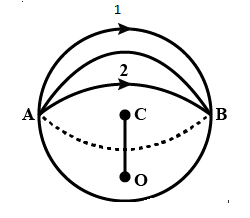
If we observe the diagram we can see that centre of the earth $O$ lies at more distance from the centre $C$. And also the centre of the earth again lies at much greater distance from the arc $1$ than the centre $C$ from arc $2$.
The path length is the distance an object travels. So, we can see that the path length of arc $1$ is much greater than arc $2$.
We have to observe the centripetal movement for both paths and see which of the centre lies at a much greater distance i.e. we have to see the radius of the circle.
Also the displacement cannot be the same here, since the centre of both the arcs is different.
Hence,
The distance travelled by the ${1^{st}}$ aeroplane is greater than that of the ${2^{nd}}$ aeroplane.
Therefore, option A is correct.
Additional information:
The length of the distance that a body covers is zero, if the body has not shifted from its original location at all, so the final position is similar to the original position. Well, if another object goes in the same direction of the body and both are entangled with another object, then it is definitely possible.
Note:
If an object travels in a straight line without returning, the distance and displacement will always be equal. Since, in the question the path is a circular path, so the distance and displacement is different.
Complete step by step solution:
Given,
An aeroplane is flying from city A to B along path $1$ . The path $1$ is a circular arc whose centre coincides with centre of the earth. The centre for path $1$ is $O$ and the centre for path $2$ is $C$ . Another aeroplane is flying along path $2$ from A to B. The path $2$ is a circular arc whose centre is at $C$. $O$ is also the centre of the earth. The centres of both the arcs are different as seen in the figure. Then,
If we observe the diagram we can see that centre of the earth $O$ lies at more distance from the centre $C$. And also the centre of the earth again lies at much greater distance from the arc $1$ than the centre $C$ from arc $2$.
The path length is the distance an object travels. So, we can see that the path length of arc $1$ is much greater than arc $2$.
We have to observe the centripetal movement for both paths and see which of the centre lies at a much greater distance i.e. we have to see the radius of the circle.
Also the displacement cannot be the same here, since the centre of both the arcs is different.
Hence,
The distance travelled by the ${1^{st}}$ aeroplane is greater than that of the ${2^{nd}}$ aeroplane.
Therefore, option A is correct.
Additional information:
The length of the distance that a body covers is zero, if the body has not shifted from its original location at all, so the final position is similar to the original position. Well, if another object goes in the same direction of the body and both are entangled with another object, then it is definitely possible.
Note:
If an object travels in a straight line without returning, the distance and displacement will always be equal. Since, in the question the path is a circular path, so the distance and displacement is different.
Recently Updated Pages
Basicity of sulphurous acid and sulphuric acid are

Master Class 11 Business Studies: Engaging Questions & Answers for Success
Master Class 11 Computer Science: Engaging Questions & Answers for Success
Master Class 11 Economics: Engaging Questions & Answers for Success
Master Class 11 Social Science: Engaging Questions & Answers for Success
Master Class 11 English: Engaging Questions & Answers for Success
Trending doubts
One Metric ton is equal to kg A 10000 B 1000 C 100 class 11 physics CBSE
What are the examples of C3 and C4 plants class 11 biology CBSE
State and prove Bernoullis theorem class 11 physics CBSE
Draw a diagram of a plant cell and label at least eight class 11 biology CBSE
10 examples of friction in our daily life
A body is said to be in dynamic equilibrium if A When class 11 physics CBSE