




An aeroplane flies around a square, the side of which measures $ 100 $ miles each. The aeroplane covers at a speed of $ 100\;m.p.h. $ the first side, at $ 200\;m.p.h. $ the second side, at $ 300\;m.p.h. $ the third side and $ 400\;m.p.h. $ the fourth side. The average speed of the aeroplane around the square is:
(A) $ 190\; $
(B) $ 195\; $
(C) $ 192\; $
(D) $ 200\; $
Answer
 Verified
564.6k+ views
Hint: To solve this question we have to consider the mathematical concept of the harmonic mean. The harmonic mean can be defined as the reciprocal of the average value of the reciprocal. Hence using this method we can find the value of the average speed of the aeroplane around the square.
Formula used:
$ H = \dfrac{N}{{\sum {\dfrac{{{f_i}}}{{{x_i}}}} }} $
where $ H $ is the harmonic mean and $ N $ is the number of terms.
Complete Step-by-step solution
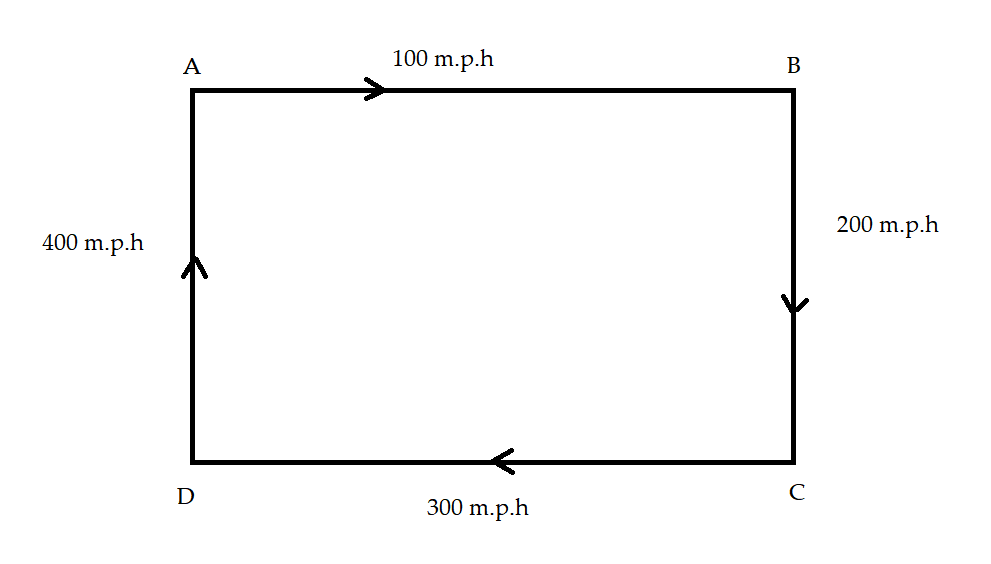
We will first consider that the plane is flying around the corner of the square and let it cover one side of the square of distance $ AB\; $ with a speed of $ 100\;m.p.h. $ and it then covers distance $ BC\; $ with the speed of $ 200\;m.p.h. $ after that it turns and covers the distance which is the third side of the side given by $ CD\; $ with the speed of $ 300\;m.p.h. $ going further it then covers a distance of $ AD\; $ which is the fourth side of the square with a speed of $ 400\;m.p.h. $ .
We have given that all side of square measures as
$ AB = BC = CD = DA = 100 $ Miles.
Now to calculate the average speed of the plane around the square we have to use the harmonic mean method given by the formula,
$ H = \dfrac{N}{{\sum {\dfrac{{{f_i}}}{{{x_i}}}} }} $
where $ H $ is the harmonic mean and $ N $ is the number of terms.
Hence the average velocity can be given in terms of harmonic mean such that
$ {V_{avg}} = \dfrac{4}{{\dfrac{1}{{100}} + \dfrac{1}{{200}} + \dfrac{1}{{300}} + \dfrac{1}{{400}}}} $
$ \Rightarrow {V_{avg}} = \dfrac{4}{{\dfrac{{12}}{{1200}} + \dfrac{6}{{1200}} + \dfrac{4}{{1200}} + \dfrac{3}{{1200}}}} $
Now we evaluate the total value to the denominator is given as
$ {V_{avg}} = \dfrac{4}{{\dfrac{{12 + 6 + 4 + 3}}{{1200}}}} $
$ \Rightarrow {V_{avg}} = \dfrac{4}{{\dfrac{{25}}{{1200}}}} $
Hence further simplification gives the value as
$ {V_{avg}} = \dfrac{{4800}}{{25}} $
$ \Rightarrow {V_{avg}} = 192m.p.h. $
Hence option (C) is the correct answer.
Note:
While dealing with such questions one should always ensure the proper method and proper units used in the questions. Here the units are given as $ \;m.p.h. $ which is miles per hours. We can also convert into the MKS system but it is required in the question to keep it as it is.
Formula used:
$ H = \dfrac{N}{{\sum {\dfrac{{{f_i}}}{{{x_i}}}} }} $
where $ H $ is the harmonic mean and $ N $ is the number of terms.
Complete Step-by-step solution
We will first consider that the plane is flying around the corner of the square and let it cover one side of the square of distance $ AB\; $ with a speed of $ 100\;m.p.h. $ and it then covers distance $ BC\; $ with the speed of $ 200\;m.p.h. $ after that it turns and covers the distance which is the third side of the side given by $ CD\; $ with the speed of $ 300\;m.p.h. $ going further it then covers a distance of $ AD\; $ which is the fourth side of the square with a speed of $ 400\;m.p.h. $ .
We have given that all side of square measures as
$ AB = BC = CD = DA = 100 $ Miles.
Now to calculate the average speed of the plane around the square we have to use the harmonic mean method given by the formula,
$ H = \dfrac{N}{{\sum {\dfrac{{{f_i}}}{{{x_i}}}} }} $
where $ H $ is the harmonic mean and $ N $ is the number of terms.
Hence the average velocity can be given in terms of harmonic mean such that
$ {V_{avg}} = \dfrac{4}{{\dfrac{1}{{100}} + \dfrac{1}{{200}} + \dfrac{1}{{300}} + \dfrac{1}{{400}}}} $
$ \Rightarrow {V_{avg}} = \dfrac{4}{{\dfrac{{12}}{{1200}} + \dfrac{6}{{1200}} + \dfrac{4}{{1200}} + \dfrac{3}{{1200}}}} $
Now we evaluate the total value to the denominator is given as
$ {V_{avg}} = \dfrac{4}{{\dfrac{{12 + 6 + 4 + 3}}{{1200}}}} $
$ \Rightarrow {V_{avg}} = \dfrac{4}{{\dfrac{{25}}{{1200}}}} $
Hence further simplification gives the value as
$ {V_{avg}} = \dfrac{{4800}}{{25}} $
$ \Rightarrow {V_{avg}} = 192m.p.h. $
Hence option (C) is the correct answer.
Note:
While dealing with such questions one should always ensure the proper method and proper units used in the questions. Here the units are given as $ \;m.p.h. $ which is miles per hours. We can also convert into the MKS system but it is required in the question to keep it as it is.
Recently Updated Pages
Master Class 11 Computer Science: Engaging Questions & Answers for Success

Master Class 11 Business Studies: Engaging Questions & Answers for Success
Master Class 11 Economics: Engaging Questions & Answers for Success
Master Class 11 English: Engaging Questions & Answers for Success
Master Class 11 Maths: Engaging Questions & Answers for Success
Master Class 11 Biology: Engaging Questions & Answers for Success
Trending doubts
One Metric ton is equal to kg A 10000 B 1000 C 100 class 11 physics CBSE
There are 720 permutations of the digits 1 2 3 4 5 class 11 maths CBSE
Discuss the various forms of bacteria class 11 biology CBSE
Draw a diagram of a plant cell and label at least eight class 11 biology CBSE
State the laws of reflection of light
Explain zero factorial class 11 maths CBSE