




Amphibole silicate structure has an 'x' number of corners shared per tetrahedron. The value of 'x' is
A.$2$
B.$2\dfrac{1}{2}$
C.3
D.4
Answer
 Verified
624.3k+ views
Hint: Amphiboles refer to common rock-forming silicates which have hydroxyl groups in their structure and are considered to be hydrous silicates that are stable only in hydrous environments where water can be incorporated into the structure as $O{H^ - }$.
Complete step by step answer:
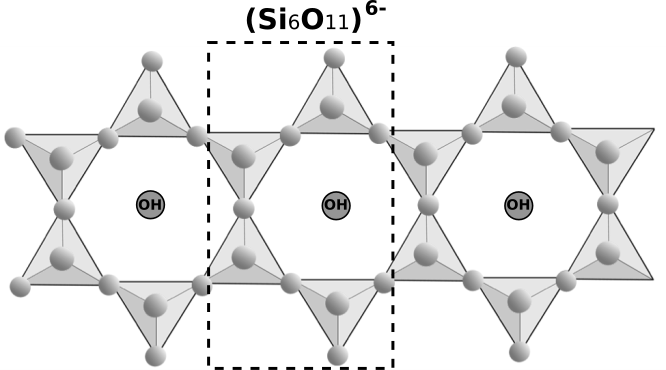
It has already been established that amphibole silicate structure has an 'x' number of corners shared per tetrahedron. The value of 'x' is $2\dfrac{1}{2}$. The structure of amphibole silicates is double-stranded cross-linked chains of composition \[{(S{i_4}{O_{11}})_n}^{6 - }\]. Two simple chains are joined together through the third oxygen atom of silicon tetrahedra \[{(Si{O_4})^{4 - }}\]. In each of the simple chains, two oxygen atoms per tetrahedra are shared. Examples of this structure include tremolite. In amphibole structure, structure of a basic unit \[{(S{i_6}{O_{11}})_n}^{6 - }\] is shown below:
Additional information: Other important types of silicates found in nature include:
Orthosilicates (or Nesosilicates): The ortho silicate ion is the strong conjugate base of weak orthosilicic acid as well as it will not persist in aqueous solutions. In nature, ortho silicates are rare and only found with cations which form highly insoluble salts.
-Pyro silicate (or Sorosilicates)
-Cyclic silicates (or Ring silicates)
-Chain silicates (or pyroxenes)
-Double chain silicate (or amphiboles)
-Sheet or phyllosilicates
-Three dimensional (or tecto) silicates
Note:
The chemical composition of amphibole silicates can be shown by the general formula:
\[{{\text{A}}_{{\text{0 - 1}}}}{{\text{B}}_{\text{2}}}{{\text{C}}_{\text{5}}}{{\text{T}}_{\text{8}}}{{\text{O}}_{{\text{22}}}}{\left( {{\text{OH, F, Cl}}} \right)_{\text{2}}}\], where
\[{\text{A}}\; = {\text{ }}Na,K\] ,
\[\;{\text{B}} = {\text{ }}Na,Zn,Li,Ca,Mn,F{e^{2 + }},Mg\] ,
\[{\text{C}} = {\text{ }}Mg,{\text{ }}F{e^{2 + }},{\text{ }}Mn,{\text{ }}Al,{\text{ }}F{e^{3 + }},Ti,Zn,{\text{ }}Cr\,{\text{ }}\;\],
\[{\text{T}}\; = {\text{ }}Si,{\text{ }}Al,{\text{ }}Ti\]
For most amphibole silicates the combination of the prismatic form and two diamond-shaped directions of cleavage at about ${56^o}$ and ${124^o}$ is the diagnostic feature.
Complete step by step answer:
It has already been established that amphibole silicate structure has an 'x' number of corners shared per tetrahedron. The value of 'x' is $2\dfrac{1}{2}$. The structure of amphibole silicates is double-stranded cross-linked chains of composition \[{(S{i_4}{O_{11}})_n}^{6 - }\]. Two simple chains are joined together through the third oxygen atom of silicon tetrahedra \[{(Si{O_4})^{4 - }}\]. In each of the simple chains, two oxygen atoms per tetrahedra are shared. Examples of this structure include tremolite. In amphibole structure, structure of a basic unit \[{(S{i_6}{O_{11}})_n}^{6 - }\] is shown below:
Additional information: Other important types of silicates found in nature include:
Orthosilicates (or Nesosilicates): The ortho silicate ion is the strong conjugate base of weak orthosilicic acid as well as it will not persist in aqueous solutions. In nature, ortho silicates are rare and only found with cations which form highly insoluble salts.
-Pyro silicate (or Sorosilicates)
-Cyclic silicates (or Ring silicates)
-Chain silicates (or pyroxenes)
-Double chain silicate (or amphiboles)
-Sheet or phyllosilicates
-Three dimensional (or tecto) silicates
Note:
The chemical composition of amphibole silicates can be shown by the general formula:
\[{{\text{A}}_{{\text{0 - 1}}}}{{\text{B}}_{\text{2}}}{{\text{C}}_{\text{5}}}{{\text{T}}_{\text{8}}}{{\text{O}}_{{\text{22}}}}{\left( {{\text{OH, F, Cl}}} \right)_{\text{2}}}\], where
\[{\text{A}}\; = {\text{ }}Na,K\] ,
\[\;{\text{B}} = {\text{ }}Na,Zn,Li,Ca,Mn,F{e^{2 + }},Mg\] ,
\[{\text{C}} = {\text{ }}Mg,{\text{ }}F{e^{2 + }},{\text{ }}Mn,{\text{ }}Al,{\text{ }}F{e^{3 + }},Ti,Zn,{\text{ }}Cr\,{\text{ }}\;\],
\[{\text{T}}\; = {\text{ }}Si,{\text{ }}Al,{\text{ }}Ti\]
For most amphibole silicates the combination of the prismatic form and two diamond-shaped directions of cleavage at about ${56^o}$ and ${124^o}$ is the diagnostic feature.
Recently Updated Pages
Master Class 11 English: Engaging Questions & Answers for Success

Master Class 11 Social Science: Engaging Questions & Answers for Success
Master Class 11 Maths: Engaging Questions & Answers for Success
Master Class 11 Biology: Engaging Questions & Answers for Success
Master Class 11 Physics: Engaging Questions & Answers for Success
Master Class 11 Chemistry: Engaging Questions & Answers for Success
Trending doubts
Find the value of the expression given below sin 30circ class 11 maths CBSE
How do I convert ms to kmh Give an example class 11 physics CBSE
What is the atomic mass of Sodium a 22 gmol b 23 gmol class 11 chemistry CBSE
In which country Lascaux cave is located A India B class 11 social science CBSE
1 ton equals to A 100 kg B 1000 kg C 10 kg D 10000 class 11 physics CBSE
Draw a welllabelled diagram of a plant cell class 11 biology CBSE