




Among the three molecules, $Xe{F_4}$, $S{F_4}$and $Si{F_4}$, which has/ have tetrahedral structure?
A) All three
B) $Si{F_4}$ and $S{F_4}$
C) Only $Si{F_4}$
D) Only $S{F_4}$
Answer
 Verified
613.8k+ views
Hint:
To answer this question you must recall the VSEPR theory. The Valence shell electron pair repulsion theory proposes that the hybridized orbitals in an atom arrange themselves in such a way so as to minimize the repulsion between them, hence determining the geometry of a molecule on the basis of its hybridization.
Complete step by step solution:
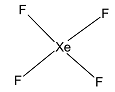
First we consider, $Xe{F_4}$.
We know that Xenon has 8 valence electrons. Since it forms four bonds with fluorine, thus, we can conclude that 2 electrons from the $5p$ orbital are excited to the empty $5d$ orbital. The atom undergoes an $s{p^3}{d^2}$ hybridisation. The geometry of the molecule is octahedral. The hybrid orbitals form four bond pairs and two lone pairs. Thus, the structure is square planar.
Now, we consider $S{F_4}$.
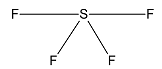
Sulphur has 6 valence electrons out of which 2 are unpaired. One electron from the $3p$ orbital is excited to $3d$ orbital and the atom undergoes $s{p^3}d$ hybridization. Geometry of molecules is trigonal bipyramidal but due to the presence of a lone pair the structure is see-saw shaped.
Considering $Si{F_4}$
Silicon has 4 valence electrons. One valence electron from $3s$ is excited to $3p$. The atom undergoes $s{p^3}$ hybridisation. All four hybrid orbitals form bond pairs and the structure is tetrahedral.

Thus, the correct answer is C.
Note:
The concept of mixing of atomic orbitals in order to form new hybrid orbitals that possess different shapes and energies as compared to the original parent atomic orbitals is known as hybridisation. Hybrid orbitals are suitable to form chemical bonds of equal energies. Also hybridization of orbitals leads to the formation of more stable compounds because hybrid orbitals have lower energy than the unhybrid orbitals.
To answer this question you must recall the VSEPR theory. The Valence shell electron pair repulsion theory proposes that the hybridized orbitals in an atom arrange themselves in such a way so as to minimize the repulsion between them, hence determining the geometry of a molecule on the basis of its hybridization.
Complete step by step solution:
First we consider, $Xe{F_4}$.
We know that Xenon has 8 valence electrons. Since it forms four bonds with fluorine, thus, we can conclude that 2 electrons from the $5p$ orbital are excited to the empty $5d$ orbital. The atom undergoes an $s{p^3}{d^2}$ hybridisation. The geometry of the molecule is octahedral. The hybrid orbitals form four bond pairs and two lone pairs. Thus, the structure is square planar.
Now, we consider $S{F_4}$.
Sulphur has 6 valence electrons out of which 2 are unpaired. One electron from the $3p$ orbital is excited to $3d$ orbital and the atom undergoes $s{p^3}d$ hybridization. Geometry of molecules is trigonal bipyramidal but due to the presence of a lone pair the structure is see-saw shaped.
Considering $Si{F_4}$
Silicon has 4 valence electrons. One valence electron from $3s$ is excited to $3p$. The atom undergoes $s{p^3}$ hybridisation. All four hybrid orbitals form bond pairs and the structure is tetrahedral.
Thus, the correct answer is C.
Note:
The concept of mixing of atomic orbitals in order to form new hybrid orbitals that possess different shapes and energies as compared to the original parent atomic orbitals is known as hybridisation. Hybrid orbitals are suitable to form chemical bonds of equal energies. Also hybridization of orbitals leads to the formation of more stable compounds because hybrid orbitals have lower energy than the unhybrid orbitals.
Recently Updated Pages
If x a + bt + ct2 where x is in meters and t is in class 11 physics CBSE

A car covers the first half distance between two places class 11 physics CBSE
The resultant of two vectors overrightarrow P and overrightarrow class 11 physics CBSE
Find the value of cos 135 class 11 maths CBSE
A mass M is held in place by an applied force F and class 11 physics CBSE
A solution of glucose in water is labelled as 10 dfracwv class 11 chemistry CBSE
Trending doubts
Find the value of the expression given below sin 30circ class 11 maths CBSE
One Metric ton is equal to kg A 10000 B 1000 C 100 class 11 physics CBSE
Draw a diagram of nephron and explain its structur class 11 biology CBSE
10 examples of friction in our daily life
Proton was discovered by A Thomson B Rutherford C Chadwick class 11 chemistry CBSE
Bond order ofO2 O2+ O2 and O22 is in order A O2 langle class 11 chemistry CBSE