




Among the following, the dissociation constant is highest for:
A: $ {C_6}{H_5}OH $
B: $ C{H_3}OH $
C: $ C{H_3}C \equiv CH $
D: $ C{H_3}N{H_3}^ + C{l^ - } $
Answer
 Verified
580.5k+ views
Hint :Atoms can either gain or lose electrons to form ions in a phenomenon known as ionization and compounds that are formed in this manner are known as ionic compounds). When these ionic compounds are dissolved in water, they yield ions in a process known as dissociation.
Complete Step By Step Answer:
If the compound has an ability to lose a proton easily in water (i.e. hydrogen can be easily removed), then that compound will possess a low dissociation constant. Now, let us look at the different compounds given in the options one by one:
Option A: $ {C_6}{H_5}OH $
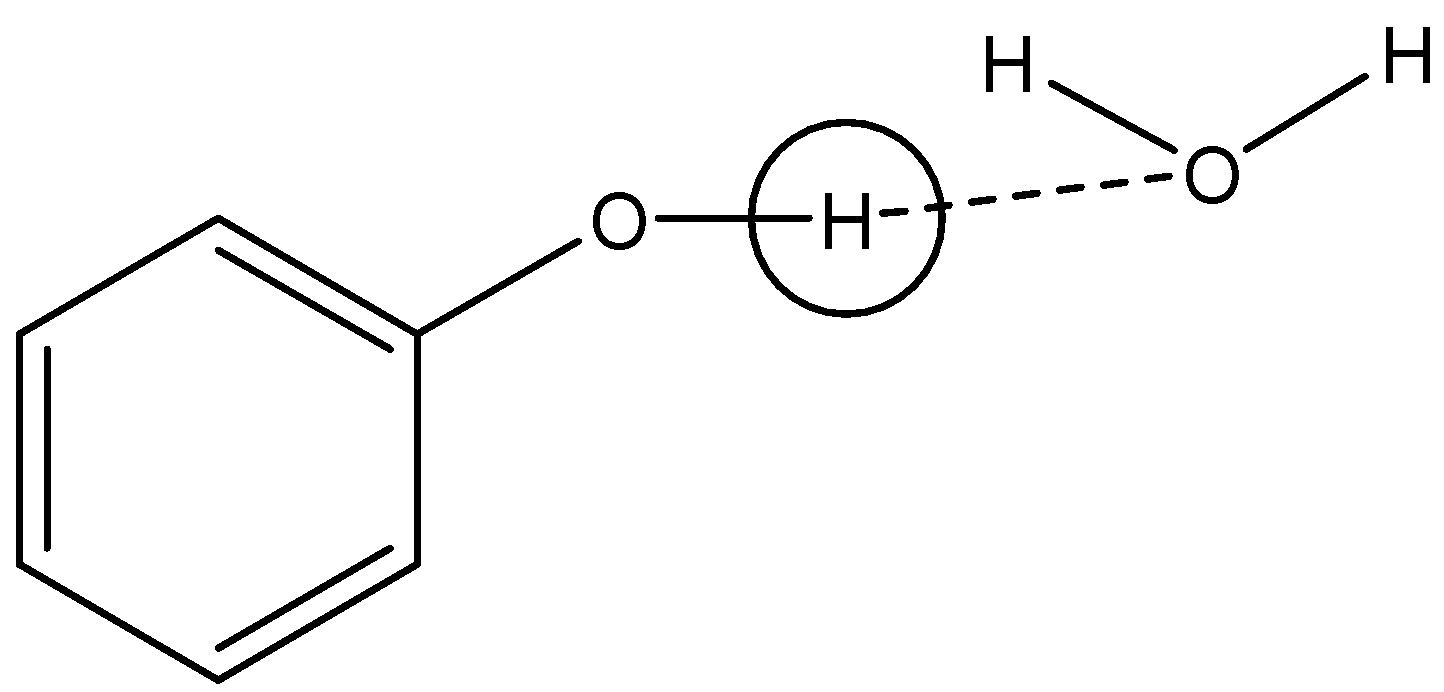
As clear from the figure, H atom of hydroxyl group will create hydrogen bonds with water molecules and thus in $ {C_6}{H_5}OH $ hydrogen can be easily removed. Hence, dissociation constant will be low in this case.
Option B: $ C{H_3}OH $

As clear from the figure, H atom of hydroxyl group will create hydrogen bonds with water molecules and thus in $ C{H_3}OH $ hydrogen can be easily removed. Hence, dissociation constant will be low in this case.
Option C: $ C{H_3}C \equiv CH $
As we know, alkyne possesses acidic hydrogen which can easily be removed as shown in figure. Hence, dissociation constant will be low in this case.

Option D: $ C{H_3}N{H_3}^ + C{l^ - } $

As clear from the above figure, nitrogen and chlorine induces the inductive effect ( $ - I $ ) and attracts hydrogen towards themselves due to which hydrogen cannot be removed easily. Hence, in this case the dissociation constant will be very high.
As a result, the correct answer is Option D.
Note :
For a generalised chemical reaction taking place in a solution:
$ aA + bB \rightleftharpoons cC + dD\; $
The equilibrium constant can be expressed as follows:
$ K = \dfrac{{{{[C]}^c}{{[D]}^d}}}{{{{[A]}^a}{{[B]}^b}}} $
where [A], [B], [C] and [D] refer to the molar concentration of species A, B, C, D respectively at equilibrium. The coefficients like a, b, c, and d in the generalised chemical equation become exponents as seen in the above expression. $ {K_a} $ is acid dissociation constant and $ {K_b} $ is base dissociation constant.
Complete Step By Step Answer:
If the compound has an ability to lose a proton easily in water (i.e. hydrogen can be easily removed), then that compound will possess a low dissociation constant. Now, let us look at the different compounds given in the options one by one:
Option A: $ {C_6}{H_5}OH $
As clear from the figure, H atom of hydroxyl group will create hydrogen bonds with water molecules and thus in $ {C_6}{H_5}OH $ hydrogen can be easily removed. Hence, dissociation constant will be low in this case.
Option B: $ C{H_3}OH $
As clear from the figure, H atom of hydroxyl group will create hydrogen bonds with water molecules and thus in $ C{H_3}OH $ hydrogen can be easily removed. Hence, dissociation constant will be low in this case.
Option C: $ C{H_3}C \equiv CH $
As we know, alkyne possesses acidic hydrogen which can easily be removed as shown in figure. Hence, dissociation constant will be low in this case.
Option D: $ C{H_3}N{H_3}^ + C{l^ - } $
As clear from the above figure, nitrogen and chlorine induces the inductive effect ( $ - I $ ) and attracts hydrogen towards themselves due to which hydrogen cannot be removed easily. Hence, in this case the dissociation constant will be very high.
As a result, the correct answer is Option D.
Note :
For a generalised chemical reaction taking place in a solution:
$ aA + bB \rightleftharpoons cC + dD\; $
The equilibrium constant can be expressed as follows:
$ K = \dfrac{{{{[C]}^c}{{[D]}^d}}}{{{{[A]}^a}{{[B]}^b}}} $
where [A], [B], [C] and [D] refer to the molar concentration of species A, B, C, D respectively at equilibrium. The coefficients like a, b, c, and d in the generalised chemical equation become exponents as seen in the above expression. $ {K_a} $ is acid dissociation constant and $ {K_b} $ is base dissociation constant.
Recently Updated Pages
Master Class 11 English: Engaging Questions & Answers for Success

Master Class 11 Social Science: Engaging Questions & Answers for Success
Master Class 11 Maths: Engaging Questions & Answers for Success
Master Class 11 Biology: Engaging Questions & Answers for Success
Master Class 11 Physics: Engaging Questions & Answers for Success
Master Class 11 Chemistry: Engaging Questions & Answers for Success
Trending doubts
One Metric ton is equal to kg A 10000 B 1000 C 100 class 11 physics CBSE
What is cell theory Who formulated it class 11 biology CBSE
Phyllotaxy is the arrangement of ALeaflets BLeaves class 11 biology CBSE
Difference Between Prokaryotic Cells and Eukaryotic Cells
The symbiotic association of fungi and algae is called class 11 biology CBSE
Cell theory was formulated by A Schleiden and Schwann class 11 biology CBSE