




Among the elements from atomic number \[1\] to \[36\] , the number of elements which have an unpaired electron in their s-subshell is:
A. $7$
B. $9$
C. $4$
D. $6$
Answer
 Verified
602.4k+ views
Hint:In order to answer this question one should be able to write the electronic configuration of the elements asked in the question. The electronic configuration tells us how the electrons are distributed in the orbitals, in order to write an electronic configuration the below diagram should be kept in mind:
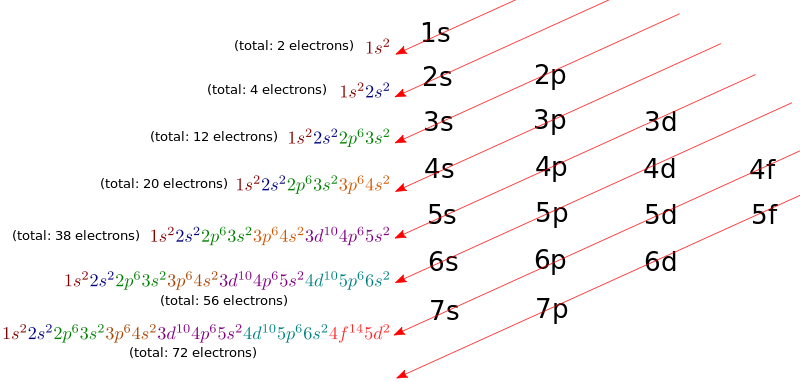
Complete step by step answer:
Below is the list of electronic configuration of elements from $1$ to $36$, it has been written in shorthand electron configuration, i.e., starting with the noble gas symbol in the previous period, followed by the remaining configuration
From the table we can clearly see that only elements (hydrogen, lithium, beryllium, sodium, copper and chromium) have unpaired electrons in the s subshell.
Hence Option D is correct.
Note:
It is important to note here that there are two exceptions, Copper and Chromium, in the expected electronic configuration of copper it should have been \[\left[ {Ar} \right]3{d^9}4{s^2}\] but because a fully filled $d$ sublevel is more stable than a partially filled one, therefore an electron from the $4s$ orbital gets excited and $3d$ orbital giving us the configuration mentioned in the table above.
Same happens in the case of Chromium, where expected configuration would have been \[\left[ {Ar} \right]3{d^4}4{s^2}\] but because half-filled $d$ orbital is more stable than a partially filled one, therefore the electron gets excited and goes to the $d$ orbital giving us the exception implemented electronic configuration.
Complete step by step answer:
Below is the list of electronic configuration of elements from $1$ to $36$, it has been written in shorthand electron configuration, i.e., starting with the noble gas symbol in the previous period, followed by the remaining configuration
| Name of the element | Atomic number | Electronic configuration of the element |
| Hydrogen | $1$ | \[1{s^1}\] |
| Helium | $2$ | \[1{s^2}\] |
| Lithium | $3$ | \[\left[ {He} \right]2{s^1}\] |
| Beryllium | $4$ | \[\left[ {He} \right]2{s^2}\] |
| Boron | $5$ | \[\left[ {He} \right]2{s^2}2{p^1}\] |
| Carbon | $6$ | \[\left[ {He} \right]2{s^2}2{p^2}\] |
| Nitrogen | $7$ | \[\left[ {He} \right]2{s^2}2{p^3}\] |
| Oxygen | $8$ | \[\left[ {He} \right]2{s^2}2{p^4}\] |
| Flourine | $9$ | \[\left[ {He} \right]2{s^2}2{p^5}\] |
| Neon | $10$ | \[\left[ {He} \right]2{s^2}2{p^6}\] |
| Sodium | $11$ | \[\left[ {Ne} \right]3{s^1}\] |
| Magnesium | $12$ | \[\left[ {Ne} \right]3{s^2}\] |
| Aluminium | $13$ | \[\left[ {Ne} \right]3{s^2}3{p^1}\] |
| Silicon | $14$ | \[\left[ {Ne} \right]3{s^2}3{p^2}\] |
| Phosphorus | $15$ | \[\left[ {Ne} \right]3{s^2}3{p^3}\] |
| Sulphur | $16$ | \[\left[ {Ne} \right]3{s^2}3{p^4}\] |
| Chlorine | $17$ | \[\left[ {Ne} \right]3{s^2}3{p^5}\] |
| Argon | $18$ | \[\left[ {Ne} \right]3{s^2}3{p^6}\] |
| Potassium | $19$ | \[\left[ {Ar} \right]4{s^1}\] |
| Calcium | $20$ | \[\left[ {Ar} \right]4{s^2}\] |
| Scandium | $21$ | \[\left[ {Ar} \right]3{d^1}4{s^2}\] |
| Titanium | $22$ | \[\left[ {Ar} \right]3{d^2}4{s^2}\] |
| Vanadium | $23$ | \[\left[ {Ar} \right]3{d^3}4{s^2}\] |
| Chromium | $24$ | \[\left[ {Ar} \right]3{d^5}4{s^1}\] |
| Manganese | $25$ | \[\left[ {Ar} \right]3{d^5}4{s^2}\] |
| Iron | $26$ | \[\left[ {Ar} \right]3{d^6}4{s^2}\] |
| Cobalt | $27$ | \[\left[ {Ar} \right]3{d^7}4{s^2}\] |
| Nickel | $28$ | \[\left[ {Ar} \right]3{d^8}4{s^2}\] |
| Copper | $29$ | \[\left[ {Ar} \right]3{d^{10}}4{s^1}\] |
| Zinc | $30$ | \[\left[ {Ar} \right]3{d^{10}}4{s^2}\] |
| Gallium | $31$ | \[\left[ {Ar} \right]3{d^{10}}4{s^2}4{p^1}\] |
| Germanium | $32$ | \[\left[ {Ar} \right]3{d^{10}}4{s^2}4{p^2}\] |
| Arsenic | $33$ | \[\left[ {Ar} \right]3{d^{10}}4{s^2}4{p^3}\] |
| Selenium | $34$ | \[\left[ {Ar} \right]3{d^{10}}4{s^2}4{p^4}\] |
| Bromine | $35$ | \[\left[ {Ar} \right]3{d^{10}}4{s^2}4{p^5}\] |
| Krypton | $36$ | \[\left[ {Ar} \right]3{d^{10}}4{s^2}4{p^6}\] |
From the table we can clearly see that only elements (hydrogen, lithium, beryllium, sodium, copper and chromium) have unpaired electrons in the s subshell.
Hence Option D is correct.
Note:
It is important to note here that there are two exceptions, Copper and Chromium, in the expected electronic configuration of copper it should have been \[\left[ {Ar} \right]3{d^9}4{s^2}\] but because a fully filled $d$ sublevel is more stable than a partially filled one, therefore an electron from the $4s$ orbital gets excited and $3d$ orbital giving us the configuration mentioned in the table above.
Same happens in the case of Chromium, where expected configuration would have been \[\left[ {Ar} \right]3{d^4}4{s^2}\] but because half-filled $d$ orbital is more stable than a partially filled one, therefore the electron gets excited and goes to the $d$ orbital giving us the exception implemented electronic configuration.
Recently Updated Pages
Master Class 11 Social Science: Engaging Questions & Answers for Success

Master Class 11 Chemistry: Engaging Questions & Answers for Success
Master Class 12 Business Studies: Engaging Questions & Answers for Success
Master Class 12 Chemistry: Engaging Questions & Answers for Success
Master Class 12 Biology: Engaging Questions & Answers for Success
Class 12 Question and Answer - Your Ultimate Solutions Guide
Trending doubts
One Metric ton is equal to kg A 10000 B 1000 C 100 class 11 physics CBSE
Difference Between Prokaryotic Cells and Eukaryotic Cells
How many of the following diseases can be studied with class 11 biology CBSE
Two of the body parts which do not appear in MRI are class 11 biology CBSE
Which of the following enzymes is used for carboxylation class 11 biology CBSE
Explain zero factorial class 11 maths CBSE