




Ammonia is basic in nature hence it turns:
A.Red litmus to blue
B.Blue litmus to red
C.White litmus to red
D.White litmus to blue
Answer
 Verified
617.7k+ views
Hint: Ammonia turns red litmus to blue so it is basic in nature. Ammonia is a compound of nitrogen and hydrogen with the chemical formula \[N{H_3}\]. It consists of one molecule of nitrogen and three molecules of hydrogen. A stable binary hydride and Pnictogen hydride nitrogen has a total of five electrons in the outer shell. It belongs to the \[15\] group of p-blocks. All basic nature elements turn the litmus paper red into blue due to the presence of lone pairs.
Complete step by step answer:
Nitrogen has a total of five electrons in the outermost shell. Nitrogen shares it’s three electrons with hydrogen to complete the octet so there is one lone pair in the \[N{H_3}\] molecule.
It acts as a Lewis base, so it can give an electron pair to two electrons deficient molecules. So due to the presence of one lone pair, it is basic in nature.
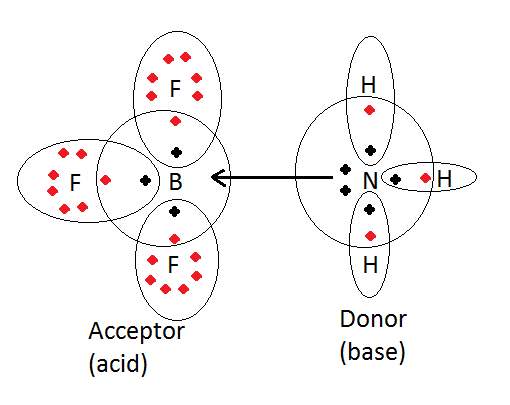
Lewis concept of acid and base for \[N{H_3}\]-
An acid is a substance (molecule or ion) which can accept a pair of electrons to form a coordinate bond. Here acid is an electron acceptor.
A base is a substance (molecule or ion) which can donate an electron pair to form a coordinate bond. Here the base is an electron donor.
According to Lewis concept, neutral molecules such as \[N{H_3}\] Having one or more lone pairs of electrons can act as Lewis bases.
\[B{F_3}(acid) \leftarrow N{H_3}(base)\]
Note:
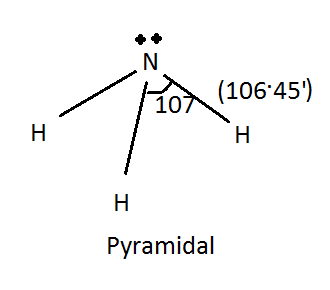
The \[N{H_3}\] has pyramidal structure and has \[s{p^3}\] hybridization. And the bond angle in \[N{H_3}\] molecule is \[ \sim {107^ \circ }\]. It can change the colour of litmus paper due to the above described reason as it is a Lewis base on the basis of the lone pair concept.
Complete step by step answer:
Nitrogen has a total of five electrons in the outermost shell. Nitrogen shares it’s three electrons with hydrogen to complete the octet so there is one lone pair in the \[N{H_3}\] molecule.
It acts as a Lewis base, so it can give an electron pair to two electrons deficient molecules. So due to the presence of one lone pair, it is basic in nature.
Lewis concept of acid and base for \[N{H_3}\]-
An acid is a substance (molecule or ion) which can accept a pair of electrons to form a coordinate bond. Here acid is an electron acceptor.
A base is a substance (molecule or ion) which can donate an electron pair to form a coordinate bond. Here the base is an electron donor.
According to Lewis concept, neutral molecules such as \[N{H_3}\] Having one or more lone pairs of electrons can act as Lewis bases.
\[B{F_3}(acid) \leftarrow N{H_3}(base)\]
Note:
The \[N{H_3}\] has pyramidal structure and has \[s{p^3}\] hybridization. And the bond angle in \[N{H_3}\] molecule is \[ \sim {107^ \circ }\]. It can change the colour of litmus paper due to the above described reason as it is a Lewis base on the basis of the lone pair concept.
Recently Updated Pages
Basicity of sulphurous acid and sulphuric acid are

Master Class 11 English: Engaging Questions & Answers for Success
Master Class 11 Physics: Engaging Questions & Answers for Success
Master Class 11 Computer Science: Engaging Questions & Answers for Success
Master Class 11 Chemistry: Engaging Questions & Answers for Success
Master Class 11 Social Science: Engaging Questions & Answers for Success
Trending doubts
Difference Between Prokaryotic Cells and Eukaryotic Cells
Two of the body parts which do not appear in MRI are class 11 biology CBSE
One Metric ton is equal to kg A 10000 B 1000 C 100 class 11 physics CBSE
10 examples of friction in our daily life
Draw a diagram of nephron and explain its structur class 11 biology CBSE
What will happen if the mucus is not secreted by the class 11 biology CBSE