



Amino acids can be identified by using the staining agent:
A. ninhydrin
B. sulphuric acid
C. ethidium bromide
D. coomassie brilliant blue
Answer
 Verified
600.9k+ views
Hint: Amino acids are proteins and so they possess two functional groups in their structure which are carboxylic acid group and amino group. These groups can be found out by various agents and thus we can detect the presence of amino acids in any substance.
Complete step by step solution:
- Amino acids are a type of protein and are very crucial for the growth of the body. So they are required to be consumed on a daily basis especially by children and pregnant women. So their identification tests are important to be studied to help us find the ingredients rich in it.
-The structure of amino acids contains carboxylic acid group (-COOH), amino group and various side chains. It can be shown as
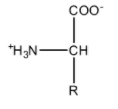
-Due to the presence of these functional groups, it becomes easy to detect the presence of amino acids in any substance. Compounds containing both the functional groups of carboxylic acid and amino group can only be said to be amino acids. Also, presence of any other functional group in the compound will not lead to the same conclusion.
-Human cells are made up of 20 different types of amino acids which differ only in their side chains and not in their functional groups. The amino acids can be neutral, acidic or basic. It can also be non-polar in nature.
-There are dyes which are used especially to stain the proteins and are blue in colour. They are the cool blue dyes. They stain the proteins in SDS-page gels which when soaked in the dyes, give the blue colour to the proteins that appear in the form of blue bands.
-The extra stain, if present in the solution, is removed with the help of a solvent and the process is called destaining. This way, the proteins are able to get visualized properly and the extra stain is reused for other purposes.
Therefore the correct option is D.
Note: There are around six or seven methods of identification of an amino acid which also includes the ninhydrin test method. But we need to see that the question is asked particularly about the staining method and so our correct option is D and not A. Ninhydrin is not a staining agent.
Complete step by step solution:
- Amino acids are a type of protein and are very crucial for the growth of the body. So they are required to be consumed on a daily basis especially by children and pregnant women. So their identification tests are important to be studied to help us find the ingredients rich in it.
-The structure of amino acids contains carboxylic acid group (-COOH), amino group and various side chains. It can be shown as
-Due to the presence of these functional groups, it becomes easy to detect the presence of amino acids in any substance. Compounds containing both the functional groups of carboxylic acid and amino group can only be said to be amino acids. Also, presence of any other functional group in the compound will not lead to the same conclusion.
-Human cells are made up of 20 different types of amino acids which differ only in their side chains and not in their functional groups. The amino acids can be neutral, acidic or basic. It can also be non-polar in nature.
-There are dyes which are used especially to stain the proteins and are blue in colour. They are the cool blue dyes. They stain the proteins in SDS-page gels which when soaked in the dyes, give the blue colour to the proteins that appear in the form of blue bands.
-The extra stain, if present in the solution, is removed with the help of a solvent and the process is called destaining. This way, the proteins are able to get visualized properly and the extra stain is reused for other purposes.
Therefore the correct option is D.
Note: There are around six or seven methods of identification of an amino acid which also includes the ninhydrin test method. But we need to see that the question is asked particularly about the staining method and so our correct option is D and not A. Ninhydrin is not a staining agent.
Recently Updated Pages
Master Class 10 Computer Science: Engaging Questions & Answers for Success

Master Class 10 General Knowledge: Engaging Questions & Answers for Success
Master Class 10 English: Engaging Questions & Answers for Success
Master Class 10 Social Science: Engaging Questions & Answers for Success
Master Class 10 Maths: Engaging Questions & Answers for Success
Master Class 10 Science: Engaging Questions & Answers for Success
Trending doubts
Which are the Top 10 Largest Countries of the World?
Draw a labelled sketch of the human eye class 12 physics CBSE
Differentiate between homogeneous and heterogeneous class 12 chemistry CBSE
What are the major means of transport Explain each class 12 social science CBSE
Sulphuric acid is known as the king of acids State class 12 chemistry CBSE
Why should a magnesium ribbon be cleaned before burning class 12 chemistry CBSE