




Why is the amino acid called building blocks of proteins?
Answer
 Verified
521.7k+ views
Hint: There are 20 naturally occurring amino acids that can be classified into- Essential amino acids and Non- essential amino acids. The amino acids which can be synthesized in our body are called Non-essential amino acids. The amino acids which cannot be synthesized in our body and must be obtained through diets or outer sources are called- Essential amino acids.
Complete Answer:
They are the main constituent of the body which consists of nitrogen, hydrogen, carbon, and oxygen that supports the body organization of an organism and helps in the growth and development. They can exist as a zwitterion, where they have no net charge.
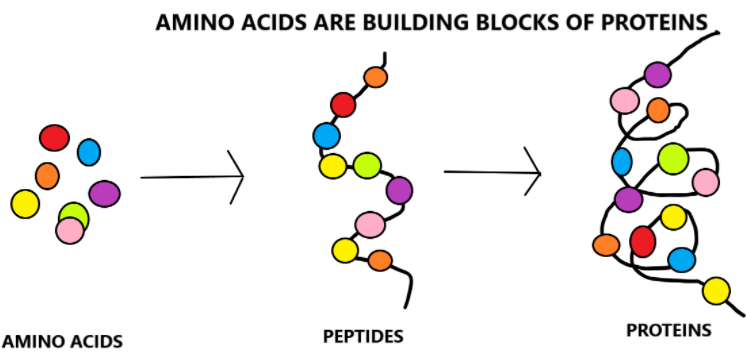
The amino acids are the fundamental building block of proteins. The proteins consist of around 20 amino acids that form a large protein molecule when they are linked together.
Proteins are the building blocks of the body that constitute various amino acids. These amino acids perform various functions including DNA replication, repair damage, cell metabolic processes, the structure of cells, and organisms.
The amino acids contain two functional groups, an amino group, and a carboxyl group. The amino acids, when joined together, will form a long chain of a protein called a polypeptide chain which will form the building blocks of the proteins. The 20 amino acids are known as the standard amino acids due to the presence of triplet codons in their genetic codes.
There are around two amino acids that do not code directly by DNA and are known as non-standard or non-canonical. They are selenocysteine and pyrrolysine. There are nine amino acids that are taken from the food and other compounds which are called essential amino acids. The amino acids are used as fertilizers, food, drugs, and supplements of nutrition.
Note:
Amino acids are the building block of proteins. Proteins are the building block of our body and are formed by the chain of amino acid sequences. The chains of amino acids are called polypeptides. Two or more polypeptide chains fold together to form a protein. Based on their structure and the arrangement of their polypeptide chains, proteins can be classified into four categories- primary, secondary, tertiary, and quaternary. They help in the coordination of metabolic reactions, various body functions, formation and maintenance of the body tissues, controlling the activity of genes, and other life-sustaining activities.
Complete Answer:
They are the main constituent of the body which consists of nitrogen, hydrogen, carbon, and oxygen that supports the body organization of an organism and helps in the growth and development. They can exist as a zwitterion, where they have no net charge.
The amino acids are the fundamental building block of proteins. The proteins consist of around 20 amino acids that form a large protein molecule when they are linked together.
Proteins are the building blocks of the body that constitute various amino acids. These amino acids perform various functions including DNA replication, repair damage, cell metabolic processes, the structure of cells, and organisms.
The amino acids contain two functional groups, an amino group, and a carboxyl group. The amino acids, when joined together, will form a long chain of a protein called a polypeptide chain which will form the building blocks of the proteins. The 20 amino acids are known as the standard amino acids due to the presence of triplet codons in their genetic codes.
There are around two amino acids that do not code directly by DNA and are known as non-standard or non-canonical. They are selenocysteine and pyrrolysine. There are nine amino acids that are taken from the food and other compounds which are called essential amino acids. The amino acids are used as fertilizers, food, drugs, and supplements of nutrition.
Note:
Amino acids are the building block of proteins. Proteins are the building block of our body and are formed by the chain of amino acid sequences. The chains of amino acids are called polypeptides. Two or more polypeptide chains fold together to form a protein. Based on their structure and the arrangement of their polypeptide chains, proteins can be classified into four categories- primary, secondary, tertiary, and quaternary. They help in the coordination of metabolic reactions, various body functions, formation and maintenance of the body tissues, controlling the activity of genes, and other life-sustaining activities.
Recently Updated Pages
Master Class 11 English: Engaging Questions & Answers for Success

Master Class 11 Social Science: Engaging Questions & Answers for Success
Master Class 11 Maths: Engaging Questions & Answers for Success
Master Class 11 Biology: Engaging Questions & Answers for Success
Master Class 11 Physics: Engaging Questions & Answers for Success
Master Class 11 Chemistry: Engaging Questions & Answers for Success
Trending doubts
One Metric ton is equal to kg A 10000 B 1000 C 100 class 11 physics CBSE
Difference Between Prokaryotic Cells and Eukaryotic Cells
Find the value of the expression given below sin 30circ class 11 maths CBSE
Difference between physical and chemical change class 11 chemistry CBSE
Two of the body parts which do not appear in MRI are class 11 biology CBSE
Draw a diagram of a plant cell and label at least eight class 11 biology CBSE