



AM is a median of $\Delta ABC$ . Prove that $AB+BC+CA > 2AM$
Answer
 Verified
596.7k+ views
Hint: Start by drawing a neat diagram. Then apply the theorem that the sum of two sides of a triangle is always greater than the third side in $\Delta AMB$ and $\Delta AMC$ separately, such that AM is the third side in both the cases. Add the two inequalities to get the answer.
Complete step by step solution:
To start with the solution, let us first draw the diagram.
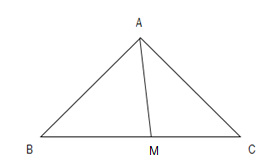
Let us start the solution to the above question by drawing some results related to $\Delta ABM$ . We know that the sum of two sides of a triangle is always greater than the third side, so we can say that:
$AB+BM > AM........(i)$
Similarly, if we take up $\Delta ACM$ and use the theorem that the sum of two sides of a triangle is always greater than the third side, we get
$AC+CM > AM........(ii)$
Now we will add inequality (i) and inequality (ii). On doing so, we get
$AC+CM+AB+BM > AM+AM$
$\Rightarrow AC+CM+AB+BM > 2AM$
Now if we look in the figure, we will find that BM+CM=BC. If we use this in our inequality, we get
$AB+BC+CA > 2AM$
Hence, we can say that we have proved the inequality asked in the question.
Note: The key to such questions is the diagram. If you get the diagram correct, then there is a high possibility that you would reach an answer provided you have the basic knowledge of regularly used theorems, as we saw in the above question. Also, the general mistake that a student makes is getting confused between the medians and the angle bisectors leading to errors, so be careful while using the properties of medians and angle bisectors. However, the above theorem is not specific to medians and can be proved for any line joining A and a point M on the line segment BC.
Complete step by step solution:
To start with the solution, let us first draw the diagram.
Let us start the solution to the above question by drawing some results related to $\Delta ABM$ . We know that the sum of two sides of a triangle is always greater than the third side, so we can say that:
$AB+BM > AM........(i)$
Similarly, if we take up $\Delta ACM$ and use the theorem that the sum of two sides of a triangle is always greater than the third side, we get
$AC+CM > AM........(ii)$
Now we will add inequality (i) and inequality (ii). On doing so, we get
$AC+CM+AB+BM > AM+AM$
$\Rightarrow AC+CM+AB+BM > 2AM$
Now if we look in the figure, we will find that BM+CM=BC. If we use this in our inequality, we get
$AB+BC+CA > 2AM$
Hence, we can say that we have proved the inequality asked in the question.
Note: The key to such questions is the diagram. If you get the diagram correct, then there is a high possibility that you would reach an answer provided you have the basic knowledge of regularly used theorems, as we saw in the above question. Also, the general mistake that a student makes is getting confused between the medians and the angle bisectors leading to errors, so be careful while using the properties of medians and angle bisectors. However, the above theorem is not specific to medians and can be proved for any line joining A and a point M on the line segment BC.
Recently Updated Pages
Master Class 9 General Knowledge: Engaging Questions & Answers for Success

Master Class 9 Social Science: Engaging Questions & Answers for Success
Master Class 9 English: Engaging Questions & Answers for Success
Master Class 9 Maths: Engaging Questions & Answers for Success
Master Class 9 Science: Engaging Questions & Answers for Success
Class 9 Question and Answer - Your Ultimate Solutions Guide
Trending doubts
Difference Between Plant Cell and Animal Cell
Fill the blanks with the suitable prepositions 1 The class 9 english CBSE
Who is eligible for RTE class 9 social science CBSE
Which places in India experience sunrise first and class 9 social science CBSE
What is pollution? How many types of pollution? Define it
Name 10 Living and Non living things class 9 biology CBSE