




Although geometries of \[N{{H}_{3}}\] and \[{{H}_{2}}O\] molecules are distorted tetrahedral, bond angle in water is less than that of ammonia. Explain.
Answer
 Verified
656.4k+ views
Hint: Whenever we are going to know about structure and bond angles in the molecules first we have to see how many bond pairs and lone pairs are present in the structure of the molecules. The presence of lone pairs of electrons is the reason behind the change in the bond angle in the molecules.
Complete step by step answer:
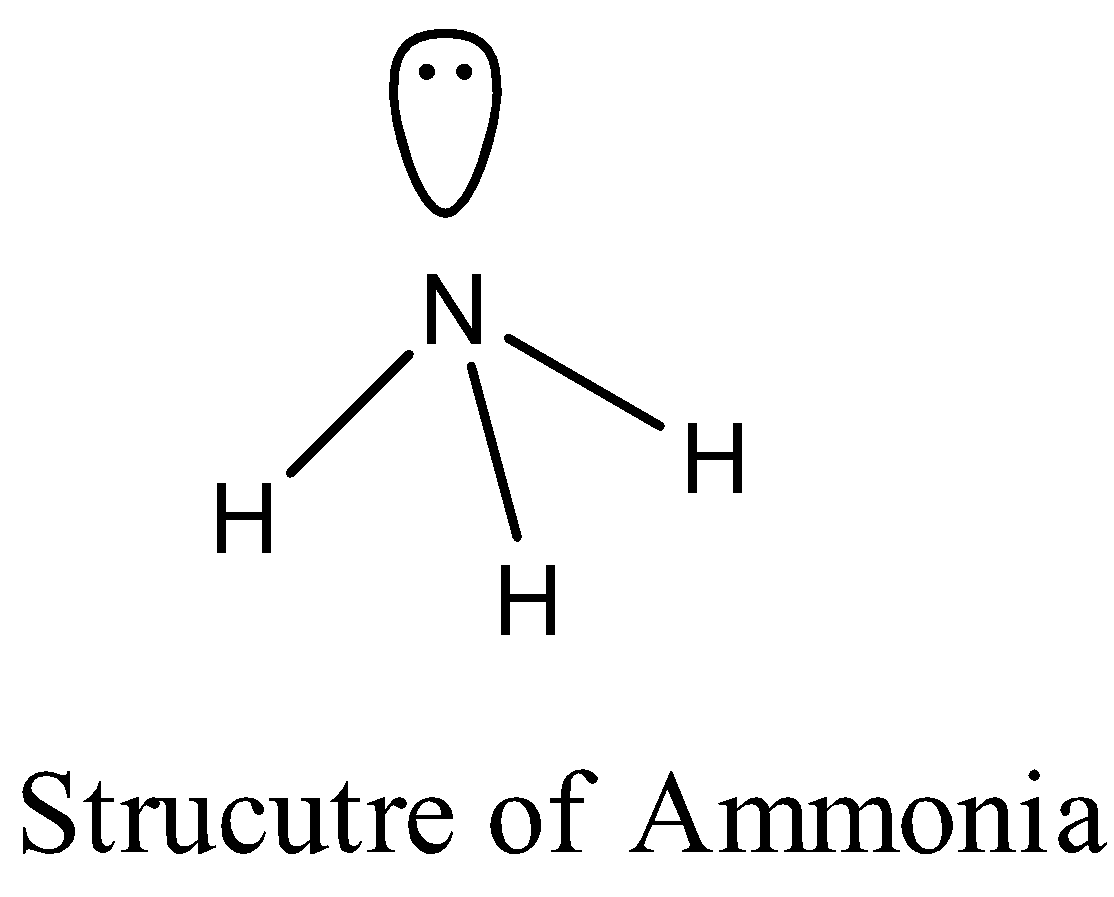
The structure of Ammonia is as follows.
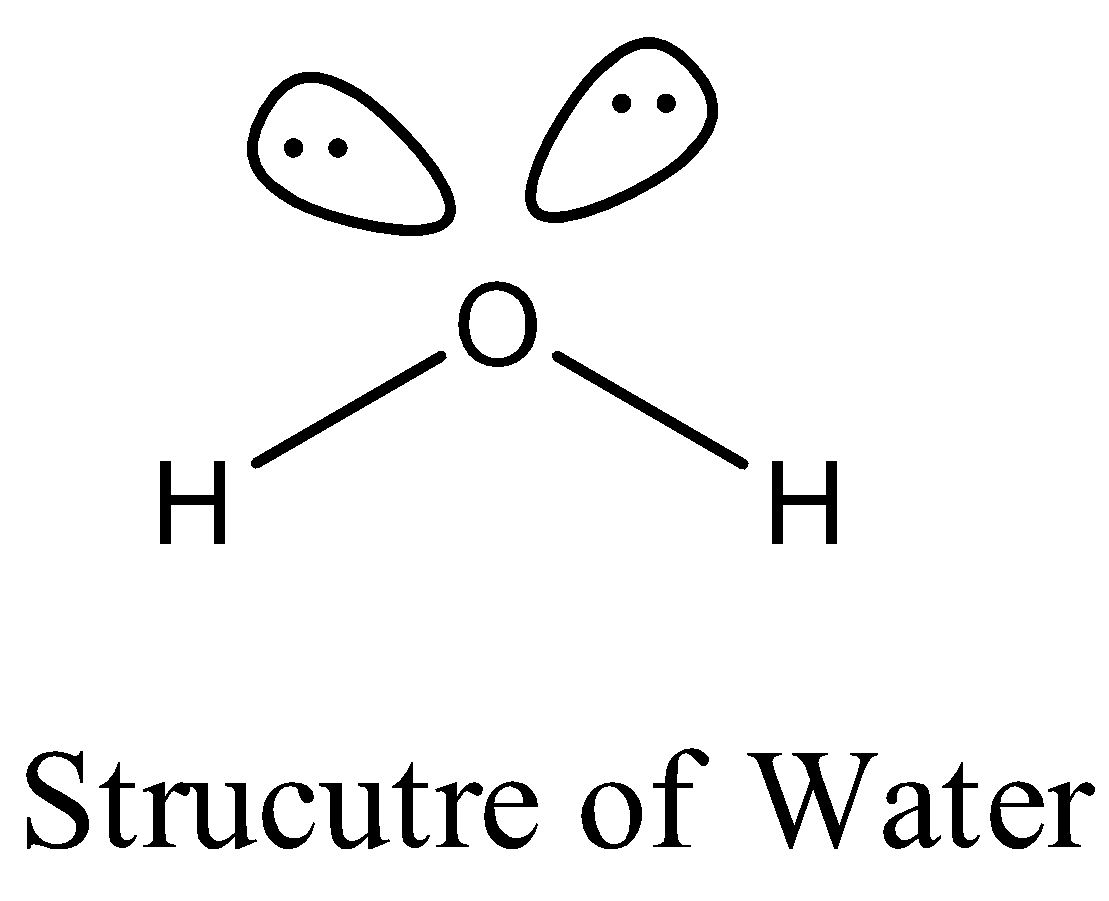
The structure of water is as follows.
In the structure of ammonia we can see clearly that there are three bond pairs and one lone pair of electrons.
In the structure of water we can see that there are two bond pairs and two lone pairs of electrons.
Due to the presence of one lone pair of electrons in the structure of ammonia the bond angle is decreased from \[{{109}^{o}}\] to \[{{107}^{o}}\].
Due to the presence of two lone pair of electrons in structure of water molecule the bond angle is decreased from \[{{107}^{o}}\] to \[{{105.4}^{o}}\].
In ammonia only one lone pair of electrons are present, but in water molecules there are two lone pairs of electrons.
Due to the presence of two lone pairs of electrons in the structure of the water molecule there is a high repulsion between two bond pairs and two lone pairs when compared to one lone pair and three bond pair repulsions in ammonia.
Then the repulsions between two bond pairs and two lone pairs in water molecules are greater than two bond pairs and two lone pairs that have ammonia. So, the bond angle in water is less than that of bond angle in ammonia.
Note: The repulsion between bond pairs and lone pairs are as follows.
Bond pair - bond pair < bond pair – lone pair < lone pair- lone pair.
Means lone pair-lone pair repulsions are high when compared to bond pair-lone pair repulsions.
Bond pair-lone pair repulsions are high when compared to bond pair-bond pair repulsions.
Complete step by step answer:
The structure of Ammonia is as follows.
The structure of water is as follows.
In the structure of ammonia we can see clearly that there are three bond pairs and one lone pair of electrons.
In the structure of water we can see that there are two bond pairs and two lone pairs of electrons.
Due to the presence of one lone pair of electrons in the structure of ammonia the bond angle is decreased from \[{{109}^{o}}\] to \[{{107}^{o}}\].
Due to the presence of two lone pair of electrons in structure of water molecule the bond angle is decreased from \[{{107}^{o}}\] to \[{{105.4}^{o}}\].
In ammonia only one lone pair of electrons are present, but in water molecules there are two lone pairs of electrons.
Due to the presence of two lone pairs of electrons in the structure of the water molecule there is a high repulsion between two bond pairs and two lone pairs when compared to one lone pair and three bond pair repulsions in ammonia.
Then the repulsions between two bond pairs and two lone pairs in water molecules are greater than two bond pairs and two lone pairs that have ammonia. So, the bond angle in water is less than that of bond angle in ammonia.
Note: The repulsion between bond pairs and lone pairs are as follows.
Bond pair - bond pair < bond pair – lone pair < lone pair- lone pair.
Means lone pair-lone pair repulsions are high when compared to bond pair-lone pair repulsions.
Bond pair-lone pair repulsions are high when compared to bond pair-bond pair repulsions.
Recently Updated Pages
If x a + bt + ct2 where x is in meters and t is in class 11 physics CBSE

A car covers the first half distance between two places class 11 physics CBSE
The resultant of two vectors overrightarrow P and overrightarrow class 11 physics CBSE
Find the value of cos 135 class 11 maths CBSE
A mass M is held in place by an applied force F and class 11 physics CBSE
A solution of glucose in water is labelled as 10 dfracwv class 11 chemistry CBSE
Trending doubts
One Metric ton is equal to kg A 10000 B 1000 C 100 class 11 physics CBSE
Find the value of the expression given below sin 30circ class 11 maths CBSE
Draw a diagram of nephron and explain its structur class 11 biology CBSE
10 examples of friction in our daily life
Proton was discovered by A Thomson B Rutherford C Chadwick class 11 chemistry CBSE
Bond order ofO2 O2+ O2 and O22 is in order A O2 langle class 11 chemistry CBSE