




Why is allosteric inhibition called feedback inhibition? Explain.
Answer
 Verified
650.7k+ views
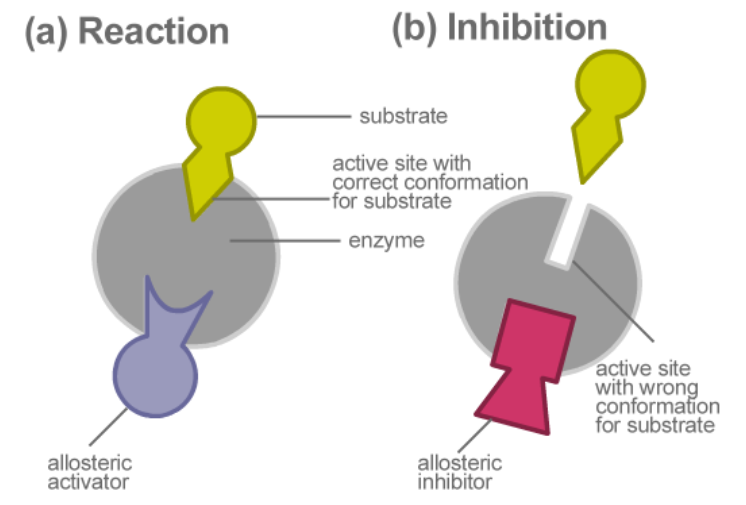
Hint: Enzyme or protein is known to possess catalytic site as well as the allosteric site. Allosteric site is the site other than the active/catalytic site of enzyme, where, when a molecule binds, it changes the conformation of enzyme which leads to either more or less product formation.
Complete answer:
Allosteric inhibition is called feedback inhibition because in feedback inhibition, the end products of a reaction are known to bind to the allosteric site of the enzyme leading to the inactivation of enzyme thereby producing a lesser amount of products. Thus, feedback inhibition is usually accomplished through an “allosteric site”. The result of feedback inhibition is that it is responsible for adjusting the rate of reaction which depends on how much of the end product is required and thus helping to prevent the accumulation of end products to undesired or dangerous levels. Therefore, allosteric inhibition is called feedback inhibition.
Additional information:
One of the typical examples of feedback inhibition is the inhibition of enzyme hexokinase (playing a role in glycolysis) by glucose-6-phosphate molecules. The enzyme hexokinase is known for the conversion of glucose to glucose-6-phosphate, but, as the reaction moves forward, there is accumulation of glucose-6-phosphate that binds to the allosteric site of hexokinase, thereby inhibiting the conversion of glucose to glucose-6-phosphate.
Note: Feedback inhibition is known for the binding of end products of reaction to the allosteric site of enzyme thereby retarding the enzyme’s activity which will result in low or no new end products. This will help in adjusting the rate of reaction in order to maintain the level of product formation.
Complete answer:
Allosteric inhibition is called feedback inhibition because in feedback inhibition, the end products of a reaction are known to bind to the allosteric site of the enzyme leading to the inactivation of enzyme thereby producing a lesser amount of products. Thus, feedback inhibition is usually accomplished through an “allosteric site”. The result of feedback inhibition is that it is responsible for adjusting the rate of reaction which depends on how much of the end product is required and thus helping to prevent the accumulation of end products to undesired or dangerous levels. Therefore, allosteric inhibition is called feedback inhibition.
Additional information:
One of the typical examples of feedback inhibition is the inhibition of enzyme hexokinase (playing a role in glycolysis) by glucose-6-phosphate molecules. The enzyme hexokinase is known for the conversion of glucose to glucose-6-phosphate, but, as the reaction moves forward, there is accumulation of glucose-6-phosphate that binds to the allosteric site of hexokinase, thereby inhibiting the conversion of glucose to glucose-6-phosphate.
Note: Feedback inhibition is known for the binding of end products of reaction to the allosteric site of enzyme thereby retarding the enzyme’s activity which will result in low or no new end products. This will help in adjusting the rate of reaction in order to maintain the level of product formation.
Recently Updated Pages
If x a + bt + ct2 where x is in meters and t is in class 11 physics CBSE

A car covers the first half distance between two places class 11 physics CBSE
The resultant of two vectors overrightarrow P and overrightarrow class 11 physics CBSE
Find the value of cos 135 class 11 maths CBSE
A mass M is held in place by an applied force F and class 11 physics CBSE
A solution of glucose in water is labelled as 10 dfracwv class 11 chemistry CBSE
Trending doubts
One Metric ton is equal to kg A 10000 B 1000 C 100 class 11 physics CBSE
Find the value of the expression given below sin 30circ class 11 maths CBSE
What do you mean by retardation What is its SI uni class 11 physics CBSE
Draw a diagram of nephron and explain its structur class 11 biology CBSE
10 examples of friction in our daily life
Difference between physical and chemical change class 11 chemistry CBSE