



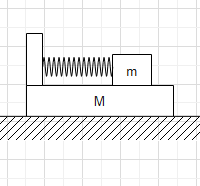
All the surfaces shown in the figure are frictionless. The mass of the car is M, that of the block is m and the spring has spring constant k. Initially, the car and the block are at rest and the spring is stretched through a length, when the system is released.
(a) Find the amplitude of the simple harmonic motion of the block and of the car as seen from the road.
(b) Find the time period(s) of the two simple harmonic motions.
Answer
 Verified
581.1k+ views
Hint: The sum of the amplitudes of the car and the block will be equal to the maximum extension of the spring. Then use the law of conservation of momentum and find the relation between the masses and the amplitudes. For the time periods use the formula for the time period of simple harmonic motion.
Complete answer:
(a) The amplitude of the block and the car will depend on the extension of the spring. When stretched or compressed to maximum, the block and the car will have the maximum displacements. The maximum displacements of the block and the car are their amplitudes.
Let the amplitudes of the car and the block be ${{A}_{1}}$ and ${{A}_{2}}$ respectively.
It is given that the spring is stretched by a length ${{x}_{0}}$ and this is the maximum extension in the spring. Therefore,
${{x}_{0}}={{A}_{1}}+{{A}_{2}}$ …. (i).
When the system is released, spring will apply force on the two objects which will be equal to F= kx directed in the opposite direction of the displacement of the objects.
Here, x is the change in the original length of the spring.
In this case, the two spring forces will be equal in magnitude but opposite in directions. Therefore, the net force on the system is zero.
When the net force acting on a system is zero, the net momentum of the system will be constants.
In other words, we can say that the momentum of the centre mass of the system will be constant. We know that the centre of mass of the system is at rest initially. Therefore, the momentum of the system will zero throughout the motion.
This means that the centre of mass of the system is always at rest.
Now displacement of the centre of mass of two bodies is given as ${{x}_{com}}=\dfrac{{{m}_{1}}{{x}_{1}}+{{m}_{2}}{{x}_{2}}}{{{m}_{1}}+{{m}_{2}}}$
In this case, ${{m}_{1}}=M$ and ${{m}_{2}}=m$ and ${{x}_{com}}=0$.
Therefore,
$0=\dfrac{M{{x}_{1}}+m{{x}_{2}}}{M+m}$
$\Rightarrow M{{x}_{1}}+m{{x}_{2}}=0$
When the car and the block are displaced by ${{A}_{1}}$ and ${{A}_{2}}$,
$\Rightarrow M{{A}_{1}}+m{{A}_{2}}=0$
$\Rightarrow M{{A}_{1}}=-m{{A}_{2}}$
If we only consider the magnitudes, then $M{{A}_{1}}=m{{A}_{2}}$.
$\Rightarrow {{A}_{1}}=\dfrac{m}{M}{{A}_{2}}$
Substitute this value in (i).
$\Rightarrow {{x}_{0}}=\left( \dfrac{m}{M}{{A}_{2}} \right)+{{A}_{2}}$
$\Rightarrow {{x}_{0}}=\left( \dfrac{m}{M}+1 \right){{A}_{2}}$
$\Rightarrow {{x}_{0}}=\left( \dfrac{m+M}{M} \right){{A}_{2}}$
$\Rightarrow {{A}_{2}}=\dfrac{M{{x}_{0}}}{M+m}$.
Substitute this value in (i)
$\Rightarrow {{x}_{0}}={{A}_{1}}+\dfrac{M{{x}_{0}}}{M+m}$
$\Rightarrow {{A}_{1}}=\dfrac{m{{x}_{0}}}{M+m}$.
Therefore, the amplitude of the car is ${{A}_{1}}=\dfrac{m{{x}_{0}}}{M+m}$.
And the amplitude of the block is ${{A}_{2}}=\dfrac{M{{x}_{0}}}{M+m}$.
(b) The time period of a body of mass m under simple harmonic motion is given as $T=2\pi \sqrt{\dfrac{m}{k}}$.
Therefore, the time period of the car is ${{T}_{1}}=2\pi \sqrt{\dfrac{M}{k}}$.
And the time period of the block is ${{T}_{2}}=2\pi \sqrt{\dfrac{m}{k}}$.
Note:
If you find the given system of a car and a block, then you can replace the system with a system of two blocks of masses M and m lying on with a spring attached in between them. This is because all the surfaces are frictionless.
Complete answer:
(a) The amplitude of the block and the car will depend on the extension of the spring. When stretched or compressed to maximum, the block and the car will have the maximum displacements. The maximum displacements of the block and the car are their amplitudes.
Let the amplitudes of the car and the block be ${{A}_{1}}$ and ${{A}_{2}}$ respectively.
It is given that the spring is stretched by a length ${{x}_{0}}$ and this is the maximum extension in the spring. Therefore,
${{x}_{0}}={{A}_{1}}+{{A}_{2}}$ …. (i).
When the system is released, spring will apply force on the two objects which will be equal to F= kx directed in the opposite direction of the displacement of the objects.
Here, x is the change in the original length of the spring.
In this case, the two spring forces will be equal in magnitude but opposite in directions. Therefore, the net force on the system is zero.
When the net force acting on a system is zero, the net momentum of the system will be constants.
In other words, we can say that the momentum of the centre mass of the system will be constant. We know that the centre of mass of the system is at rest initially. Therefore, the momentum of the system will zero throughout the motion.
This means that the centre of mass of the system is always at rest.
Now displacement of the centre of mass of two bodies is given as ${{x}_{com}}=\dfrac{{{m}_{1}}{{x}_{1}}+{{m}_{2}}{{x}_{2}}}{{{m}_{1}}+{{m}_{2}}}$
In this case, ${{m}_{1}}=M$ and ${{m}_{2}}=m$ and ${{x}_{com}}=0$.
Therefore,
$0=\dfrac{M{{x}_{1}}+m{{x}_{2}}}{M+m}$
$\Rightarrow M{{x}_{1}}+m{{x}_{2}}=0$
When the car and the block are displaced by ${{A}_{1}}$ and ${{A}_{2}}$,
$\Rightarrow M{{A}_{1}}+m{{A}_{2}}=0$
$\Rightarrow M{{A}_{1}}=-m{{A}_{2}}$
If we only consider the magnitudes, then $M{{A}_{1}}=m{{A}_{2}}$.
$\Rightarrow {{A}_{1}}=\dfrac{m}{M}{{A}_{2}}$
Substitute this value in (i).
$\Rightarrow {{x}_{0}}=\left( \dfrac{m}{M}{{A}_{2}} \right)+{{A}_{2}}$
$\Rightarrow {{x}_{0}}=\left( \dfrac{m}{M}+1 \right){{A}_{2}}$
$\Rightarrow {{x}_{0}}=\left( \dfrac{m+M}{M} \right){{A}_{2}}$
$\Rightarrow {{A}_{2}}=\dfrac{M{{x}_{0}}}{M+m}$.
Substitute this value in (i)
$\Rightarrow {{x}_{0}}={{A}_{1}}+\dfrac{M{{x}_{0}}}{M+m}$
$\Rightarrow {{A}_{1}}=\dfrac{m{{x}_{0}}}{M+m}$.
Therefore, the amplitude of the car is ${{A}_{1}}=\dfrac{m{{x}_{0}}}{M+m}$.
And the amplitude of the block is ${{A}_{2}}=\dfrac{M{{x}_{0}}}{M+m}$.
(b) The time period of a body of mass m under simple harmonic motion is given as $T=2\pi \sqrt{\dfrac{m}{k}}$.
Therefore, the time period of the car is ${{T}_{1}}=2\pi \sqrt{\dfrac{M}{k}}$.
And the time period of the block is ${{T}_{2}}=2\pi \sqrt{\dfrac{m}{k}}$.
Note:
If you find the given system of a car and a block, then you can replace the system with a system of two blocks of masses M and m lying on with a spring attached in between them. This is because all the surfaces are frictionless.
Recently Updated Pages
Master Class 11 Computer Science: Engaging Questions & Answers for Success

Master Class 11 Business Studies: Engaging Questions & Answers for Success
Master Class 11 Economics: Engaging Questions & Answers for Success
Master Class 11 English: Engaging Questions & Answers for Success
Master Class 11 Maths: Engaging Questions & Answers for Success
Master Class 11 Biology: Engaging Questions & Answers for Success
Trending doubts
One Metric ton is equal to kg A 10000 B 1000 C 100 class 11 physics CBSE
There are 720 permutations of the digits 1 2 3 4 5 class 11 maths CBSE
Discuss the various forms of bacteria class 11 biology CBSE
Draw a diagram of a plant cell and label at least eight class 11 biology CBSE
State the laws of reflection of light
Explain zero factorial class 11 maths CBSE