




$A\left( {5,7} \right),B\left( {4,12} \right),C\left( {9,11} \right)$ and $D\left( {10,6} \right)$ are four points. Show that ABCD is a rhombus.
Answer
 Verified
576k+ views
Hint:
We can find the distance of AB using distance formula. We can also find the distances BC, CD and AD. Then by comparing the values we can prove that all the 4 sides are equal. Thus, we can prove that ABCD is a rhombus.
Complete step by step solution:
We are given that points A $\left( {5,7} \right)$ , B $\left( {4,12} \right)$ , C $\left( {9,11} \right)$ and D $\left( {10,6} \right)$.
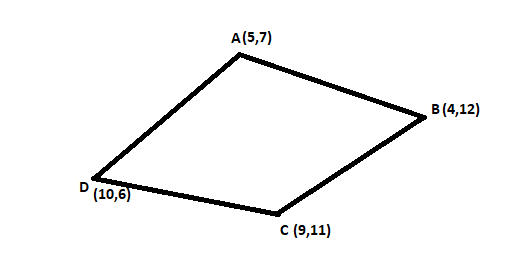
We know that distance between the points $\left( {{x_1},{y_1}} \right)$ and $\left( {{x_2},{y_2}} \right)$ is given by,
$d = \sqrt {{{\left( {{x_1} - {x_2}} \right)}^2} + {{\left( {{y_1} - {y_2}} \right)}^2}} $
So, the distance between the points A $\left( {5,7} \right)$ and B $\left( {4,12} \right)$ is
$AB = \sqrt {{{\left( {5 - 4} \right)}^2} + {{\left( {7 - 12} \right)}^2}} $
On simplification, we get
$ \Rightarrow AB = \sqrt {{1^2} + {{\left( { - 5} \right)}^2}} $
On solving further, we have
$ \Rightarrow AB = \sqrt {1 + 25} $
So, we have
$ \Rightarrow AB = \sqrt {26} $ …. (1)
Now the distance between B $\left( {4,12} \right)$ and C $\left( {9,11} \right)$ is given by,
$ \Rightarrow BC = \sqrt {{{\left( {4 - 9} \right)}^2} + {{\left( {12 - 11} \right)}^2}} $
On simplification, we get
$ \Rightarrow BC = \sqrt {{{\left( { - 5} \right)}^2} + {1^2}} $
On solving further, we have
$ \Rightarrow BC = \sqrt {25 + 1} $
So, we have
$ \Rightarrow BC = \sqrt {26} $ … (2)
Now the distance CD is given by, C $\left( {9,11} \right)$ and D $\left( {10,6} \right)$.
$CD = \sqrt {{{\left( {9 - 10} \right)}^2} + {{\left( {11 - 6} \right)}^2}} $
On simplification, we get
$ \Rightarrow CD = \sqrt {{{\left( { - 1} \right)}^2} + {5^2}} $
On solving further, we have
\[ \Rightarrow CD = \sqrt {1 + 25} \]
So, we have
$ \Rightarrow CD = \sqrt {26} $ … (3)
Now the distance between A $\left( {5,7} \right)$ and D $\left( {10,6} \right)$ is given by,
$AD = \sqrt {{{\left( {5 - 10} \right)}^2} + {{\left( {7 - 6} \right)}^2}} $
On simplification, we get
$ \Rightarrow AD = \sqrt {{{\left( { - 5} \right)}^2} + {1^2}} $
On solving further, we have
\[ \Rightarrow AD = \sqrt {25 + 1} \]
So, we have
$ \Rightarrow AD = \sqrt {26} $ … (4)
From equations (1), (2), (3) and (4), we can say that
$ \Rightarrow AB = BC = CD = AD = \sqrt {26} $
We know that a rhombus is a quadrilateral with all 4 sides equal. As all the sides are equal.
$\therefore $ ABCD is a rhombus.
Note:
Alternate method to solve this problem is given by,
We are given that points A $\left( {5,7} \right)$ , B $\left( {4,12} \right)$ , C $\left( {9,11} \right)$ and D $\left( {10,6} \right)$ .
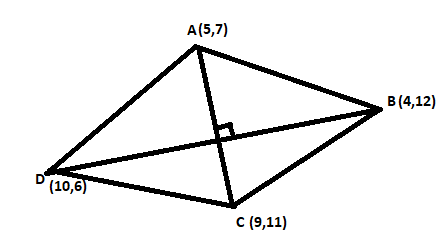
We know that for a rhombus, its diagonals are perpendicular.
We know that slope of the line joining the points $\left( {{x_1},{y_1}} \right)$ and $\left( {{x_2},{y_2}} \right)$ is given by,
$m = \dfrac{{{x_1} - {x_2}}}{{{y_1} - {y_2}}}$
So, the slope of the diagonal AC is,
$ \Rightarrow {m_1} = \dfrac{{5 - 9}}{{7 - 11}}$
On simplification, we get
$ \Rightarrow {m_1} = \dfrac{{ - 4}}{{ - 4}}$
Hence, we have
$ \Rightarrow {m_1} = 1$
similarly, the slope of the diagonal BD is
$ \Rightarrow {m_2} = \dfrac{{10 - 4}}{{6 - 12}}$
On simplification, we get
$ \Rightarrow {m_2} = \dfrac{6}{{ - 6}}$
Hence, we have
$ \Rightarrow {m_2} = - 1$
We know that if two lines are perpendicular, the product of their slope must be equal to -1.
$ \Rightarrow {m_1} \times {m_2} = 1 \times - 1$
So, we have
$ \Rightarrow {m_1} \times {m_2} = - 1$
Therefore, AC and BD are perpendicular. As the diagonals are perpendicular, we can say that ABCD is a rhombus.
We can find the distance of AB using distance formula. We can also find the distances BC, CD and AD. Then by comparing the values we can prove that all the 4 sides are equal. Thus, we can prove that ABCD is a rhombus.
Complete step by step solution:
We are given that points A $\left( {5,7} \right)$ , B $\left( {4,12} \right)$ , C $\left( {9,11} \right)$ and D $\left( {10,6} \right)$.
We know that distance between the points $\left( {{x_1},{y_1}} \right)$ and $\left( {{x_2},{y_2}} \right)$ is given by,
$d = \sqrt {{{\left( {{x_1} - {x_2}} \right)}^2} + {{\left( {{y_1} - {y_2}} \right)}^2}} $
So, the distance between the points A $\left( {5,7} \right)$ and B $\left( {4,12} \right)$ is
$AB = \sqrt {{{\left( {5 - 4} \right)}^2} + {{\left( {7 - 12} \right)}^2}} $
On simplification, we get
$ \Rightarrow AB = \sqrt {{1^2} + {{\left( { - 5} \right)}^2}} $
On solving further, we have
$ \Rightarrow AB = \sqrt {1 + 25} $
So, we have
$ \Rightarrow AB = \sqrt {26} $ …. (1)
Now the distance between B $\left( {4,12} \right)$ and C $\left( {9,11} \right)$ is given by,
$ \Rightarrow BC = \sqrt {{{\left( {4 - 9} \right)}^2} + {{\left( {12 - 11} \right)}^2}} $
On simplification, we get
$ \Rightarrow BC = \sqrt {{{\left( { - 5} \right)}^2} + {1^2}} $
On solving further, we have
$ \Rightarrow BC = \sqrt {25 + 1} $
So, we have
$ \Rightarrow BC = \sqrt {26} $ … (2)
Now the distance CD is given by, C $\left( {9,11} \right)$ and D $\left( {10,6} \right)$.
$CD = \sqrt {{{\left( {9 - 10} \right)}^2} + {{\left( {11 - 6} \right)}^2}} $
On simplification, we get
$ \Rightarrow CD = \sqrt {{{\left( { - 1} \right)}^2} + {5^2}} $
On solving further, we have
\[ \Rightarrow CD = \sqrt {1 + 25} \]
So, we have
$ \Rightarrow CD = \sqrt {26} $ … (3)
Now the distance between A $\left( {5,7} \right)$ and D $\left( {10,6} \right)$ is given by,
$AD = \sqrt {{{\left( {5 - 10} \right)}^2} + {{\left( {7 - 6} \right)}^2}} $
On simplification, we get
$ \Rightarrow AD = \sqrt {{{\left( { - 5} \right)}^2} + {1^2}} $
On solving further, we have
\[ \Rightarrow AD = \sqrt {25 + 1} \]
So, we have
$ \Rightarrow AD = \sqrt {26} $ … (4)
From equations (1), (2), (3) and (4), we can say that
$ \Rightarrow AB = BC = CD = AD = \sqrt {26} $
We know that a rhombus is a quadrilateral with all 4 sides equal. As all the sides are equal.
$\therefore $ ABCD is a rhombus.
Note:
Alternate method to solve this problem is given by,
We are given that points A $\left( {5,7} \right)$ , B $\left( {4,12} \right)$ , C $\left( {9,11} \right)$ and D $\left( {10,6} \right)$ .
We know that for a rhombus, its diagonals are perpendicular.
We know that slope of the line joining the points $\left( {{x_1},{y_1}} \right)$ and $\left( {{x_2},{y_2}} \right)$ is given by,
$m = \dfrac{{{x_1} - {x_2}}}{{{y_1} - {y_2}}}$
So, the slope of the diagonal AC is,
$ \Rightarrow {m_1} = \dfrac{{5 - 9}}{{7 - 11}}$
On simplification, we get
$ \Rightarrow {m_1} = \dfrac{{ - 4}}{{ - 4}}$
Hence, we have
$ \Rightarrow {m_1} = 1$
similarly, the slope of the diagonal BD is
$ \Rightarrow {m_2} = \dfrac{{10 - 4}}{{6 - 12}}$
On simplification, we get
$ \Rightarrow {m_2} = \dfrac{6}{{ - 6}}$
Hence, we have
$ \Rightarrow {m_2} = - 1$
We know that if two lines are perpendicular, the product of their slope must be equal to -1.
$ \Rightarrow {m_1} \times {m_2} = 1 \times - 1$
So, we have
$ \Rightarrow {m_1} \times {m_2} = - 1$
Therefore, AC and BD are perpendicular. As the diagonals are perpendicular, we can say that ABCD is a rhombus.
Recently Updated Pages
Master Class 11 Business Studies: Engaging Questions & Answers for Success

Master Class 11 Economics: Engaging Questions & Answers for Success
Master Class 11 Computer Science: Engaging Questions & Answers for Success
Master Class 11 English: Engaging Questions & Answers for Success
Master Class 11 Maths: Engaging Questions & Answers for Success
Master Class 11 Biology: Engaging Questions & Answers for Success
Trending doubts
One Metric ton is equal to kg A 10000 B 1000 C 100 class 11 physics CBSE
Discuss the various forms of bacteria class 11 biology CBSE
Draw a diagram of a plant cell and label at least eight class 11 biology CBSE
State the laws of reflection of light
Explain zero factorial class 11 maths CBSE
10 examples of friction in our daily life