




Aldol condensation will not be observed in?
A.Chloral
B.Phenyl acetaldehyde
C.Hexanal
D.Ethanal
Answer
 Verified
548.1k+ views
Hint: Aldol is the combination of aldehydes and alcohol. The aldol condensation is characterized by the reaction between an aldehyde or ketone with a dilute base. The only important thing is that the aldehyde or ketone should contain an $\alpha -Hydrogen$ atom.
Complete answer:
We know that $\alpha$ hydrogen is the hydrogen present in the carbon atom that is attached to the carbonyl carbon. Now, let us see which compound does not have $\alpha$ hydrogen.
Option A: Chloral
Chloral is also referred to as trichloroacetaldehyde or trichloroethanal. The molecular formula for chloral is $C{{l}_{3}}CCHO$.
Its structural formula is given by:
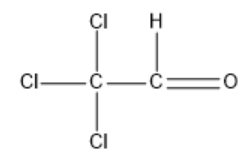
In the above structure, we can observe that the carbon next to the carbonyl carbon does not have any $\alpha $hydrogen. So, this compound cannot undergo an Aldol condensation reaction.
Option B: Phenyl acetaldehyde
Phenyl acetaldehyde has the molecular formula of ${{C}_{6}}{{H}_{5}}C{{H}_{2}}CHO$.
Its structural formula is given by:
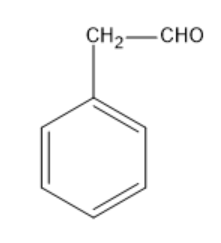
In the above structure, we can observe that the carbon next to the carbonyl carbon has $\alpha $hydrogen. So, this compound can undergo an Aldol condensation reaction.
Option C: Hexanal
The molecular formula of Hexanal is $C{{H}_{3}}C{{H}_{2}}C{{H}_{2}}C{{H}_{2}}C{{H}_{2}}CHO$.
Its structural formula is given by:
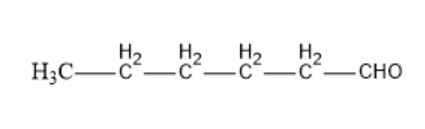
In the above structure, we can observe that the carbon next to the carbonyl carbon has $\alpha $hydrogen. So, this compound can undergo an Aldol condensation reaction.
Option D: Ethanal
The molecular formula of Hexanal is $C{{H}_{3}}CHO$.
Its structural formula is given by:
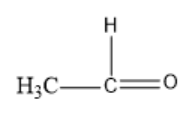
In the above structure, we can observe that the carbon next to the carbonyl carbon has $\alpha $hydrogen. So, this compound can undergo an Aldol condensation reaction.
Final answer: The correct answer is Option A: Chloral.
Note:
Aldol condensation will not be possible if the $\alpha $hydrogen is absent. Because in Aldol condensation, the $\alpha $ hydrogen attacks the carbonyl carbon to form an $\beta $ Unsaturated carbonyl compound. It is favoured by the loss of water molecules from both reactants.
Complete answer:
We know that $\alpha$ hydrogen is the hydrogen present in the carbon atom that is attached to the carbonyl carbon. Now, let us see which compound does not have $\alpha$ hydrogen.
Option A: Chloral
Chloral is also referred to as trichloroacetaldehyde or trichloroethanal. The molecular formula for chloral is $C{{l}_{3}}CCHO$.
Its structural formula is given by:
In the above structure, we can observe that the carbon next to the carbonyl carbon does not have any $\alpha $hydrogen. So, this compound cannot undergo an Aldol condensation reaction.
Option B: Phenyl acetaldehyde
Phenyl acetaldehyde has the molecular formula of ${{C}_{6}}{{H}_{5}}C{{H}_{2}}CHO$.
Its structural formula is given by:
In the above structure, we can observe that the carbon next to the carbonyl carbon has $\alpha $hydrogen. So, this compound can undergo an Aldol condensation reaction.
Option C: Hexanal
The molecular formula of Hexanal is $C{{H}_{3}}C{{H}_{2}}C{{H}_{2}}C{{H}_{2}}C{{H}_{2}}CHO$.
Its structural formula is given by:
In the above structure, we can observe that the carbon next to the carbonyl carbon has $\alpha $hydrogen. So, this compound can undergo an Aldol condensation reaction.
Option D: Ethanal
The molecular formula of Hexanal is $C{{H}_{3}}CHO$.
Its structural formula is given by:
In the above structure, we can observe that the carbon next to the carbonyl carbon has $\alpha $hydrogen. So, this compound can undergo an Aldol condensation reaction.
Final answer: The correct answer is Option A: Chloral.
Note:
Aldol condensation will not be possible if the $\alpha $hydrogen is absent. Because in Aldol condensation, the $\alpha $ hydrogen attacks the carbonyl carbon to form an $\beta $ Unsaturated carbonyl compound. It is favoured by the loss of water molecules from both reactants.
Recently Updated Pages
Basicity of sulphurous acid and sulphuric acid are

Master Class 11 English: Engaging Questions & Answers for Success
Master Class 11 Physics: Engaging Questions & Answers for Success
Master Class 11 Computer Science: Engaging Questions & Answers for Success
Master Class 11 Chemistry: Engaging Questions & Answers for Success
Master Class 11 Social Science: Engaging Questions & Answers for Success
Trending doubts
Difference Between Prokaryotic Cells and Eukaryotic Cells
Two of the body parts which do not appear in MRI are class 11 biology CBSE
One Metric ton is equal to kg A 10000 B 1000 C 100 class 11 physics CBSE
10 examples of friction in our daily life
Draw a diagram of nephron and explain its structur class 11 biology CBSE
What will happen if the mucus is not secreted by the class 11 biology CBSE