




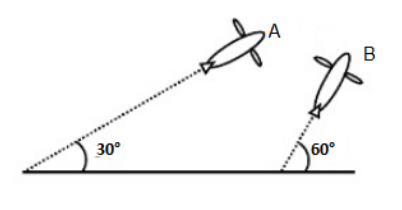
Airplanes $ A $ and $ B $ are flying with constant velocity in the same vertical plane at angles $ {30^ \circ } $ and $ {60^ \circ } $ with respect to the horizontal respectively as shown in the figure. The speed of $ A $ is $ 100\sqrt 3 m{s^{ - 1}} $ . At time $ t = 0s $ , an observer in $ A $ finds $ B $ at a distance of $ 500m $ . This observer sees $ B $ moving with a constant velocity perpendicular to the line of motion of $ A $ . If at $ t = {t_0} $ , $ A $ just escapes being hit by $ B $ , $ {t_0} $ in seconds is:
$ \left( A \right)5 \\
\left( B \right)7 \\
\left( C \right)6 \\
\left( D \right)8 \\ $
Answer
 Verified
579.3k+ views
Hint :In this question, we are going to first divide the two velocities into horizontal and vertical components. By equating the components, the velocity $ {V_B} $ is calculated. From $ {V_B} $ , the time for the escape can be calculated from the distance given and the vertical component of the velocity $ {V_B} $ .
The horizontal and the vertical components of a velocity $ V $ with projection angle $ \theta $ are $ V\cos \theta $ and $ V\sin \theta $ respectively.
The time taken for $ B $ is
$ {T_0} = \dfrac{{distance}}{{vertical{\text{ }}component{\text{ }}of speed{\text{ }}of{\text{ }}B}} $
Complete Step By Step Answer:
In the given figure, we can see that the velocities $ {V_A} $ and $ {V_B} $ can be split into its vertical and horizontal components.
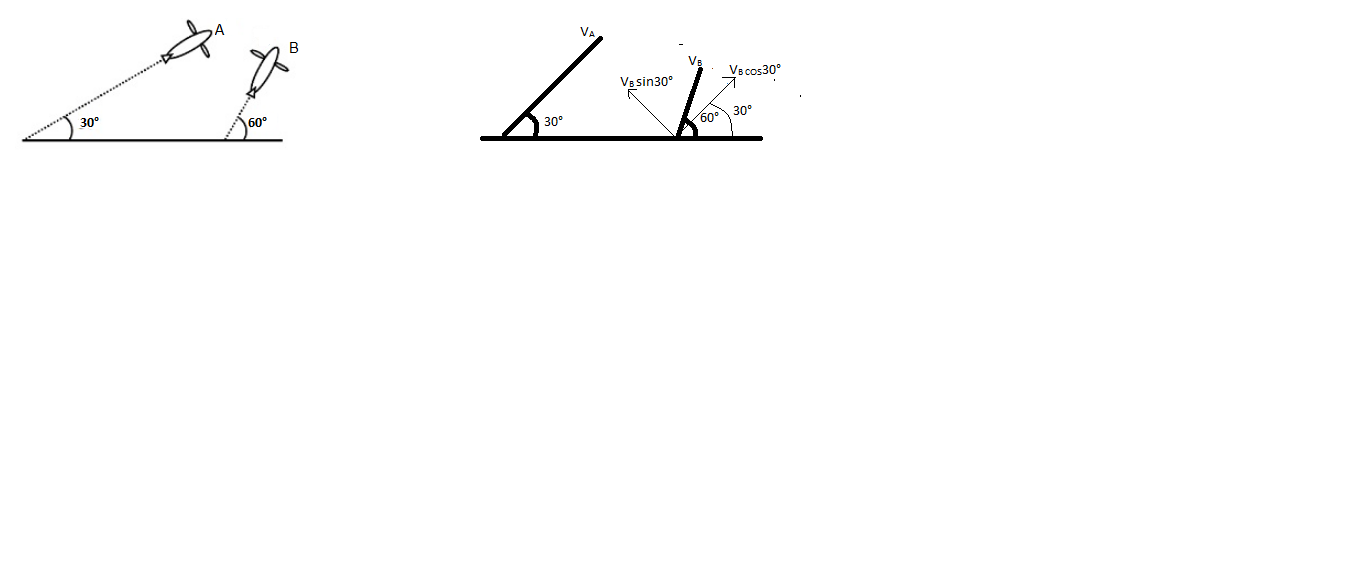
The components of the velocities can be related as
$ {V_A} = {V_B}\cos {30^ \circ } $
Here, if we put the values of the velocity $ {V_A} $ and $ \cos {30^ \circ } $ , we get, the value of $ {V_B} $ as:
$ 100\sqrt 3 = {V_B} \times \dfrac{{\sqrt 3 }}{2} $
On solving this, we get
$ {V_B} = 200m{s^{ - 1}} $
Here, we are given that the distance between the two planes is $ 500m $ and also that the observer sees that the motion of $ B $ moving with a constant velocity perpendicular to the line of motion of $ A $ thus, the time $ t = {t_0} $ at which $ A $ just escapes being hit by $ B $ , is
$ {T_0} = \dfrac{{distance}}{{vertical{\text{ }}component{\text{ }}of speed{\text{ }}of{\text{ }}B}} $
Putting the values, we get
$ {T_0} = \dfrac{{500}}{{{V_B}\sin {{30}^ \circ }}} = \dfrac{{500}}{{200 \times \dfrac{1}{2}}} \\
\Rightarrow {T_0} = 5s \\ $
Hence, option $ \left( A \right)5 $ is the correct answer.
Note :
In the question, we are given that the distance along the line of motion is $ 500m $ , along this direction, the velocity that is prevalent is the vertical component of the velocity along the angle $ {30^ \circ } $ . Where the horizontal component of the velocity $ {V_B} $ is equal to the speed of the airplane $ A $ .
The horizontal and the vertical components of a velocity $ V $ with projection angle $ \theta $ are $ V\cos \theta $ and $ V\sin \theta $ respectively.
The time taken for $ B $ is
$ {T_0} = \dfrac{{distance}}{{vertical{\text{ }}component{\text{ }}of speed{\text{ }}of{\text{ }}B}} $
Complete Step By Step Answer:
In the given figure, we can see that the velocities $ {V_A} $ and $ {V_B} $ can be split into its vertical and horizontal components.
The components of the velocities can be related as
$ {V_A} = {V_B}\cos {30^ \circ } $
Here, if we put the values of the velocity $ {V_A} $ and $ \cos {30^ \circ } $ , we get, the value of $ {V_B} $ as:
$ 100\sqrt 3 = {V_B} \times \dfrac{{\sqrt 3 }}{2} $
On solving this, we get
$ {V_B} = 200m{s^{ - 1}} $
Here, we are given that the distance between the two planes is $ 500m $ and also that the observer sees that the motion of $ B $ moving with a constant velocity perpendicular to the line of motion of $ A $ thus, the time $ t = {t_0} $ at which $ A $ just escapes being hit by $ B $ , is
$ {T_0} = \dfrac{{distance}}{{vertical{\text{ }}component{\text{ }}of speed{\text{ }}of{\text{ }}B}} $
Putting the values, we get
$ {T_0} = \dfrac{{500}}{{{V_B}\sin {{30}^ \circ }}} = \dfrac{{500}}{{200 \times \dfrac{1}{2}}} \\
\Rightarrow {T_0} = 5s \\ $
Hence, option $ \left( A \right)5 $ is the correct answer.
Note :
In the question, we are given that the distance along the line of motion is $ 500m $ , along this direction, the velocity that is prevalent is the vertical component of the velocity along the angle $ {30^ \circ } $ . Where the horizontal component of the velocity $ {V_B} $ is equal to the speed of the airplane $ A $ .
Recently Updated Pages
Master Class 11 English: Engaging Questions & Answers for Success

Master Class 11 Social Science: Engaging Questions & Answers for Success
Master Class 11 Maths: Engaging Questions & Answers for Success
Master Class 11 Biology: Engaging Questions & Answers for Success
Master Class 11 Physics: Engaging Questions & Answers for Success
Master Class 11 Chemistry: Engaging Questions & Answers for Success
Trending doubts
One Metric ton is equal to kg A 10000 B 1000 C 100 class 11 physics CBSE
Difference Between Prokaryotic Cells and Eukaryotic Cells
Find the value of the expression given below sin 30circ class 11 maths CBSE
Difference between physical and chemical change class 11 chemistry CBSE
Two of the body parts which do not appear in MRI are class 11 biology CBSE
Draw a diagram of a plant cell and label at least eight class 11 biology CBSE