




Air speed of an airplane is $400km{{h}^{-1}}$. The wind is blowing at $200km{{h}^{-1}}$ towards east direction. In what direction should the pilot try to fly the plane so as to move exactly towards the north east.
Answer
 Verified
581.4k+ views
Hint:The flow of the wind will affect the motion of the plane. The resultant velocity of the plane will be equal to the vector sum of the airspeed of the plane and the velocity of the wind. Draw a vector diagram and find the angle that the pilot should make for the required condition.
Complete step by step answer:
When an airplane flies in presence of a wind, the speed and direction of the wind affects the motion of the plane. The wind may either assist the motion of the plane or oppose the motion of the plane depending upon the speed and direction of the wind.In this case, the wind is blowing with a speed of $200km{{h}^{-1}}$ towards east. This will increase the speed of the plane by $200km{{h}^{-1}}$ towards east. Let the initial direction of the plane be making an angle $\theta $ with horizontal and the plane will move with a speed of $400km{{h}^{-1}}$. Due to this the resultant velocity of the plane will be equal to the vector sum of the airspeed of the plane and the velocity of the wind, as shown in the figure.
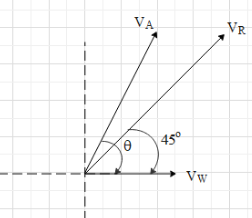
Here, ${{V}_{A}}$ is the airspeed of the plane, ${{V}_{W}}$ is the velocity of the wind and ${{V}_{R}}$ is the resultant velocity of the plane.
Since ${{V}_{R}}$ is resultant of ${{V}_{A}}$ and ${{V}_{W}}$, the vertical component of the ${{V}_{R}}$ is equal to sum of the vertical components of the ${{V}_{A}}$ and ${{V}_{W}}$.
i.e. $\dfrac{{{V}_{R}}}{\sqrt{2}}={{V}_{A}}\sin \theta $ .…. (i)
And the horizontal component of ${{V}_{R}}$ is equal to sum of the horizontal components of the ${{V}_{A}}$ and ${{V}_{W}}$.
i.e. $\dfrac{{{V}_{R}}}{\sqrt{2}}={{V}_{A}}\cos \theta +{{V}_{W}}$ ….. (ii).
Now, equate (i) and (ii).
$\Rightarrow {{V}_{A}}\sin \theta ={{V}_{A}}\cos \theta +{{V}_{W}}$
$\Rightarrow {{V}_{A}}\sin \theta -{{V}_{A}}\cos \theta ={{V}_{W}}$
Substitute ${{V}_{A}}=400km{{h}^{-1}}$ and ${{V}_{W}}=200km{{h}^{-1}}$.
$\Rightarrow 400\sin \theta -400\cos \theta =200$
$\Rightarrow \sin \theta -\cos \theta =\dfrac{1}{2}$
Divide the equation by $\cos {{45}^{\circ }}=\dfrac{1}{\sqrt{2}}$.
$\Rightarrow \sin \theta \cos {{45}^{\circ }}-\cos \theta \cos {{45}^{\circ }}=\dfrac{1}{2\sqrt{2}}$
But from trigonometry we know that,
$\sin \theta \cos {{45}^{\circ }}-\cos \theta \cos {{45}^{\circ }}=\sin (\theta -{{45}^{\circ }})$.
Then,
$\Rightarrow \sin (\theta -{{45}^{\circ }})=\dfrac{1}{2\sqrt{2}}$
$\Rightarrow \theta -{{45}^{\circ }}={{\sin }^{-1}}\dfrac{1}{2\sqrt{2}}$
$\Rightarrow \theta -{{45}^{\circ }}={{20.7}^{\circ }}$
$\therefore \theta ={{20.7}^{\circ }}+{{45}^{\circ }}={{65.7}^{\circ }}$
Therefore, in order to fly the plane towards north-east, the pilot must try to fly the plane in the direction that makes an angle of ${{65.7}^{\circ }}$ with a positive x-axis.
Note: In order to solve direction problems students may be confused in direction. So always remember below chart
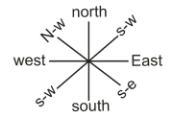
And always assume all distances to be along straight lines and between specified points each main direction changes north to west /east, it will be $90{}^\circ $change but the change between north and north east is only $45{}^\circ $.
Complete step by step answer:
When an airplane flies in presence of a wind, the speed and direction of the wind affects the motion of the plane. The wind may either assist the motion of the plane or oppose the motion of the plane depending upon the speed and direction of the wind.In this case, the wind is blowing with a speed of $200km{{h}^{-1}}$ towards east. This will increase the speed of the plane by $200km{{h}^{-1}}$ towards east. Let the initial direction of the plane be making an angle $\theta $ with horizontal and the plane will move with a speed of $400km{{h}^{-1}}$. Due to this the resultant velocity of the plane will be equal to the vector sum of the airspeed of the plane and the velocity of the wind, as shown in the figure.
Here, ${{V}_{A}}$ is the airspeed of the plane, ${{V}_{W}}$ is the velocity of the wind and ${{V}_{R}}$ is the resultant velocity of the plane.
Since ${{V}_{R}}$ is resultant of ${{V}_{A}}$ and ${{V}_{W}}$, the vertical component of the ${{V}_{R}}$ is equal to sum of the vertical components of the ${{V}_{A}}$ and ${{V}_{W}}$.
i.e. $\dfrac{{{V}_{R}}}{\sqrt{2}}={{V}_{A}}\sin \theta $ .…. (i)
And the horizontal component of ${{V}_{R}}$ is equal to sum of the horizontal components of the ${{V}_{A}}$ and ${{V}_{W}}$.
i.e. $\dfrac{{{V}_{R}}}{\sqrt{2}}={{V}_{A}}\cos \theta +{{V}_{W}}$ ….. (ii).
Now, equate (i) and (ii).
$\Rightarrow {{V}_{A}}\sin \theta ={{V}_{A}}\cos \theta +{{V}_{W}}$
$\Rightarrow {{V}_{A}}\sin \theta -{{V}_{A}}\cos \theta ={{V}_{W}}$
Substitute ${{V}_{A}}=400km{{h}^{-1}}$ and ${{V}_{W}}=200km{{h}^{-1}}$.
$\Rightarrow 400\sin \theta -400\cos \theta =200$
$\Rightarrow \sin \theta -\cos \theta =\dfrac{1}{2}$
Divide the equation by $\cos {{45}^{\circ }}=\dfrac{1}{\sqrt{2}}$.
$\Rightarrow \sin \theta \cos {{45}^{\circ }}-\cos \theta \cos {{45}^{\circ }}=\dfrac{1}{2\sqrt{2}}$
But from trigonometry we know that,
$\sin \theta \cos {{45}^{\circ }}-\cos \theta \cos {{45}^{\circ }}=\sin (\theta -{{45}^{\circ }})$.
Then,
$\Rightarrow \sin (\theta -{{45}^{\circ }})=\dfrac{1}{2\sqrt{2}}$
$\Rightarrow \theta -{{45}^{\circ }}={{\sin }^{-1}}\dfrac{1}{2\sqrt{2}}$
$\Rightarrow \theta -{{45}^{\circ }}={{20.7}^{\circ }}$
$\therefore \theta ={{20.7}^{\circ }}+{{45}^{\circ }}={{65.7}^{\circ }}$
Therefore, in order to fly the plane towards north-east, the pilot must try to fly the plane in the direction that makes an angle of ${{65.7}^{\circ }}$ with a positive x-axis.
Note: In order to solve direction problems students may be confused in direction. So always remember below chart
And always assume all distances to be along straight lines and between specified points each main direction changes north to west /east, it will be $90{}^\circ $change but the change between north and north east is only $45{}^\circ $.
Recently Updated Pages
Master Class 11 Social Science: Engaging Questions & Answers for Success

Master Class 11 Physics: Engaging Questions & Answers for Success
Master Class 11 Maths: Engaging Questions & Answers for Success
Master Class 11 Economics: Engaging Questions & Answers for Success
Master Class 11 Computer Science: Engaging Questions & Answers for Success
Master Class 11 Chemistry: Engaging Questions & Answers for Success
Trending doubts
One Metric ton is equal to kg A 10000 B 1000 C 100 class 11 physics CBSE
There are 720 permutations of the digits 1 2 3 4 5 class 11 maths CBSE
1 Quintal is equal to a 110 kg b 10 kg c 100kg d 1000 class 11 physics CBSE
State and prove Bernoullis theorem class 11 physics CBSE
Difference Between Prokaryotic Cells and Eukaryotic Cells
Which among the following are examples of coming together class 11 social science CBSE