




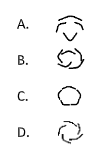
Aestivation in petals in flower of cotton is correctly shown in-
Answer
 Verified
613.2k+ views
Hint:The positional arrangement of whorls of a flower within a flower bud even before it has blossomed is called aestivation. Aestivation is also known as prefoliation or praefoliation, these terms can also be defined as vernation, which is the arrangement of leaves within a vegetative bud.
Complete answer:
Aestivation is considered important from a view of taxonomic diagnosis. Let’s take an example of Malvaceae flower buds, members of malvaceae have their sepals arranged in valvate manner, but there is an exception in general Fremontodendron and Chiranthodendron, which sometimes have misplaced arrangement.
The aestivation in different flowers is classified as-
>Twisted Aestivation- in twisted aestivation, one margin of petal or sepal overlaps the margin of the next one. Example- China rose.
>Valvate Aestivation- in valvate aestivation, sepals or petals are arranged in a whorl in a way that they touch the margin of one another. Example- Calotropis.
>Imbricate Aestivation- Margin of petal or sepal overlaps in a particular manner as in Gulmohar.
>Vexillary Aestivation- five petals are arranged into a large standard petal or vexillum, overlapping two lateral petals known as wings which in turn overlap the smallest anterior petals called keel. This is the characteristic feature of the Papilionaceae family. Example- garden pea.
>Quincuncial Aestivation- in this, the petals are arranged in such a manner that two petals lie completely out of the whorl and two completely inside while one is half out and half in. Example- Ranunculus.
The cotton plant has twisted aestivation.
Hence the correct answer is option ‘D’.
Note:Mode of arrangement of petals and sepals in a bud with respect to other members of the same whorl is known as aestivation. In the options of the questions, A. is vexillary, B is imbricate, C is valvate and D is twisted.
Complete answer:
Aestivation is considered important from a view of taxonomic diagnosis. Let’s take an example of Malvaceae flower buds, members of malvaceae have their sepals arranged in valvate manner, but there is an exception in general Fremontodendron and Chiranthodendron, which sometimes have misplaced arrangement.
The aestivation in different flowers is classified as-
>Twisted Aestivation- in twisted aestivation, one margin of petal or sepal overlaps the margin of the next one. Example- China rose.
>Valvate Aestivation- in valvate aestivation, sepals or petals are arranged in a whorl in a way that they touch the margin of one another. Example- Calotropis.
>Imbricate Aestivation- Margin of petal or sepal overlaps in a particular manner as in Gulmohar.
>Vexillary Aestivation- five petals are arranged into a large standard petal or vexillum, overlapping two lateral petals known as wings which in turn overlap the smallest anterior petals called keel. This is the characteristic feature of the Papilionaceae family. Example- garden pea.
>Quincuncial Aestivation- in this, the petals are arranged in such a manner that two petals lie completely out of the whorl and two completely inside while one is half out and half in. Example- Ranunculus.
The cotton plant has twisted aestivation.
Hence the correct answer is option ‘D’.
Note:Mode of arrangement of petals and sepals in a bud with respect to other members of the same whorl is known as aestivation. In the options of the questions, A. is vexillary, B is imbricate, C is valvate and D is twisted.
Recently Updated Pages
Master Class 12 Economics: Engaging Questions & Answers for Success

Master Class 12 English: Engaging Questions & Answers for Success
Master Class 12 Social Science: Engaging Questions & Answers for Success
Master Class 12 Maths: Engaging Questions & Answers for Success
Master Class 12 Physics: Engaging Questions & Answers for Success
Master Class 9 General Knowledge: Engaging Questions & Answers for Success
Trending doubts
One Metric ton is equal to kg A 10000 B 1000 C 100 class 11 physics CBSE
Difference Between Prokaryotic Cells and Eukaryotic Cells
Two of the body parts which do not appear in MRI are class 11 biology CBSE
Find the value of the expression given below sin 30circ class 11 maths CBSE
1 ton equals to A 100 kg B 1000 kg C 10 kg D 10000 class 11 physics CBSE
Draw a diagram of nephron and explain its structur class 11 biology CBSE