




Adjacent sides of a parallelogram are \[11cm\] and \[17cm\] . If the length of one of its diagonals is \[26cm\] , find the length of the other.
Answer
 Verified
555.6k+ views
Hint: A parallelogram has two diagonals joining two opposite corners. In the given question, we are given the length of one diagonal and have to find the length of the other. We can solve the question by using Apollonius Theorem.
Complete step-by-step answer:
Let us draw a diagram for better understanding:
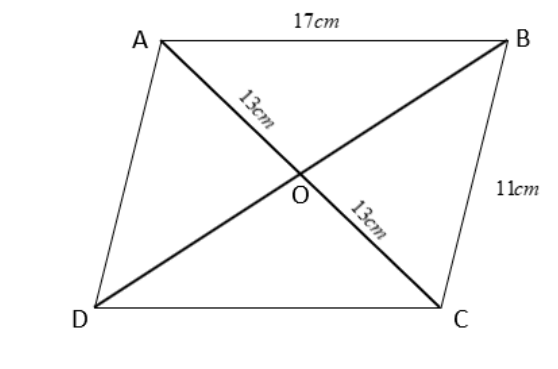
We draw with \[AB = 17cm\] , \[BC = 11cm\] and diagonal \[AC = 26cm\] . We have to find the length of diagonal \[BD\] .
Let the diagonals bisect each other at point \[O\] .
We know that diagonal of a parallelogram bisects each other at a point which divides it into two equal parts.
Hence, we can say that:
\[AO = OC = \dfrac{1}{2}AC\]
\[AO = \dfrac{1}{2}(26) = 13cm\]
Similarly, \[BO = OD = \dfrac{1}{2}BD\]
Now in \[\vartriangle ABC\] , \[\overline {BO} \] is the median as it divides \[\overline {AB} \] in two equal parts.
Now to find the length of \[\overline {BO} \] , we can use Apollonius Theorem.
Apollonius Theorem states that “the sum of squares of any of the two sides of a triangle equals to twice its square on half of the third side, along with the twice of its square on the median bisecting the third side”
Using the above theorem, we can conclude that, in \[\vartriangle ABC\] ,
\[A{B^2} + B{C^2} = 2{(BO)^2} + 2{(AO)^2}\]
Substituting the values by comparing with above formula, we get,
\[{(17)^2} + {(11)^2} = 2{(BO)^2} + 2{(13)^2}\]
\[289 + 121 = 2{(BO)^2} + 2(169)\]
\[289 + 121 = 2{(BO)^2} + 338\]
\[2{(BO)^2} = 289 + 121 - 338\]
\[2{(BO)^2} = 72\]
\[B{O^2} = \dfrac{{72}}{2} = 36\]
Taking square root, we get,
\[BO = \sqrt {36} \]
\[BO = 6cm\]
Now to find the length of diagonal \[\overline {BD} \] , we use the following formula:
\[BD = BO + OD = BO + BO = 2BO\]
\[BO\] and \[OD\] are equal since \[O\] is a point of intersection of two diagonals.
\[BD = 2(6)\]
\[BD = 12cm\]
Hence the length of the other diagonal is \[12cm\] .
So, the correct answer is “ \[12\;cm\] ”.
Note: A simple quadrilateral with two pairs of parallel sides is known as a parallelogram. A parallelogram's opposite or facing sides are of equal length, and the parallelogram's opposite angles are of equal measure.
Complete step-by-step answer:
Let us draw a diagram for better understanding:
We draw with \[AB = 17cm\] , \[BC = 11cm\] and diagonal \[AC = 26cm\] . We have to find the length of diagonal \[BD\] .
Let the diagonals bisect each other at point \[O\] .
We know that diagonal of a parallelogram bisects each other at a point which divides it into two equal parts.
Hence, we can say that:
\[AO = OC = \dfrac{1}{2}AC\]
\[AO = \dfrac{1}{2}(26) = 13cm\]
Similarly, \[BO = OD = \dfrac{1}{2}BD\]
Now in \[\vartriangle ABC\] , \[\overline {BO} \] is the median as it divides \[\overline {AB} \] in two equal parts.
Now to find the length of \[\overline {BO} \] , we can use Apollonius Theorem.
Apollonius Theorem states that “the sum of squares of any of the two sides of a triangle equals to twice its square on half of the third side, along with the twice of its square on the median bisecting the third side”
Using the above theorem, we can conclude that, in \[\vartriangle ABC\] ,
\[A{B^2} + B{C^2} = 2{(BO)^2} + 2{(AO)^2}\]
Substituting the values by comparing with above formula, we get,
\[{(17)^2} + {(11)^2} = 2{(BO)^2} + 2{(13)^2}\]
\[289 + 121 = 2{(BO)^2} + 2(169)\]
\[289 + 121 = 2{(BO)^2} + 338\]
\[2{(BO)^2} = 289 + 121 - 338\]
\[2{(BO)^2} = 72\]
\[B{O^2} = \dfrac{{72}}{2} = 36\]
Taking square root, we get,
\[BO = \sqrt {36} \]
\[BO = 6cm\]
Now to find the length of diagonal \[\overline {BD} \] , we use the following formula:
\[BD = BO + OD = BO + BO = 2BO\]
\[BO\] and \[OD\] are equal since \[O\] is a point of intersection of two diagonals.
\[BD = 2(6)\]
\[BD = 12cm\]
Hence the length of the other diagonal is \[12cm\] .
So, the correct answer is “ \[12\;cm\] ”.
Note: A simple quadrilateral with two pairs of parallel sides is known as a parallelogram. A parallelogram's opposite or facing sides are of equal length, and the parallelogram's opposite angles are of equal measure.

Recently Updated Pages
Master Class 8 English: Engaging Questions & Answers for Success

Master Class 8 Science: Engaging Questions & Answers for Success
Master Class 8 Maths: Engaging Questions & Answers for Success
Class 8 Question and Answer - Your Ultimate Solutions Guide
Master Class 8 Social Science: Engaging Questions & Answers for Success
Master Class 12 Economics: Engaging Questions & Answers for Success
Trending doubts
What is BLO What is the full form of BLO class 8 social science CBSE
Citizens of India can vote at the age of A 18 years class 8 social science CBSE
Right to vote is a AFundamental Right BFundamental class 8 social science CBSE
Give me the opposite gender of Duck class 8 english CBSE
Full form of STD, ISD and PCO
Explain land use pattern in India and why has the land class 8 social science CBSE