




a)Distinguish between pollination and fertilization.
b)Mention the site and product of fertilisation in the flower.
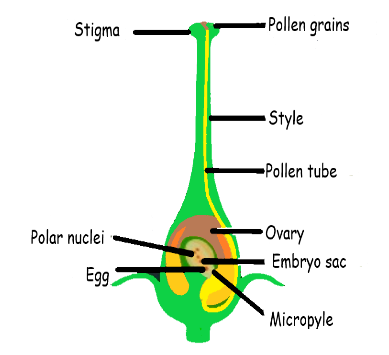
c)Draw a neat diagram of pistil showing pollen tube growth and its entry into ovule.
Answer
 Verified
586.8k+ views
Hint: Pollination and fertilization occurs in plants during sexual reproduction. They are the two main and natural processes for producing offspring. Both processes occur in all bisexual flowers, in which both male and female reproductive structures (anther and stigma) are involved. Therefore, flowers are considered to be the reproductive organs of all flowering plants.
Complete answer:
a)
b)The fertilization site is ovule/ovary
A zygote is the product of fertilization.
(C)In flowers, the pollen grain germinates after the carpel is pollinated and grows into a style by creating a pathway for the pollen grain to move down to the ovary.
The tube of pollen opens through the micropyle into the ovule and bursts into the embryo bag. Here, the male nucleus unites with the nucleus of the egg inside the ovule forming a diploid zygote, which later swells and develops into a fruit.
Note: Double fertilization is a fertilization process characterized by the fusion of a female gametophyte with two male gametes. In this mechanism, one sperm cell fuses with the egg-producing zygote, and the other fuses with the two polar nuclei to make the endosperm. All angiosperm plants undergo double fertilization.
Complete answer:
a)
| Pollination | Fertilisation |
| It is an external process | It can either be external or internal |
| It takes place before fertilisation | It takes place after pollination |
| It is a physical process | It is genetic and biochemical process |
| Pollination occurs from stamen anthers to ovarian stigma. | It's a fusion of female and male gametes. |
| The pollinants are wind, water, birds, insects, and other animals | Fertilization is carried out by the growing pollen tube which enters the ovule |
| External factors are needed. | External factors are not necessary. |
| This process is leading to fertilization. | This process is leading to the formation of seeds. |
| Pollen tube is not required | Pollen tubes are formed for the transfer of male gametes to the egg cell. |
| Pollination occurs in flowering plants only. | Fertilization is followed by almost every living being on the planet Earth, including plants, animals, birds, insects, humans, etc. |
b)The fertilization site is ovule/ovary
A zygote is the product of fertilization.
(C)In flowers, the pollen grain germinates after the carpel is pollinated and grows into a style by creating a pathway for the pollen grain to move down to the ovary.
The tube of pollen opens through the micropyle into the ovule and bursts into the embryo bag. Here, the male nucleus unites with the nucleus of the egg inside the ovule forming a diploid zygote, which later swells and develops into a fruit.
Note: Double fertilization is a fertilization process characterized by the fusion of a female gametophyte with two male gametes. In this mechanism, one sperm cell fuses with the egg-producing zygote, and the other fuses with the two polar nuclei to make the endosperm. All angiosperm plants undergo double fertilization.
Recently Updated Pages
Master Class 12 Business Studies: Engaging Questions & Answers for Success

Master Class 12 Chemistry: Engaging Questions & Answers for Success
Master Class 12 Biology: Engaging Questions & Answers for Success
Class 12 Question and Answer - Your Ultimate Solutions Guide
Master Class 11 English: Engaging Questions & Answers for Success
Master Class 11 Social Science: Engaging Questions & Answers for Success
Trending doubts
Which are the Top 10 Largest Countries of the World?
Draw a labelled sketch of the human eye class 12 physics CBSE
The end of compass needle which points towards north class 12 physics CBSE
Differentiate between homogeneous and heterogeneous class 12 chemistry CBSE
Why is the cell called the structural and functional class 12 biology CBSE
When was the first election held in India a 194748 class 12 sst CBSE