




Addition of excess potassium iodide solution to a solution of mercuric chloride gives the halide complex:
A.Tetrahedral\[{{K}_{2}}[Hg{{I}_{4}}]\]
B.Trigonal\[{{K}_{2}}[Hg{{I}_{3}}]\]
C.Linear\[H{{g}_{2}}{{I}_{2}}\]
D.Square planar\[{{K}_{2}}[HgC{{l}_{2}}{{I}_{2}}]\]
Answer
 Verified
667.2k+ views
Hint:
To solve this question, first write the equation for the reaction. The given equation is an example of double displacement reaction. Then, through electronic configuration of the central atom of the complex, decipher the geometry.
Complete step by step answer:
Let us write the equation for the reaction given in the question.
According to the question, mercuric chloride reacts with excess potassium iodide solution to give a halide complex. Therefore,
\[HgC{{l}_{2}}+4KI\to {{K}_{2}}[Hg{{I}_{4}}]+2KCl\]
So, the halide complex formed is Potassium mercuric iodide - \[{{K}_{2}}[Hg{{I}_{4}}]\]. This is an example of double displacement reaction.
Now, let us use the geometry of the complex.
Mercury is the central compound of the complex. The electronic configuration of Hg is –
\[Hg=[Xe]4{{f}^{14}}5{{d}^{10}}6{{s}^{2}}\]
In the complex, mercury has an oxidation state of +2.
\[H{{g}^{2+}}=[Xe]4{{f}^{14}}5{{d}^{10}}6{{s}^{0}}\]
It therefore has orbitals 6s and 6p for bonding.
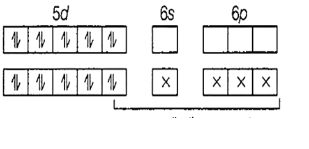
Since bonding takes place through 1 s-orbital and 3-p orbitals, the hybridization of the compound is \[s{{p}^{3}}\]. All \[s{{p}^{3}}\]hybridized compounds have a tetrahedral geometry.
Therefore, the answer is – option (a).
Additional Information: The IUPAC name of the halide formed is Potassium tetraiodomercurate(II).
Note:
The hybridization and geometry of any compound can be related as –
To solve this question, first write the equation for the reaction. The given equation is an example of double displacement reaction. Then, through electronic configuration of the central atom of the complex, decipher the geometry.
Complete step by step answer:
Let us write the equation for the reaction given in the question.
According to the question, mercuric chloride reacts with excess potassium iodide solution to give a halide complex. Therefore,
\[HgC{{l}_{2}}+4KI\to {{K}_{2}}[Hg{{I}_{4}}]+2KCl\]
So, the halide complex formed is Potassium mercuric iodide - \[{{K}_{2}}[Hg{{I}_{4}}]\]. This is an example of double displacement reaction.
Now, let us use the geometry of the complex.
Mercury is the central compound of the complex. The electronic configuration of Hg is –
\[Hg=[Xe]4{{f}^{14}}5{{d}^{10}}6{{s}^{2}}\]
In the complex, mercury has an oxidation state of +2.
\[H{{g}^{2+}}=[Xe]4{{f}^{14}}5{{d}^{10}}6{{s}^{0}}\]
It therefore has orbitals 6s and 6p for bonding.
Since bonding takes place through 1 s-orbital and 3-p orbitals, the hybridization of the compound is \[s{{p}^{3}}\]. All \[s{{p}^{3}}\]hybridized compounds have a tetrahedral geometry.
Therefore, the answer is – option (a).
Additional Information: The IUPAC name of the halide formed is Potassium tetraiodomercurate(II).
Note:
The hybridization and geometry of any compound can be related as –
| Hybridization | Geometry |
| \[sp\] | Linear |
| \[s{{p}^{2}}\] | Trigonal planar |
| \[s{{p}^{3}}\] | Tetrahedral |
| \[s{{p}^{3}}d\] | Trigonal bipyramidal |
| \[s{{p}^{3}}{{d}^{2}}\] | Octahedral |
| \[s{{p}^{3}}{{d}^{3}}\] | Pentagonal bipyramidal |
Recently Updated Pages
Which of the following graphs shows the variation of class 12 physics CBSE

Draw a labelled diagram of the human male reproductive class 12 biology CBSE
Describe the experiment to compare the emf of two cells class 12 physics CBSE
What is standard hydrogen electrode
What is conventional current and electric current class 12 physics CBSE
2Bromopentane is treated with an alcoholic KOH solution class 12 chemistry CBSE
Trending doubts
Draw a labelled sketch of the human eye class 12 physics CBSE
Which are the Top 10 Largest Countries of the World?
A member of Simon commission later became Prime Minister class 12 social science CBSE
Draw ray diagrams each showing i myopic eye and ii class 12 physics CBSE
Give one example of a reptile that is viviparous class 12 biology CBSE
Which is the correct genotypic ratio of mendel dihybrid class 12 biology CBSE