




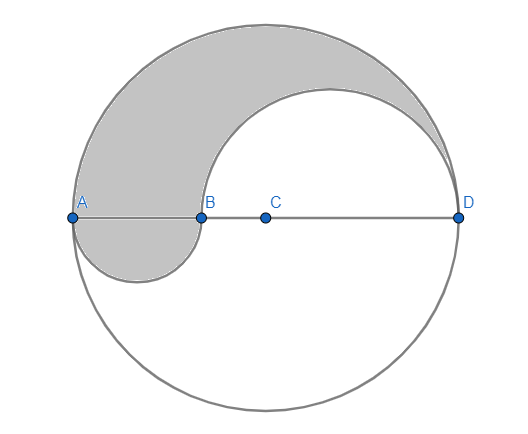
AD is the diameter of a circle of radius 6cm, and AB=BC=CD. Semi-circles are drawn with AB and BD as diameter as shown in the figure. Find the perimeter and area of the shaded region.
Answer
 Verified
550.7k+ views
Hint: Use the area and perimeter of the semicircle with the radius as AC and subtract or add the other parts to it according to the need to reach the answer.
Complete step-by-step answer:
In the question, it is given in the question that AB=BC=CD, and also we know AD is the diameter and the length of AD is twice the radius i.e., 12cm.
Therefore AB=BC=CD= $\dfrac{1}{3}\times AD=4cm$ .
Now moving to find the perimeter of the shaded region. As we can see in the figure that the perimeter of the shaded region is the length of the semi-circular arc AD added with the length of the semi-circular arc AB and the length of the semi-circular arc BD.
We know that the length of the semicircular arc is $\pi r$ , where r is the radius. Therefore, we get
Perimeter= $\pi \dfrac{\left( AB \right)}{2}+\pi \dfrac{\left( BD \right)}{2}+\pi \dfrac{\left( AD \right)}{2}=\pi \left( 2+4+6 \right)=12\pi \text{ cm}$
Therefore, the perimeter of the shaded region is $12\pi \text{ cm}$ .
Now moving to find the area of the shaded region. As we can see in the figure, the area of the shaded region is the area of semi-circular part AD minus the area of semi-circular part BD plus the area of semi-circular part AB.
We know that the area of the semicircular arc is $\dfrac{\pi {{r}^{2}}}{2}$ , where r is the radius. Therefore, we get
Area= \[\dfrac{\pi }{2}{{\left( \dfrac{AB}{2} \right)}^{2}}-\dfrac{\pi }{2}{{\left( \dfrac{BD}{2} \right)}^{2}}+\dfrac{\pi }{2}{{\left( \dfrac{AD}{2} \right)}^{2}}\]
Area= \[\dfrac{\pi }{2}\left( {{2}^{2}}-{{4}^{2}}+{{6}^{2}} \right)=\dfrac{\pi }{2}\left( 4-16+36 \right)=\dfrac{\pi }{2}\times 24=12\pi \text{ c}{{\text{m}}^{2}}\]
Therefore, the area of the shaded region is $12\pi \text{ c}{{\text{m}}^{2}}$.
Note: It is prescribed to learn all the basic theorems related to circles as they are regularly used in the questions related to circles and triangles, as we did in the above question. Also, learn all the formulas related to the area and perimeter of the circle.
Complete step-by-step answer:
In the question, it is given in the question that AB=BC=CD, and also we know AD is the diameter and the length of AD is twice the radius i.e., 12cm.
Therefore AB=BC=CD= $\dfrac{1}{3}\times AD=4cm$ .
Now moving to find the perimeter of the shaded region. As we can see in the figure that the perimeter of the shaded region is the length of the semi-circular arc AD added with the length of the semi-circular arc AB and the length of the semi-circular arc BD.
We know that the length of the semicircular arc is $\pi r$ , where r is the radius. Therefore, we get
Perimeter= $\pi \dfrac{\left( AB \right)}{2}+\pi \dfrac{\left( BD \right)}{2}+\pi \dfrac{\left( AD \right)}{2}=\pi \left( 2+4+6 \right)=12\pi \text{ cm}$
Therefore, the perimeter of the shaded region is $12\pi \text{ cm}$ .
Now moving to find the area of the shaded region. As we can see in the figure, the area of the shaded region is the area of semi-circular part AD minus the area of semi-circular part BD plus the area of semi-circular part AB.
We know that the area of the semicircular arc is $\dfrac{\pi {{r}^{2}}}{2}$ , where r is the radius. Therefore, we get
Area= \[\dfrac{\pi }{2}{{\left( \dfrac{AB}{2} \right)}^{2}}-\dfrac{\pi }{2}{{\left( \dfrac{BD}{2} \right)}^{2}}+\dfrac{\pi }{2}{{\left( \dfrac{AD}{2} \right)}^{2}}\]
Area= \[\dfrac{\pi }{2}\left( {{2}^{2}}-{{4}^{2}}+{{6}^{2}} \right)=\dfrac{\pi }{2}\left( 4-16+36 \right)=\dfrac{\pi }{2}\times 24=12\pi \text{ c}{{\text{m}}^{2}}\]
Therefore, the area of the shaded region is $12\pi \text{ c}{{\text{m}}^{2}}$.
Note: It is prescribed to learn all the basic theorems related to circles as they are regularly used in the questions related to circles and triangles, as we did in the above question. Also, learn all the formulas related to the area and perimeter of the circle.
Recently Updated Pages
Master Class 12 Economics: Engaging Questions & Answers for Success

Master Class 12 English: Engaging Questions & Answers for Success
Master Class 12 Social Science: Engaging Questions & Answers for Success
Master Class 12 Maths: Engaging Questions & Answers for Success
Master Class 12 Physics: Engaging Questions & Answers for Success
Master Class 9 General Knowledge: Engaging Questions & Answers for Success
Trending doubts
Explain the Treaty of Vienna of 1815 class 10 social science CBSE
Who Won 36 Oscar Awards? Record Holder Revealed
What is the median of the first 10 natural numbers class 10 maths CBSE
Why is it 530 pm in india when it is 1200 afternoon class 10 social science CBSE
Make a sketch of the human nerve cell What function class 10 biology CBSE
Define Potential, Developed, Stock and Reserved resources