




Action and reaction forces never balance out because
A. they are equal but not opposite always
B. they are unequal in magnitude even though opposite in direction
C. they act on different bodies
D. they are unequal in magnitude
Answer
 Verified
602.4k+ views
Hint: Action and reaction forces arise from Newton’s Third Law which states that every action has an equal and opposite reaction. These are contact forces i.e., only arise when the bodies are in contact with each other. Closer examination of Newton’s third law can give us an idea about why they never balance out.
Formula used:
${F_{12}} = - {F_{21}}$
Complete answer:
Newton’s 3rd law states that- “For every action, there is an equal and opposite reaction”. There’s a little ambiguity here in Newton’s third law. So, let us put it in another way which is more elaborate and has the same meaning.
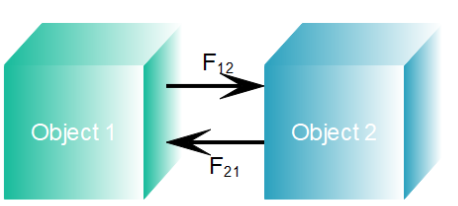
“Forces always occur in pairs. If object 1 exerts a force F on object 2, then object 2 exerts an equal and opposite force –F on object 1, simultaneously in a straight line.” i.e.,
${F_{12}} = - {F_{21}}$
Where:
${F_{12}}$ is the force applied by object 1 on object 2
${F_{21}}$ is the force applied by the object 2 on object 1
‘−‘ indicates the opposition or the opposite direction of ${F_{21}}$.
Clearly, object 1 is exerting force on object 2 and vice-versa. They’re acting on two completely different objects. So, they’ll never cancel each other out.
Therefore the correct option is C.
Note:
If you consider rocket propulsion, the exhaust gases are released to create an action force. And as a reaction, thrust force acts on the rocket. If the forces were equal the rocket would not move forward. The same applies to the rowing of the boat. When someone paddles a boat in the backward direction, they apply force on the water, in return water pushes the boat.
Formula used:
${F_{12}} = - {F_{21}}$
Complete answer:
Newton’s 3rd law states that- “For every action, there is an equal and opposite reaction”. There’s a little ambiguity here in Newton’s third law. So, let us put it in another way which is more elaborate and has the same meaning.
“Forces always occur in pairs. If object 1 exerts a force F on object 2, then object 2 exerts an equal and opposite force –F on object 1, simultaneously in a straight line.” i.e.,
${F_{12}} = - {F_{21}}$
Where:
${F_{12}}$ is the force applied by object 1 on object 2
${F_{21}}$ is the force applied by the object 2 on object 1
‘−‘ indicates the opposition or the opposite direction of ${F_{21}}$.
Clearly, object 1 is exerting force on object 2 and vice-versa. They’re acting on two completely different objects. So, they’ll never cancel each other out.
Therefore the correct option is C.
Note:
If you consider rocket propulsion, the exhaust gases are released to create an action force. And as a reaction, thrust force acts on the rocket. If the forces were equal the rocket would not move forward. The same applies to the rowing of the boat. When someone paddles a boat in the backward direction, they apply force on the water, in return water pushes the boat.
Recently Updated Pages
Master Class 11 Social Science: Engaging Questions & Answers for Success

Master Class 11 Physics: Engaging Questions & Answers for Success
Master Class 11 Maths: Engaging Questions & Answers for Success
Master Class 11 Economics: Engaging Questions & Answers for Success
Master Class 11 Computer Science: Engaging Questions & Answers for Success
Master Class 11 Chemistry: Engaging Questions & Answers for Success
Trending doubts
One Metric ton is equal to kg A 10000 B 1000 C 100 class 11 physics CBSE
There are 720 permutations of the digits 1 2 3 4 5 class 11 maths CBSE
1 Quintal is equal to a 110 kg b 10 kg c 100kg d 1000 class 11 physics CBSE
State and prove Bernoullis theorem class 11 physics CBSE
Difference Between Prokaryotic Cells and Eukaryotic Cells
Which among the following are examples of coming together class 11 social science CBSE