



Action and Reaction:
A. Acts on two different objects
B. Have equal magnitude
C. Have opposite direction
D. Have resultant zero
Answer
 Verified
625.2k+ views
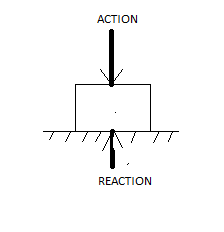
Hint: A force always acts in pairs and in the opposite direction. When an object is pushed to a stationary body, it applies a force to a body, which is called action force, and the body also exerts a force to the object, which is a reaction force on the object.
Complete step by step answer:
Newton's law of motion is three physical laws that together laid the foundation for classical mechanics. Newton's laws relate an object's motion to the forces acting on it.
First law: Newton's first law states that every object will remain at rest or in uniform motion in a straight line unless compelled to change its state by the action of an external force.
Second law: Newton's second law states that when a force F of 1 Newton is applied to a body of mass 1 kilogram, then acceleration will cause that will bring that body into motion, F=ma.
Third law: The third law, also known as the law of action and reaction, states that for every action, there is an equal and opposite reaction. Action and reaction are reciprocal to each other; the greater the force of action is greater will be the reaction force. Action and reaction occurs on two different bodies with equal magnitudes in the opposite direction and thus, have resultant force acts as zero.
So, the correct answers are “Option A,B,C,D”.
Note:
Newton’s third law of motion is applicable in our daily life schedules also, such as when we walk on the road then, we push the road so that road/ground pushes our feet upwards and so we are able to move. For Newton's third law to be applicable, friction acts as a very supportive force.
Complete step by step answer:
Newton's law of motion is three physical laws that together laid the foundation for classical mechanics. Newton's laws relate an object's motion to the forces acting on it.
First law: Newton's first law states that every object will remain at rest or in uniform motion in a straight line unless compelled to change its state by the action of an external force.
Second law: Newton's second law states that when a force F of 1 Newton is applied to a body of mass 1 kilogram, then acceleration will cause that will bring that body into motion, F=ma.
Third law: The third law, also known as the law of action and reaction, states that for every action, there is an equal and opposite reaction. Action and reaction are reciprocal to each other; the greater the force of action is greater will be the reaction force. Action and reaction occurs on two different bodies with equal magnitudes in the opposite direction and thus, have resultant force acts as zero.
So, the correct answers are “Option A,B,C,D”.
Note:
Newton’s third law of motion is applicable in our daily life schedules also, such as when we walk on the road then, we push the road so that road/ground pushes our feet upwards and so we are able to move. For Newton's third law to be applicable, friction acts as a very supportive force.
Recently Updated Pages
Master Class 11 English: Engaging Questions & Answers for Success

Master Class 11 Social Science: Engaging Questions & Answers for Success
Master Class 11 Maths: Engaging Questions & Answers for Success
Master Class 11 Biology: Engaging Questions & Answers for Success
Master Class 11 Physics: Engaging Questions & Answers for Success
Master Class 11 Chemistry: Engaging Questions & Answers for Success
Trending doubts
One Metric ton is equal to kg A 10000 B 1000 C 100 class 11 physics CBSE
Difference Between Prokaryotic Cells and Eukaryotic Cells
Find the value of the expression given below sin 30circ class 11 maths CBSE
Difference between physical and chemical change class 11 chemistry CBSE
Two of the body parts which do not appear in MRI are class 11 biology CBSE
Draw a diagram of a plant cell and label at least eight class 11 biology CBSE