



Acid present in tamarind is:
(A) Lactic acid
(B) Citric acid
(C) Tartaric acid
(D) Acetic acid
Answer
 Verified
616.8k+ views
Hint :So, we know that tamarind is a hardwood tree which produces bean-like pods filled with seeds surrounded by fibrous pulp. The pulp of young fruit is green and sour. The sourness comes from the acid present in it. Also, tamarind is edible so it means that the acid present in it will be a weak acid.
Complete Step By Step Answer:
The acid present in tamarind is the tartaric acid. Tartaric acid is also known as dihydroxybutane-dioic acid. It is mainly found in fruits like grapes, bananas, tamarind etc. As its IUPAC name suggests, it will therefore be made up of four carbons, two alcoholic groups and two carboxylic acid groups attached to the carbon chain.
So, the molecular formula of Tartaric acid is: $ {C_4}{H_6}{O_6} $
The chemical formula will be as: $ {(CH(OH)COOH)_2} $
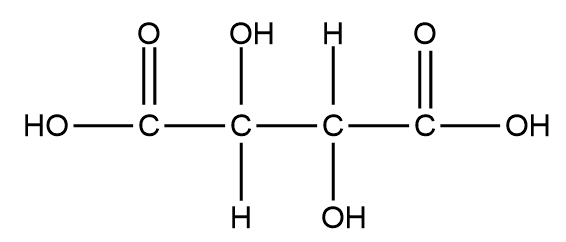
Therefore, the structural formula of Tartaric acid will be:
Some uses of tartaric acid:
It is readily soluble in water and is used in food industries due to its antioxidant property.
It is used for polishing metals, photographic printing, wool dyeing etc.
Cream of tartar is incorporated into baking powder, hard candies etc.
It is used as an acidulant in grape and lime-flavored beverages, gelatin desserts, jams, jellies etc.
Hence the correct answer is Option C. i.e., Tartaric acid.
Note :
Tartaric acid is a weak acid because it does not completely dissociate in the solution and also it has a $ pH $ of $ 3.5 $ . It dissociates into bitartrate and tartrate ions. Also, Tartaric acid is a chiral molecule and will thus form stereoisomers. Thus, tartaric acid forms three stereoisomers namely D-Tartaric acid, L-Tartaric acid and meso- Tartaric acid.
Complete Step By Step Answer:
The acid present in tamarind is the tartaric acid. Tartaric acid is also known as dihydroxybutane-dioic acid. It is mainly found in fruits like grapes, bananas, tamarind etc. As its IUPAC name suggests, it will therefore be made up of four carbons, two alcoholic groups and two carboxylic acid groups attached to the carbon chain.
So, the molecular formula of Tartaric acid is: $ {C_4}{H_6}{O_6} $
The chemical formula will be as: $ {(CH(OH)COOH)_2} $
Therefore, the structural formula of Tartaric acid will be:
Some uses of tartaric acid:
It is readily soluble in water and is used in food industries due to its antioxidant property.
It is used for polishing metals, photographic printing, wool dyeing etc.
Cream of tartar is incorporated into baking powder, hard candies etc.
It is used as an acidulant in grape and lime-flavored beverages, gelatin desserts, jams, jellies etc.
Hence the correct answer is Option C. i.e., Tartaric acid.
Note :
Tartaric acid is a weak acid because it does not completely dissociate in the solution and also it has a $ pH $ of $ 3.5 $ . It dissociates into bitartrate and tartrate ions. Also, Tartaric acid is a chiral molecule and will thus form stereoisomers. Thus, tartaric acid forms three stereoisomers namely D-Tartaric acid, L-Tartaric acid and meso- Tartaric acid.
Recently Updated Pages
Which will be the least stable resonating structure class 11 chemistry CBSE

How many 5 digit telephone numbers can be construc-class-11-maths-CBSE
How do you find the angle of the resultant vector class 11 physics CBSE
Draw labelled diagram of the following i Gram seed class 11 biology CBSE
1 Quintal is equal to a 110 kg b 10 kg c 100kg d 1000 class 11 physics CBSE
What is the need and importance of classification class 11 biology CBSE
Trending doubts
Find the value of the expression given below sin 30circ class 11 maths CBSE
One Metric ton is equal to kg A 10000 B 1000 C 100 class 11 physics CBSE
10 examples of friction in our daily life
Draw a diagram of a plant cell and label at least eight class 11 biology CBSE
Difference between physical and chemical change class 11 chemistry CBSE
Proton was discovered by A Thomson B Rutherford C Chadwick class 11 chemistry CBSE