




Account for the following:
A) The ${\text{C}} - {\text{Cl}}$ bond length in chlorobenzene is shorter than that in ${\text{C}}{{\text{H}}_3} - {\text{Cl}}$.
B) Chloroform is stored in closed dark brown bottles.
Answer
 Verified
602.4k+ views
Hint: The carbon atom of ${\text{C}} - {\text{Cl}}$ bond in chlorobenzene is $s{p^2}$ hybridised and the carbon atom of ${\text{C}} - {\text{Cl}}$ bond in methyl chloride is $s{p^3}$ hybridised. In the presence of light, chloroform $\left( {{\text{CHC}}{{\text{l}}_{\text{3}}}} \right)$ gets oxidised by air to form phosgene.
Complete step by step answer:
A) The structures of chlorobenzene and methyl chloride are as follows:
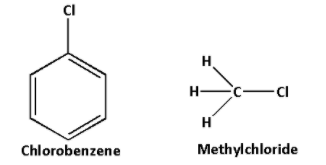
In chlorobenzene, the carbon atom of ${\text{C}} - {\text{Cl}}$ bond is attached to three groups. Thus, the carbon atom of ${\text{C}} - {\text{Cl}}$ bond in chlorobenzene forms three sigma bonds. Thus, the carbon atom of ${\text{C}} - {\text{Cl}}$ bond in chlorobenzene is $s{p^2}$ hybridised.
In methyl chloride, the carbon atom of ${\text{C}} - {\text{Cl}}$ bond is attached to four groups. Thus, the carbon atom of ${\text{C}} - {\text{Cl}}$ bond in methyl chloride forms four sigma bonds. Thus, the carbon atom of ${\text{C}} - {\text{Cl}}$ bond in methyl chloride is $s{p^3}$ hybridised.
In $s{p^2}$ hybrid orbitals, the s-character is more than that of in $s{p^3}$ hybrid orbitals. Thus, the $s{p^2}$ hybridised carbon atom withdraws the electron pair between the ${\text{C}} - {\text{Cl}}$ bond with greater force than that of $s{p^3}$ hybridised carbon atom.
Thus, the ${\text{C}} - {\text{Cl}}$ bond length in chlorobenzene is shorter than that in ${\text{C}}{{\text{H}}_3} - {\text{Cl}}$.
B) In the presence of light, chloroform $\left( {{\text{CHC}}{{\text{l}}_{\text{3}}}} \right)$ gets oxidised by air. This oxidation reaction of chloroform leads to formation of carbonyl chloride or phosgene $\left( {{\text{COC}}{{\text{l}}_{\text{2}}}} \right)$. Phosgene is extremely poisonous.
The reaction is as follows:
${\text{2CHC}}{{\text{l}}_{\text{3}}} + {{\text{O}}_{\text{2}}}\xrightarrow{{{\text{Sunlight}}}}{\text{2COC}}{{\text{l}}_{\text{2}}} + {\text{2HCl}}$
Thus, to avoid the formation of phosgene, chloroform is stored away from light and air.
In closed dark brown bottles, no light and air can enter. Thus, oxidation of chloroform to phosgene can be avoided.
Thus, chloroform is stored in closed dark brown bottles.
Note: Apart from $s{p^2}$ and $s{p^3}$ hybrid orbitals there is presence of $sp$ hybrid orbitals also in which contribution of s and p orbitals is the same. Phosgene is an organic compound that is highly poisonous colourless gas. Phosgene damages skin, eyes, nose, throat and lungs.
Complete step by step answer:
A) The structures of chlorobenzene and methyl chloride are as follows:
In chlorobenzene, the carbon atom of ${\text{C}} - {\text{Cl}}$ bond is attached to three groups. Thus, the carbon atom of ${\text{C}} - {\text{Cl}}$ bond in chlorobenzene forms three sigma bonds. Thus, the carbon atom of ${\text{C}} - {\text{Cl}}$ bond in chlorobenzene is $s{p^2}$ hybridised.
In methyl chloride, the carbon atom of ${\text{C}} - {\text{Cl}}$ bond is attached to four groups. Thus, the carbon atom of ${\text{C}} - {\text{Cl}}$ bond in methyl chloride forms four sigma bonds. Thus, the carbon atom of ${\text{C}} - {\text{Cl}}$ bond in methyl chloride is $s{p^3}$ hybridised.
In $s{p^2}$ hybrid orbitals, the s-character is more than that of in $s{p^3}$ hybrid orbitals. Thus, the $s{p^2}$ hybridised carbon atom withdraws the electron pair between the ${\text{C}} - {\text{Cl}}$ bond with greater force than that of $s{p^3}$ hybridised carbon atom.
Thus, the ${\text{C}} - {\text{Cl}}$ bond length in chlorobenzene is shorter than that in ${\text{C}}{{\text{H}}_3} - {\text{Cl}}$.
B) In the presence of light, chloroform $\left( {{\text{CHC}}{{\text{l}}_{\text{3}}}} \right)$ gets oxidised by air. This oxidation reaction of chloroform leads to formation of carbonyl chloride or phosgene $\left( {{\text{COC}}{{\text{l}}_{\text{2}}}} \right)$. Phosgene is extremely poisonous.
The reaction is as follows:
${\text{2CHC}}{{\text{l}}_{\text{3}}} + {{\text{O}}_{\text{2}}}\xrightarrow{{{\text{Sunlight}}}}{\text{2COC}}{{\text{l}}_{\text{2}}} + {\text{2HCl}}$
Thus, to avoid the formation of phosgene, chloroform is stored away from light and air.
In closed dark brown bottles, no light and air can enter. Thus, oxidation of chloroform to phosgene can be avoided.
Thus, chloroform is stored in closed dark brown bottles.
Note: Apart from $s{p^2}$ and $s{p^3}$ hybrid orbitals there is presence of $sp$ hybrid orbitals also in which contribution of s and p orbitals is the same. Phosgene is an organic compound that is highly poisonous colourless gas. Phosgene damages skin, eyes, nose, throat and lungs.
Recently Updated Pages
Master Class 11 English: Engaging Questions & Answers for Success

Master Class 11 Maths: Engaging Questions & Answers for Success
Class 11 Question and Answer - Your Ultimate Solutions Guide
Master Class 11 Biology: Engaging Questions & Answers for Success
Master Class 11 Physics: Engaging Questions & Answers for Success
Master Class 11 Accountancy: Engaging Questions & Answers for Success
Trending doubts
Differentiate between an exothermic and an endothermic class 11 chemistry CBSE
One Metric ton is equal to kg A 10000 B 1000 C 100 class 11 physics CBSE
In what year Guru Nanak Dev ji was born A15 April 1469 class 11 social science CBSE
Difference Between Prokaryotic Cells and Eukaryotic Cells
There are 720 permutations of the digits 1 2 3 4 5 class 11 maths CBSE
Draw a diagram of a plant cell and label at least eight class 11 biology CBSE