




According to this example, the COM of a composite body (having two or more basic shapes, combined) lies in a heavier part.
A) Yes.
B) No.
C) Can’t say.
D) None of these.
Answer
 Verified
608.4k+ views
Hint:The centre of mass is defined as the position on the body or system of the body where all the mass is assumed to be distributed. The centre of mass is very important to bear with
Formula used:The formula for calculating the centre of mass is given by,
$ \Rightarrow {\vec r_{com}} = \dfrac{{\sum {{m_i}} {{\left( {{{\vec r}_{com}}} \right)}_i}}}{{\sum {{m_i}} }}$
Where ${m_i}$ is the mass of the body and ${\left( {{{\vec r}_{com}}} \right)_i}$ is the position of the object.
Step by step solution:
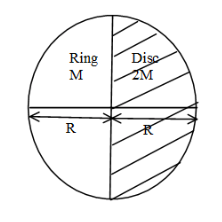
It is asked in the problem that the centre of mass of a composite body does always lie in the heavier part of the composite body.
For solving this we will have some assumptions:
-We will assume that mass is uniformly distributed in both the parts of the composite body.
-There is no cavity present in the body.
The center of mass of the ring will be at distance $\dfrac{{2R}}{\pi }$ from the y-axis and the center of mass of the disc will be at $\dfrac{{4R}}{{3\pi }}$ from the y-axis.
Now let us calculate the center of mass of the composite body.
The formula for calculating the centre of mass is given by,
$ \Rightarrow {\vec r_{com}} = \dfrac{{\sum {{m_i}} {{\left( {{{\vec r}_{com}}} \right)}_i}}}{{\sum {{m_i}} }}$
Where ${m_i}$ is the mass of the body and ${\left( {{{\vec r}_{com}}} \right)_i}$is the position of the object from the x-axis or y-axis.
$ \Rightarrow {\vec r_{com}} = \dfrac{{\sum {{m_i}} {{\left( {{{\vec r}_{com}}} \right)}_i}}}{{\sum {{m_i}} }}$
$ \Rightarrow {\vec r_{com}} = \dfrac{{M{{\left( {{{\vec r}_{com}}} \right)}_{ring}} + 2M{{\left( {{{\vec r}_{com}}} \right)}_{disc}}}}{{2M + M}}$
$ \Rightarrow {\vec r_{com}} = \left[ {\dfrac{{M \times - \dfrac{{2R}}{\pi } + 2M \times \dfrac{{4R}}{{3\pi }}}}{{3M}}} \right]\hat i$
$ \Rightarrow {\vec r_{com}} = \dfrac{{2R}}{{9\pi }}\hat i$
Here we get that the ${\vec r_{com}}$ lies on the heavier side of the composite body, so the given statement in the problem is true.
The correct option for this problem is option A.
Note:The centre of mass concept is very important for the calculation of the many problems of large bodies. If the large bodies are considered as point mass then the calculation becomes very easy and more accurate.
Formula used:The formula for calculating the centre of mass is given by,
$ \Rightarrow {\vec r_{com}} = \dfrac{{\sum {{m_i}} {{\left( {{{\vec r}_{com}}} \right)}_i}}}{{\sum {{m_i}} }}$
Where ${m_i}$ is the mass of the body and ${\left( {{{\vec r}_{com}}} \right)_i}$ is the position of the object.
Step by step solution:
It is asked in the problem that the centre of mass of a composite body does always lie in the heavier part of the composite body.
For solving this we will have some assumptions:
-We will assume that mass is uniformly distributed in both the parts of the composite body.
-There is no cavity present in the body.
The center of mass of the ring will be at distance $\dfrac{{2R}}{\pi }$ from the y-axis and the center of mass of the disc will be at $\dfrac{{4R}}{{3\pi }}$ from the y-axis.
Now let us calculate the center of mass of the composite body.
The formula for calculating the centre of mass is given by,
$ \Rightarrow {\vec r_{com}} = \dfrac{{\sum {{m_i}} {{\left( {{{\vec r}_{com}}} \right)}_i}}}{{\sum {{m_i}} }}$
Where ${m_i}$ is the mass of the body and ${\left( {{{\vec r}_{com}}} \right)_i}$is the position of the object from the x-axis or y-axis.
$ \Rightarrow {\vec r_{com}} = \dfrac{{\sum {{m_i}} {{\left( {{{\vec r}_{com}}} \right)}_i}}}{{\sum {{m_i}} }}$
$ \Rightarrow {\vec r_{com}} = \dfrac{{M{{\left( {{{\vec r}_{com}}} \right)}_{ring}} + 2M{{\left( {{{\vec r}_{com}}} \right)}_{disc}}}}{{2M + M}}$
$ \Rightarrow {\vec r_{com}} = \left[ {\dfrac{{M \times - \dfrac{{2R}}{\pi } + 2M \times \dfrac{{4R}}{{3\pi }}}}{{3M}}} \right]\hat i$
$ \Rightarrow {\vec r_{com}} = \dfrac{{2R}}{{9\pi }}\hat i$
Here we get that the ${\vec r_{com}}$ lies on the heavier side of the composite body, so the given statement in the problem is true.
The correct option for this problem is option A.
Note:The centre of mass concept is very important for the calculation of the many problems of large bodies. If the large bodies are considered as point mass then the calculation becomes very easy and more accurate.
Recently Updated Pages
Master Class 12 Economics: Engaging Questions & Answers for Success

Master Class 12 English: Engaging Questions & Answers for Success
Master Class 12 Social Science: Engaging Questions & Answers for Success
Master Class 12 Maths: Engaging Questions & Answers for Success
Master Class 12 Physics: Engaging Questions & Answers for Success
Master Class 9 General Knowledge: Engaging Questions & Answers for Success
Trending doubts
One Metric ton is equal to kg A 10000 B 1000 C 100 class 11 physics CBSE
Difference Between Prokaryotic Cells and Eukaryotic Cells
Find the value of the expression given below sin 30circ class 11 maths CBSE
Two of the body parts which do not appear in MRI are class 11 biology CBSE
Draw a diagram of nephron and explain its structur class 11 biology CBSE
10 examples of friction in our daily life