




According to the carrier concept, the transport of ions across the membrane is
(a) Passive process
(b) Active process
(c ) Osmotic process
(d) None of the above
Answer
 Verified
571.8k+ views
Hint: The cell membrane not only provides structure to a cell, it also acts as a barrier to the external environment and keeps a check on the entry and exit of all the particles. There are two major ways for the ions to cross the membrane based on the utilization of energy.
Complete answer:
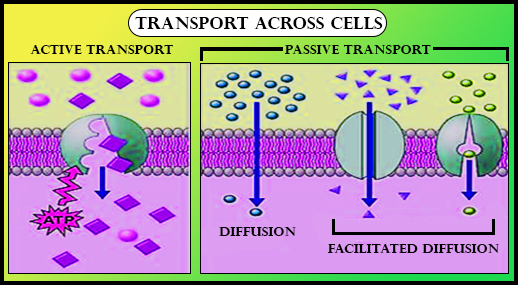
If they use cellular energy to cross a membrane, then such a type of process is known as active transport. If there is no energy expenditure in the movement of ions across a cell membrane, then such a type of transport is labeled as passive transport. Carrier’s concept was given by Van den Honert in 1937. According to him, there are separate carrier proteins for the transport of various anions and cations. The carrier protein binds an ion and forms an ion-carrier complex. This complex is activated by enzyme kinase where ATP is hydrolyzed to transport the ions across the cell membrane.
Additional Information: -The passive transport involves diffusion wherein the movement of particles or molecules or ions takes place from a region of higher concentration to the region of low concentration.
-There are some substances that find it difficult to pass through the membrane and thus their movement needs to be facilitated. Certain membrane proteins are present on the membrane that provide sites for the attachment of and transport of such molecules. A concentration gradient must be there for the molecules to diffuse even if facilitated by the proteins. This is described as facilitated diffusion.
-Osmotic process is the diffusion of water molecules through a differentially permeable or semipermeable membrane.
So, the correct answer is ‘Active process.’
Note: There’s no energy expenditure in facilitated diffusion. As it is very specific, it allows cells to select substances for uptake. It is very sensitive to inhibitors that react with the protein site and blocks the transport. E.g water channels which are made up of eight different types of aquaporins.
Complete answer:
If they use cellular energy to cross a membrane, then such a type of process is known as active transport. If there is no energy expenditure in the movement of ions across a cell membrane, then such a type of transport is labeled as passive transport. Carrier’s concept was given by Van den Honert in 1937. According to him, there are separate carrier proteins for the transport of various anions and cations. The carrier protein binds an ion and forms an ion-carrier complex. This complex is activated by enzyme kinase where ATP is hydrolyzed to transport the ions across the cell membrane.
Additional Information: -The passive transport involves diffusion wherein the movement of particles or molecules or ions takes place from a region of higher concentration to the region of low concentration.
-There are some substances that find it difficult to pass through the membrane and thus their movement needs to be facilitated. Certain membrane proteins are present on the membrane that provide sites for the attachment of and transport of such molecules. A concentration gradient must be there for the molecules to diffuse even if facilitated by the proteins. This is described as facilitated diffusion.
-Osmotic process is the diffusion of water molecules through a differentially permeable or semipermeable membrane.
So, the correct answer is ‘Active process.’
Note: There’s no energy expenditure in facilitated diffusion. As it is very specific, it allows cells to select substances for uptake. It is very sensitive to inhibitors that react with the protein site and blocks the transport. E.g water channels which are made up of eight different types of aquaporins.
Recently Updated Pages
Master Class 11 Computer Science: Engaging Questions & Answers for Success

Master Class 11 Business Studies: Engaging Questions & Answers for Success
Master Class 11 Economics: Engaging Questions & Answers for Success
Master Class 11 English: Engaging Questions & Answers for Success
Master Class 11 Maths: Engaging Questions & Answers for Success
Master Class 11 Biology: Engaging Questions & Answers for Success
Trending doubts
One Metric ton is equal to kg A 10000 B 1000 C 100 class 11 physics CBSE
There are 720 permutations of the digits 1 2 3 4 5 class 11 maths CBSE
Discuss the various forms of bacteria class 11 biology CBSE
Draw a diagram of a plant cell and label at least eight class 11 biology CBSE
State the laws of reflection of light
Explain zero factorial class 11 maths CBSE