




According to Euclid's definition, the ends of a line are: \[\]
A. Breadthless\[\]
B. Points\[\]
C. Lengthless\[\]
D. None of these\[\]
Answer
 Verified
590.1k+ views
Hint: We recall the definitions about straight lines written by Euclid in his first book of Elements which are “. A line is a breadth less length”, “The ends of a line are points” and “A straight line lies equally with respect to the points itself”. We use the second definition of the line to choose the correct option.\[\]
Complete step-by-step solution
We know that Greek mathematician Euclid has listed 23 important definitions in Book-1 of the ‘Elements’. Let’s see some of the important definitions involving the line given by Euclid’s\[\]
1. A point is that which has no part.\[\]
2. A line is a breadthless length.\[\]
3. The ends of a line are points.\[\]
4. A straight line lies equally with respect to the points itself.\[\]
5. A surface is that which has length and breadth only.\[\]
6. The edges of a surface are lines. \[\]
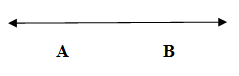
These are the most important definitions of Euclid’s. Now, referring to the definitions given by Euclid in which he stated that “The ends of a line are points''. This statement can be taken as indicating that between certain lines and points a relation holds that a point can be an end of a line. It doesn’t say what ends are. It also doesn’t indicate how many ends a line can have. For instance, the circumference of a circle has no ends, but a finite line has its two endpoints. This implies the option (b) of the question is correct as it shows that the ends of a line are points. The line is named with two points on the line. We draw the figure of a line $\overleftrightarrow{AB}$ with two-point A and B on it.\[\]
Note: Euclid assumed certain properties in mathematics, which could not be proved. These are actually ‘obvious universal truths’. Euclid’s divided them into two types: postulates and axioms. Postulates are universal truths in geometry without any proof and the definitions of points, line, and plane according to Euclid are postulates. Axioms are universal truths in mathematics.
Complete step-by-step solution
We know that Greek mathematician Euclid has listed 23 important definitions in Book-1 of the ‘Elements’. Let’s see some of the important definitions involving the line given by Euclid’s\[\]
1. A point is that which has no part.\[\]
2. A line is a breadthless length.\[\]
3. The ends of a line are points.\[\]
4. A straight line lies equally with respect to the points itself.\[\]
5. A surface is that which has length and breadth only.\[\]
6. The edges of a surface are lines. \[\]
These are the most important definitions of Euclid’s. Now, referring to the definitions given by Euclid in which he stated that “The ends of a line are points''. This statement can be taken as indicating that between certain lines and points a relation holds that a point can be an end of a line. It doesn’t say what ends are. It also doesn’t indicate how many ends a line can have. For instance, the circumference of a circle has no ends, but a finite line has its two endpoints. This implies the option (b) of the question is correct as it shows that the ends of a line are points. The line is named with two points on the line. We draw the figure of a line $\overleftrightarrow{AB}$ with two-point A and B on it.\[\]
Note: Euclid assumed certain properties in mathematics, which could not be proved. These are actually ‘obvious universal truths’. Euclid’s divided them into two types: postulates and axioms. Postulates are universal truths in geometry without any proof and the definitions of points, line, and plane according to Euclid are postulates. Axioms are universal truths in mathematics.
Recently Updated Pages
Master Class 9 Social Science: Engaging Questions & Answers for Success

Master Class 9 Science: Engaging Questions & Answers for Success
Master Class 9 Maths: Engaging Questions & Answers for Success
Master Class 9 General Knowledge: Engaging Questions & Answers for Success
Class 9 Question and Answer - Your Ultimate Solutions Guide
Master Class 8 Social Science: Engaging Questions & Answers for Success
Trending doubts
Find the sum of series 1 + 2 + 3 + 4 + 5 + + 100 class 9 maths CBSE
What is the Full Form of ISI and RAW
Fill the blanks with the suitable prepositions 1 The class 9 english CBSE
Difference Between Plant Cell and Animal Cell
Who is eligible for RTE class 9 social science CBSE
What is pollution? How many types of pollution? Define it