




According to Cartesian sign convention, in ray optics:
A. All distances in the direction of incident rays are taken positive.
B. All distances are taken negative
C. All distances in the direction of incident ray are taken negative
D. All distances are taken positive.
Answer
 Verified
612.9k+ views
Hint: In cartesians sign convention we take the incident ray as the guide for setting up the coordinate system. There are mainly two types of sign conventions for optics:
Complete step-by-step answer:
For the Cartesian sign convention, we need to consider the direction of incident rays. The X-axis will go through the pole of any spherical surface in the system. For example, the diagram shows the principal axis.
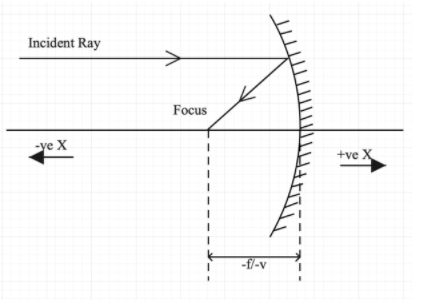
In the Cartesian sign convention, we consider the direction of incident to be positive. Hence, if the incident is travelling from left to right (as shown in the figure), we can treat this direction as +ve X-axis. And the opposite direction will be treated as the -ve X axis.
Y-axis can be decided according to choice. However, any distance above the principal axis is considered to be +ve, and any direction below the principal axis is considered to be negative.
Hence, the correct option is (A).
Note:There is another well known sign convention that is used. It is the real sign convention. In this sign convention, we calculate the distances from the pole of an optical device. For example, if there is a spherical mirror in the optical system, any distance on the right of the pole is positive, and any distance on the left of the pole is negative. Any distance above the principal axis is considered to be +ve Y-axis and below is considered to be -ve Y-axis.
Complete step-by-step answer:
For the Cartesian sign convention, we need to consider the direction of incident rays. The X-axis will go through the pole of any spherical surface in the system. For example, the diagram shows the principal axis.
In the Cartesian sign convention, we consider the direction of incident to be positive. Hence, if the incident is travelling from left to right (as shown in the figure), we can treat this direction as +ve X-axis. And the opposite direction will be treated as the -ve X axis.
Y-axis can be decided according to choice. However, any distance above the principal axis is considered to be +ve, and any direction below the principal axis is considered to be negative.
Hence, the correct option is (A).
Note:There is another well known sign convention that is used. It is the real sign convention. In this sign convention, we calculate the distances from the pole of an optical device. For example, if there is a spherical mirror in the optical system, any distance on the right of the pole is positive, and any distance on the left of the pole is negative. Any distance above the principal axis is considered to be +ve Y-axis and below is considered to be -ve Y-axis.
Recently Updated Pages
Master Class 12 Social Science: Engaging Questions & Answers for Success

Master Class 12 Physics: Engaging Questions & Answers for Success
Master Class 12 Maths: Engaging Questions & Answers for Success
Master Class 12 Economics: Engaging Questions & Answers for Success
Master Class 12 Chemistry: Engaging Questions & Answers for Success
Master Class 12 Business Studies: Engaging Questions & Answers for Success
Trending doubts
Which are the Top 10 Largest Countries of the World?
Draw a labelled sketch of the human eye class 12 physics CBSE
Explain the structure of megasporangium class 12 biology CBSE
What are the major means of transport Explain each class 12 social science CBSE
How many chromosomes are found in human ovum a 46 b class 12 biology CBSE
The diagram of the section of a maize grain is given class 12 biology CBSE