




What is the acceleration $\overrightarrow a $ at a point P(R,$\theta $) on the circle of radius R for a particle in uniform circular motion? (here ‘v’ is the speed of the particle and $\theta $ is measured from the x-axis)
\[
{\text{A}}{\text{. }} - \left( {\dfrac{{{{\text{v}}^2}}}{{\text{R}}}\cos \theta } \right)\widehat i + \left( {\dfrac{{{{\text{v}}^2}}}{{\text{R}}}\sin \theta } \right)\widehat j \\
{\text{B}}{\text{. }} - \left( {\dfrac{{{{\text{v}}^2}}}{{\text{R}}}\sin \theta } \right)\widehat i + \left( {\dfrac{{{{\text{v}}^2}}}{{\text{R}}}\cos \theta } \right)\widehat j \\
{\text{C}}{\text{. }} - \left( {\dfrac{{{{\text{v}}^2}}}{{\text{R}}}\cos \theta } \right)\widehat i - \left( {\dfrac{{{{\text{v}}^2}}}{{\text{R}}}\sin \theta } \right)\widehat j \\
{\text{D}}{\text{. }}\left( {\dfrac{{{{\text{v}}^2}}}{{\text{R}}}} \right)\widehat i + \left( {\dfrac{{{{\text{v}}^2}}}{{\text{R}}}} \right)\widehat j \\
\]
Answer
 Verified
609.3k+ views
Hint: Here, we will proceed by drawing the figure corresponding to any particle undergoing uniform circular motion. Then, we will show the acceleration acting on the particle at the given point and resolve it into Cartesian components.
Formula Used: ${a_c} = \dfrac{{{{\text{v}}^2}}}{{\text{R}}}$.
Complete Step-by-Step solution:
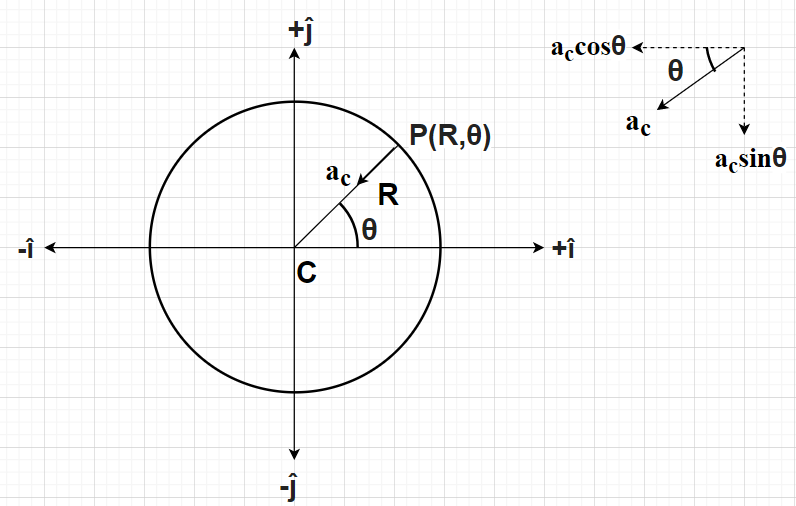
Let us suppose a particle undergoing a uniform circular motion around the circle having radius R as shown in the figure. Let at this particular instant, the particle is at point P(R,$\theta $).
As we know that for any particle to have uniform circular motion, centripetal acceleration towards the centre of the circle should be acting on the particle.
Also, centripetal acceleration experienced by any particle having linear velocity v and radius of the circular motion as R is given by
${a_c} = \dfrac{{{{\text{v}}^2}}}{{\text{R}}}$
This centripetal acceleration will be acting towards the centre of the circle as shown in the figure.
Now, let us resolve this centripetal acceleration into its components acting towards the negative x-axis and negative y-axis as shown in the other figure.
Since, the alternative angles are always equal in measure
The component of the centripetal acceleration acting towards the negative x-axis is equal to \[ - \left( {{a_c}\cos \theta } \right)\widehat i\]
Similarly, the component of the centripetal acceleration acting towards the negative y-axis is equal to \[ - \left( {{a_c}\sin \theta } \right)\widehat j\]
The total acceleration acting on the particle (in vector form) can be obtained by summing the components of the centripetal acceleration acting on the particle
Acceleration at the point P(R,$\theta $), $
\overrightarrow a = - \left( {{a_c}\cos \theta } \right)\widehat i + \left[ { - \left( {{a_c}\sin \theta } \right)\widehat j} \right] \\
\Rightarrow \overrightarrow a = - \left( {{a_c}\cos \theta } \right)\widehat i - \left( {{a_c}\sin \theta } \right)\widehat j \\
$
By substituting ${a_c} = \dfrac{{{{\text{v}}^2}}}{{\text{R}}}$ in the above equation, we get
$ \Rightarrow \overrightarrow a = - \left( {\dfrac{{{{\text{v}}^2}}}{{\text{R}}}\cos \theta } \right)\widehat i - \left( {\dfrac{{{{\text{v}}^2}}}{{\text{R}}}\sin \theta } \right)\widehat j$
Therefore, option C is correct.
Note- Uniform circular motion at a constant velocity can be defined as the motion of an object in a circle. As an object moves around in a circle, its direction is constantly changing. The object is moving tangent to the circle at all instances. Since the direction of the velocity vector is identical to that of the motion of the object, the velocity vector is also directed tangent to the circle.
Formula Used: ${a_c} = \dfrac{{{{\text{v}}^2}}}{{\text{R}}}$.
Complete Step-by-Step solution:
Let us suppose a particle undergoing a uniform circular motion around the circle having radius R as shown in the figure. Let at this particular instant, the particle is at point P(R,$\theta $).
As we know that for any particle to have uniform circular motion, centripetal acceleration towards the centre of the circle should be acting on the particle.
Also, centripetal acceleration experienced by any particle having linear velocity v and radius of the circular motion as R is given by
${a_c} = \dfrac{{{{\text{v}}^2}}}{{\text{R}}}$
This centripetal acceleration will be acting towards the centre of the circle as shown in the figure.
Now, let us resolve this centripetal acceleration into its components acting towards the negative x-axis and negative y-axis as shown in the other figure.
Since, the alternative angles are always equal in measure
The component of the centripetal acceleration acting towards the negative x-axis is equal to \[ - \left( {{a_c}\cos \theta } \right)\widehat i\]
Similarly, the component of the centripetal acceleration acting towards the negative y-axis is equal to \[ - \left( {{a_c}\sin \theta } \right)\widehat j\]
The total acceleration acting on the particle (in vector form) can be obtained by summing the components of the centripetal acceleration acting on the particle
Acceleration at the point P(R,$\theta $), $
\overrightarrow a = - \left( {{a_c}\cos \theta } \right)\widehat i + \left[ { - \left( {{a_c}\sin \theta } \right)\widehat j} \right] \\
\Rightarrow \overrightarrow a = - \left( {{a_c}\cos \theta } \right)\widehat i - \left( {{a_c}\sin \theta } \right)\widehat j \\
$
By substituting ${a_c} = \dfrac{{{{\text{v}}^2}}}{{\text{R}}}$ in the above equation, we get
$ \Rightarrow \overrightarrow a = - \left( {\dfrac{{{{\text{v}}^2}}}{{\text{R}}}\cos \theta } \right)\widehat i - \left( {\dfrac{{{{\text{v}}^2}}}{{\text{R}}}\sin \theta } \right)\widehat j$
Therefore, option C is correct.
Note- Uniform circular motion at a constant velocity can be defined as the motion of an object in a circle. As an object moves around in a circle, its direction is constantly changing. The object is moving tangent to the circle at all instances. Since the direction of the velocity vector is identical to that of the motion of the object, the velocity vector is also directed tangent to the circle.
Recently Updated Pages
Master Class 10 Computer Science: Engaging Questions & Answers for Success

Master Class 10 General Knowledge: Engaging Questions & Answers for Success
Master Class 10 English: Engaging Questions & Answers for Success
Master Class 10 Social Science: Engaging Questions & Answers for Success
Master Class 10 Maths: Engaging Questions & Answers for Success
Master Class 10 Science: Engaging Questions & Answers for Success
Trending doubts
What is the median of the first 10 natural numbers class 10 maths CBSE
Which women's tennis player has 24 Grand Slam singles titles?
Who is the Brand Ambassador of Incredible India?
Why is there a time difference of about 5 hours between class 10 social science CBSE
Write a letter to the principal requesting him to grant class 10 english CBSE
A moving boat is observed from the top of a 150 m high class 10 maths CBSE