




Acceleration due to gravity at the surface of the earth and density is $1.5$ times that of earth. if radius of earth is $R$ then radius of planet is
A. $\dfrac{R}{{1.5}}$
B. $\dfrac{2}{3}R$
C. $\dfrac{9}{4}R$
D. $\dfrac{4}{9}R$
Answer
 Verified
577.8k+ views
Hint:We know the value here, the surface value of the earth, and the value of density. The inertial mass and gravitational mass are equal in measuring the relative radius of the planet recorded by the principle of equivalence. We're going to use this while accelerating due to gravity.
Useful formula:
The acceleration due to gravity,
${\text{Gravity}}\,{\text{at}}\,{\text{surface}}\,{\text{of}}\,{\text{planet = Gravity}}\,{\text{at}}\,{\text{surface}}\,{\text{of}}\,{\text{earth}}$
It can be written as ${g_p} = {g_e}$
${\text{volume}}\,{\text{of}}\,{\text{the}}\,{\text{sphere}}\,,\,g = \dfrac{{G\left( {P \times \dfrac{4}{3}\pi {R^3}} \right)}}{{{R^2}}}$
Where,
$R$ is the Radius
$G$ is the gravitational constant
$P$ surface of density.
${g_e}$ is gravity at the surface of earth.
${g_p}$ gravity at surface of planet
Complete step by step procedure:
Given by,
Density of the earth is ${P_1} = 1.5{P_e}$
Radius of the earth is $R$
Find the radius of planet,
Now,
We know that,
${\text{Gravity}}\,{\text{at}}\,{\text{surface}}\,{\text{of}}\,{\text{planet = Gravity}}\,{\text{at}}\,{\text{surface}}\,{\text{of}}\,{\text{earth}}$
Here,
${g_p} = {g_e}$
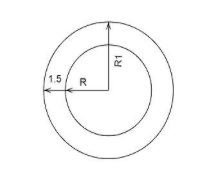
We know the volume of the sphere is $g = \dfrac{{G\left( {P \times \dfrac{4}{3}\pi {R^3}} \right)}}{{{R^2}}}$
Given value ${P_p} = 1.5{P_E}$
Given formula can be substituting in both planet and earth
\[\dfrac{{G\left( {P \times \dfrac{4}{3}\pi {R^3}} \right) \times {P_e}}}{{{R^2}}} = \dfrac{{G\left( {P \times \dfrac{4}{3}\pi {R^3}} \right) \times {P_p}}}{{{{\left( {{R^1}} \right)}^2}}}\]
Or,
$R.{P_e} = {R^1}.{P_p}$
Radius of the earth is equal to Radius of planet,
Rearranging the given equation is
${R^1} = R \times \dfrac{{{P_p}}}{{{P_e}}}$
Substituting the given value,
${R^1} = R \times \dfrac{R}{{1.5}}$
On simplifying,
Therefore, $\left( {1.5 + 1.5 = 3} \right)$
${R^1} = \dfrac{{2R}}{3}$.
Hence,
If radius of earth is $R$, then radius of planet is ${R^1} = \dfrac{2}{3}R$
Therefore, option B is the correct answer.
Note:According to the force of gravity between earth and the planet. The distance variance in g follows an inverse square law in which g is inversely proportional to the distance from the center of the earth. As the gap is doubled, this inverse square relationship means that gravitational force is a very long-range, but relatively small, basic pull force that operates between all particles with mass.
Useful formula:
The acceleration due to gravity,
${\text{Gravity}}\,{\text{at}}\,{\text{surface}}\,{\text{of}}\,{\text{planet = Gravity}}\,{\text{at}}\,{\text{surface}}\,{\text{of}}\,{\text{earth}}$
It can be written as ${g_p} = {g_e}$
${\text{volume}}\,{\text{of}}\,{\text{the}}\,{\text{sphere}}\,,\,g = \dfrac{{G\left( {P \times \dfrac{4}{3}\pi {R^3}} \right)}}{{{R^2}}}$
Where,
$R$ is the Radius
$G$ is the gravitational constant
$P$ surface of density.
${g_e}$ is gravity at the surface of earth.
${g_p}$ gravity at surface of planet
Complete step by step procedure:
Given by,
Density of the earth is ${P_1} = 1.5{P_e}$
Radius of the earth is $R$
Find the radius of planet,
Now,
We know that,
${\text{Gravity}}\,{\text{at}}\,{\text{surface}}\,{\text{of}}\,{\text{planet = Gravity}}\,{\text{at}}\,{\text{surface}}\,{\text{of}}\,{\text{earth}}$
Here,
${g_p} = {g_e}$
We know the volume of the sphere is $g = \dfrac{{G\left( {P \times \dfrac{4}{3}\pi {R^3}} \right)}}{{{R^2}}}$
Given value ${P_p} = 1.5{P_E}$
Given formula can be substituting in both planet and earth
\[\dfrac{{G\left( {P \times \dfrac{4}{3}\pi {R^3}} \right) \times {P_e}}}{{{R^2}}} = \dfrac{{G\left( {P \times \dfrac{4}{3}\pi {R^3}} \right) \times {P_p}}}{{{{\left( {{R^1}} \right)}^2}}}\]
Or,
$R.{P_e} = {R^1}.{P_p}$
Radius of the earth is equal to Radius of planet,
Rearranging the given equation is
${R^1} = R \times \dfrac{{{P_p}}}{{{P_e}}}$
Substituting the given value,
${R^1} = R \times \dfrac{R}{{1.5}}$
On simplifying,
Therefore, $\left( {1.5 + 1.5 = 3} \right)$
${R^1} = \dfrac{{2R}}{3}$.
Hence,
If radius of earth is $R$, then radius of planet is ${R^1} = \dfrac{2}{3}R$
Therefore, option B is the correct answer.
Note:According to the force of gravity between earth and the planet. The distance variance in g follows an inverse square law in which g is inversely proportional to the distance from the center of the earth. As the gap is doubled, this inverse square relationship means that gravitational force is a very long-range, but relatively small, basic pull force that operates between all particles with mass.
Recently Updated Pages
Master Class 11 Computer Science: Engaging Questions & Answers for Success

Master Class 11 Business Studies: Engaging Questions & Answers for Success
Master Class 11 Economics: Engaging Questions & Answers for Success
Master Class 11 English: Engaging Questions & Answers for Success
Master Class 11 Maths: Engaging Questions & Answers for Success
Master Class 11 Biology: Engaging Questions & Answers for Success
Trending doubts
One Metric ton is equal to kg A 10000 B 1000 C 100 class 11 physics CBSE
There are 720 permutations of the digits 1 2 3 4 5 class 11 maths CBSE
Discuss the various forms of bacteria class 11 biology CBSE
Draw a diagram of a plant cell and label at least eight class 11 biology CBSE
State the laws of reflection of light
Explain zero factorial class 11 maths CBSE