




ABCD is a wire frame of identical wires in which point D is given a velocity v as shown in the figure. Choose the correct statement(s)
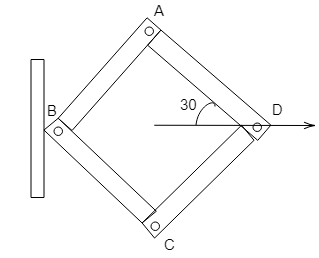
(A) Velocity of point $A$ along the x-axis will be $\dfrac{v}{2}$
(B) Speed of point $A$ will be $v$
(C) Speed of point $A$ along the y-axis will be $\dfrac{v}{2}$
(D) velocity of point $A$ will be equal to velocity of the point $C$
Answer
 Verified
516.9k+ views
Hint: We know that the angle made at the point $D$ is ${30^o}$, so the angle made at the point $A$ will also be ${30^o}$ due to the property of alternate interior angles. Now, we will resolve the velocity at the point $A$ into the x-component and the y-component and hence get the answer.
Complete step by step solution:
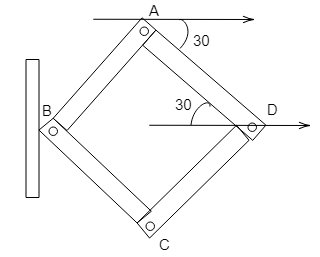
As we can clearly see in the diagram the velocity $v$ of the point $D$ will get transferred to the frame of the wire at the point $A$.
Now, the speed of the point $A = v.......(1)$
The x-component of the velocity at the point $A$ is,
${v_x} = v\cos {30^ \circ }$
On putting the value of \[\cos {30^ \circ }\], we get,
${v_x} = \dfrac{{\sqrt 3 v}}{2}$
The y-component of the velocity at the point $A$ is,
${v_y} = v\sin {30^ \circ }$
On putting the value of $\sin {30^ \circ }$, we get, ${v_y} = \dfrac{v}{2}......(2)$
From equation (1) and (2), we can say that the speed of point $A$ will be $v$ and the speed of point $A$ along the y-axis will be $\dfrac{v}{2}$.
Thus, option (B) and option (C) is the correct answer.
Note:
When an object moves in a projectile motion, then it has two components of velocity vector. The horizontal velocity component ${v_x}$ acts in a way such that it displaces the projectile horizontally. On the other hand, the vertical velocity component ${v_y}$ acts in a way such that it displaces the projectile vertically.
Complete step by step solution:
As we can clearly see in the diagram the velocity $v$ of the point $D$ will get transferred to the frame of the wire at the point $A$.
Now, the speed of the point $A = v.......(1)$
The x-component of the velocity at the point $A$ is,
${v_x} = v\cos {30^ \circ }$
On putting the value of \[\cos {30^ \circ }\], we get,
${v_x} = \dfrac{{\sqrt 3 v}}{2}$
The y-component of the velocity at the point $A$ is,
${v_y} = v\sin {30^ \circ }$
On putting the value of $\sin {30^ \circ }$, we get, ${v_y} = \dfrac{v}{2}......(2)$
From equation (1) and (2), we can say that the speed of point $A$ will be $v$ and the speed of point $A$ along the y-axis will be $\dfrac{v}{2}$.
Thus, option (B) and option (C) is the correct answer.
Note:
When an object moves in a projectile motion, then it has two components of velocity vector. The horizontal velocity component ${v_x}$ acts in a way such that it displaces the projectile horizontally. On the other hand, the vertical velocity component ${v_y}$ acts in a way such that it displaces the projectile vertically.
Recently Updated Pages
Master Class 11 Social Science: Engaging Questions & Answers for Success

Master Class 11 Chemistry: Engaging Questions & Answers for Success
Master Class 12 Business Studies: Engaging Questions & Answers for Success
Master Class 12 Chemistry: Engaging Questions & Answers for Success
Master Class 12 Biology: Engaging Questions & Answers for Success
Class 12 Question and Answer - Your Ultimate Solutions Guide
Trending doubts
One Metric ton is equal to kg A 10000 B 1000 C 100 class 11 physics CBSE
Difference Between Prokaryotic Cells and Eukaryotic Cells
Two of the body parts which do not appear in MRI are class 11 biology CBSE
Explain zero factorial class 11 maths CBSE
10 examples of friction in our daily life
Name the Largest and the Smallest Cell in the Human Body ?