




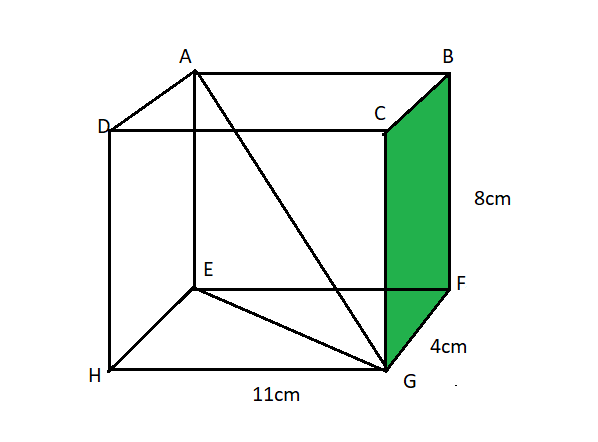
ABCDEFGH is a cuboid. Find the angle between AG and plane EFGH(angle AGE).
Answer
 Verified
658.2k+ views
Hint: In this question first we need to find the unknowns involved in the $\Delta AEG$ which will be used to find the $\angle AGE$ that is the angle between line AG and plane EFGH. Using Pythagoras theorem, we have to find the length of EG. And then apply the trigonometric ratios to find the required angle.
Complete step-by-step answer:
In $\Delta EFG$
We have,
$\angle EFG = {90^ \circ }$
FG=4cm
EF=11cm
Now, apply Pythagoras theorem in $\Delta EFG$
$
\Rightarrow {(EG)^2} = {(EF)^2} + {(FG)^2} \\
\Rightarrow {(EG)^2} = {11^2} + {4^2} \\
\Rightarrow {(EG)^2} = 137 \\
\Rightarrow EG = \sqrt {137} {\text{ --eq}}{\text{.1}} \\
$
In $\Delta AEG$
We have,
$\angle AEG = {90^ \circ }$
AE=8cm
And EG=$\sqrt {137} $ {from eq.1}
Now, on applying trigonometric ratios in $\Delta AEG$
$
\Rightarrow \tan (\angle AGE) = \dfrac{{AE}}{{EG}} \\
\Rightarrow \tan (\angle AGE) = \dfrac{8}{{\sqrt {137} }} \\
\Rightarrow \tan (\angle AGE) = 0.6837 \\
$
Now, using inverse trigonometric relations, we get
$
\Rightarrow \angle AGE = {\tan ^{ - 1}}(0.6837) \\
\Rightarrow \angle AGE = {34.36^ \circ } \\
$
Hence, the angle between AG and plane EFGH($\angle AGE$) is ${34.36^ \circ }$.
Note:- Whenever you get this type of question the key concept to solve is to learn the concept of Pythagoras theorem and how it is applied in a right angled triangle and trigonometric ratios. And one more thing to learn is the properties of inverse trigonometric relations.
Complete step-by-step answer:
In $\Delta EFG$
We have,
$\angle EFG = {90^ \circ }$
FG=4cm
EF=11cm
Now, apply Pythagoras theorem in $\Delta EFG$
$
\Rightarrow {(EG)^2} = {(EF)^2} + {(FG)^2} \\
\Rightarrow {(EG)^2} = {11^2} + {4^2} \\
\Rightarrow {(EG)^2} = 137 \\
\Rightarrow EG = \sqrt {137} {\text{ --eq}}{\text{.1}} \\
$
In $\Delta AEG$
We have,
$\angle AEG = {90^ \circ }$
AE=8cm
And EG=$\sqrt {137} $ {from eq.1}
Now, on applying trigonometric ratios in $\Delta AEG$
$
\Rightarrow \tan (\angle AGE) = \dfrac{{AE}}{{EG}} \\
\Rightarrow \tan (\angle AGE) = \dfrac{8}{{\sqrt {137} }} \\
\Rightarrow \tan (\angle AGE) = 0.6837 \\
$
Now, using inverse trigonometric relations, we get
$
\Rightarrow \angle AGE = {\tan ^{ - 1}}(0.6837) \\
\Rightarrow \angle AGE = {34.36^ \circ } \\
$
Hence, the angle between AG and plane EFGH($\angle AGE$) is ${34.36^ \circ }$.
Note:- Whenever you get this type of question the key concept to solve is to learn the concept of Pythagoras theorem and how it is applied in a right angled triangle and trigonometric ratios. And one more thing to learn is the properties of inverse trigonometric relations.
Recently Updated Pages
Master Class 11 Social Science: Engaging Questions & Answers for Success

Master Class 11 English: Engaging Questions & Answers for Success
Master Class 11 Accountancy: Engaging Questions & Answers for Success
Master Class 11 Physics: Engaging Questions & Answers for Success
Master Class 11 Computer Science: Engaging Questions & Answers for Success
Master Class 11 Business Studies: Engaging Questions & Answers for Success
Trending doubts
Find the value of the expression given below sin 30circ class 11 maths CBSE
One Metric ton is equal to kg A 10000 B 1000 C 100 class 11 physics CBSE
10 examples of friction in our daily life
Draw a diagram of nephron and explain its structur class 11 biology CBSE
The teeth used for biting and cutting food are called class 11 biology CBSE
Proton was discovered by A Thomson B Rutherford C Chadwick class 11 chemistry CBSE