




ABCD is parallelogram and P is the midpoint of the side AD. The line BP meets the diagonal AC in Q. Then the ratio $AQ:QC$ is
(a) $1:2$
(b) $2:1$
(c) $1:3$
(d) $3:1$
Answer
 Verified
593.4k+ views
Hint: By using the properties of the parallelogram, we can show the sides AD and BC to be equal. Since P is the midpoint of AD, we can write $AD=2AP$ and since $BC=AD$ we will get $BC=2AP$. Then, using the AAA similarity, we can prove the triangles AQP and CQB to be similar. Finally, on equating the ratios of the corresponding sides, we will get the final answer.
Complete step-by-step answer:
According to the information given in the above question, we can draw the parallelogram ABCD as shown in the figure below.
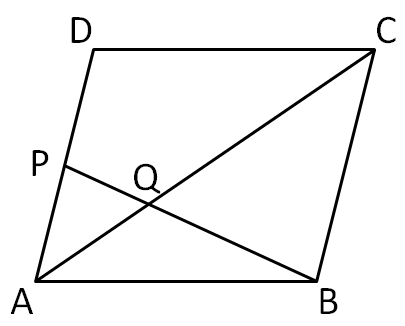
We know by the properties of a parallelogram that the opposite sides are equal in length. Therefore, from the above figure we can write
$\Rightarrow BC=AD.......\left( i \right)$
Now, since P is given to be the midpoint of the side AD, we can write
$\Rightarrow AD=2AP.......\left( ii \right)$
On substituting the equation (ii) into the equation (i) we get
$\Rightarrow BC=2AP........\left( iii \right)$
Now, in the triangles AQP and BQC we can observe
$\Rightarrow \angle QAP=\angle QCB$ (Alternate interior angles)
$\Rightarrow \angle AQP=\angle CQB$ (Vertically opposite angles)
$\Rightarrow \angle APQ=\angle CBQ$ (Alternate interior angles)
Therefore, from the AAA similarity, we can say that
\[\Rightarrow \Delta AQP\sim \Delta CQB\]
We know that the sides of the similar triangles are proportional. Therefore we can write
$\Rightarrow \dfrac{AQ}{CQ}=\dfrac{AP}{BC}$
Substituting the equation (iii) into the above equation, we finally get
$\begin{align}
& \Rightarrow \dfrac{AQ}{CQ}=\dfrac{AP}{2AP} \\
& \Rightarrow \dfrac{AQ}{CQ}=\dfrac{1}{2} \\
\end{align}$
Thus, the ratio $AQ:QC$ is equal to $1:2$.
So, the correct answer is “Option A”.
Note: While proving two triangles to be similar, it is important to order the labelling of the triangles. We can also use the AA similarity to prove the two triangles similar. Therefore, there is no need to prove all the three angles equal to prove the triangles AQP and CQB similar.
Complete step-by-step answer:
According to the information given in the above question, we can draw the parallelogram ABCD as shown in the figure below.
We know by the properties of a parallelogram that the opposite sides are equal in length. Therefore, from the above figure we can write
$\Rightarrow BC=AD.......\left( i \right)$
Now, since P is given to be the midpoint of the side AD, we can write
$\Rightarrow AD=2AP.......\left( ii \right)$
On substituting the equation (ii) into the equation (i) we get
$\Rightarrow BC=2AP........\left( iii \right)$
Now, in the triangles AQP and BQC we can observe
$\Rightarrow \angle QAP=\angle QCB$ (Alternate interior angles)
$\Rightarrow \angle AQP=\angle CQB$ (Vertically opposite angles)
$\Rightarrow \angle APQ=\angle CBQ$ (Alternate interior angles)
Therefore, from the AAA similarity, we can say that
\[\Rightarrow \Delta AQP\sim \Delta CQB\]
We know that the sides of the similar triangles are proportional. Therefore we can write
$\Rightarrow \dfrac{AQ}{CQ}=\dfrac{AP}{BC}$
Substituting the equation (iii) into the above equation, we finally get
$\begin{align}
& \Rightarrow \dfrac{AQ}{CQ}=\dfrac{AP}{2AP} \\
& \Rightarrow \dfrac{AQ}{CQ}=\dfrac{1}{2} \\
\end{align}$
Thus, the ratio $AQ:QC$ is equal to $1:2$.
So, the correct answer is “Option A”.
Note: While proving two triangles to be similar, it is important to order the labelling of the triangles. We can also use the AA similarity to prove the two triangles similar. Therefore, there is no need to prove all the three angles equal to prove the triangles AQP and CQB similar.
Recently Updated Pages
Class 10 Question and Answer - Your Ultimate Solutions Guide

Master Class 10 Computer Science: Engaging Questions & Answers for Success
Master Class 10 General Knowledge: Engaging Questions & Answers for Success
Master Class 12 Economics: Engaging Questions & Answers for Success
Master Class 12 Social Science: Engaging Questions & Answers for Success
Master Class 12 English: Engaging Questions & Answers for Success
Trending doubts
Explain the Treaty of Vienna of 1815 class 10 social science CBSE
The slogan Jai Hind was given by A Lal Bahadur Shastri class 10 social science CBSE
10 examples of evaporation in daily life with explanations
What is the full form of POSCO class 10 social science CBSE
Identify the feminine form of noun nephew a shenephew class 10 english CBSE
CSIR full form?