



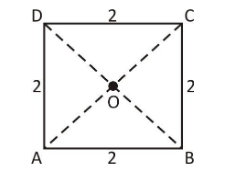
ABCD is a square of area of $ 4 $ square units which is divided into $ 4 $ non overlapping triangles as shown in figure, then sum of perimeters of the triangles so formed is
A. $ 8(2 + \sqrt 2 ) $
B. $ 8(1 + \sqrt 2 ) $
C. $ 4(1 + \sqrt 2 ) $
D. $ 4(2 + \sqrt 2 ) $
Answer
 Verified
626.7k+ views
Hint: Here we will use the perimeter of the triangle as equal to the sum of all the three sides. Here four triangles are formed so sum of all the twelve sides. Use Pythagoras theorem to find the unknown side. Also, use the formula for the area of the square.
Complete step-by-step answer:
Given that the area of the square ABCD is $ 4 $
Also, $ AB = BC = CD = DA = 2 $
Now, by using Pythagora's theorem which states that sum of the squares of the sides of the right angled triangle is equal to the square of the hypotenuse.
$ \therefore A{C^2} = A{B^2} + B{C^2} $
Place the values in the above equation –
$ \therefore A{C^2} = {2^2} + {2^2} $
Simplify the above equation –
$
\therefore A{C^2} = 4 + 4 \\
\therefore A{C^2} = 8 \;
$
Take square-root on both the sides of the equation-
$ \Rightarrow \sqrt {A{C^2}} = \sqrt 8 $
Square and square-root cancel each other on the left side of the equation –
$ \Rightarrow AC = \sqrt {4 \times 2} $
Also, $ \sqrt 4 \;{\text{is 2}} $ replace it and simplify-
$ \Rightarrow AC = 2\sqrt 2 $
Now, the perimeter of the four triangles is $ = AB + BC + CD + DA + 2(AC + BD) $
Place the values in the above equation and simplify –
Perimeter of the four triangles $ = 2 + 2 + 2 + 2 + 2(2\sqrt 2 + 2\sqrt 2 ) $
Directly add the like terms in the above equation and simplify the above equation –
Perimeter of the four triangles
$
= 8 + 2(4\sqrt 2 ) \\
= 8 + 8\sqrt 2 \;
$
Take common factors and simplify –
$ = 8(1 + \sqrt 2 ) $
So, the correct answer is “Option B”.
Note: Always remember the properties of the closed solid figures and apply accordingly. Such we used here that every angle in the square is the right angle and so used the Pythagoras theorem. Apply the properties of the square and square-roots and simplify accordingly.
Complete step-by-step answer:
Given that the area of the square ABCD is $ 4 $
Also, $ AB = BC = CD = DA = 2 $
Now, by using Pythagora's theorem which states that sum of the squares of the sides of the right angled triangle is equal to the square of the hypotenuse.
$ \therefore A{C^2} = A{B^2} + B{C^2} $
Place the values in the above equation –
$ \therefore A{C^2} = {2^2} + {2^2} $
Simplify the above equation –
$
\therefore A{C^2} = 4 + 4 \\
\therefore A{C^2} = 8 \;
$
Take square-root on both the sides of the equation-
$ \Rightarrow \sqrt {A{C^2}} = \sqrt 8 $
Square and square-root cancel each other on the left side of the equation –
$ \Rightarrow AC = \sqrt {4 \times 2} $
Also, $ \sqrt 4 \;{\text{is 2}} $ replace it and simplify-
$ \Rightarrow AC = 2\sqrt 2 $
Now, the perimeter of the four triangles is $ = AB + BC + CD + DA + 2(AC + BD) $
Place the values in the above equation and simplify –
Perimeter of the four triangles $ = 2 + 2 + 2 + 2 + 2(2\sqrt 2 + 2\sqrt 2 ) $
Directly add the like terms in the above equation and simplify the above equation –
Perimeter of the four triangles
$
= 8 + 2(4\sqrt 2 ) \\
= 8 + 8\sqrt 2 \;
$
Take common factors and simplify –
$ = 8(1 + \sqrt 2 ) $
So, the correct answer is “Option B”.
Note: Always remember the properties of the closed solid figures and apply accordingly. Such we used here that every angle in the square is the right angle and so used the Pythagoras theorem. Apply the properties of the square and square-roots and simplify accordingly.
Recently Updated Pages
Master Class 12 Economics: Engaging Questions & Answers for Success

Master Class 12 Social Science: Engaging Questions & Answers for Success
Master Class 12 English: Engaging Questions & Answers for Success
Master Class 12 Maths: Engaging Questions & Answers for Success
Master Class 12 Physics: Engaging Questions & Answers for Success
Master Class 12 Biology: Engaging Questions & Answers for Success
Trending doubts
The common name of Rheo leaf is A Oyster plant B Boat class 9 biology CBSE
Difference Between Plant Cell and Animal Cell
Fill the blanks with the suitable prepositions 1 The class 9 english CBSE
What is the full form of pH?
Any five important events between the years 1930 to class 9 social science CBSE
What is the Full Form of ICSE, CBSE and SSC