




ABCD is a square. F is the mid-point of AB. BE is one third of BC . If the area of triangle FBE=108 sq. cm., find the length of AC.
Answer
 Verified
618.3k+ views
Hint: Draw a diagram to understand the geometry better. Let the length of a side of the square ABCD be 2x cm. find the lengths of AF, FB, BE and EC in terms of x. then use the formula area of triangle FBE = $\dfrac{1}{2}\times $ FB $\times $ BE and equate that to 108 to find x. Now use the formula the length of the diagonal of a square is $side\sqrt{2}$ to arrive at the final answer.
Complete step-by-step answer:
In this question, we are given that ABCD is a square. F is the mid point of AB. BE is one third of BC . The area of triangle FBE = 108 sq. cm.
We need to find the length of the diagonal AC.
Let the length of the side of the square ABCD be 2x cm.
Then, the length of AF will be equal to the length of FB which will be equal to the half of the length of the side of the square ABCD.
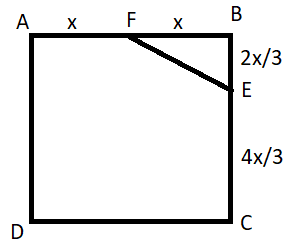
i.e. AF = FB = $\dfrac{2x}{2}=x$ cm
We assumed the side of the square as 2x then the length of BE will be equal to one third of the length of the side of the square ABCD. The length of EC will be equal to two thirds of the length of the side of the square ABCD.
i.e. BE = $\dfrac{2x}{3}$ cm. and EC = $\dfrac{4x}{3}$ cm.
We can see the things found above in the following figure:
Now, we are given that area of the triangle FBE = 108 sq. cm.
We know that area of a triangle = $\dfrac{1}{2}\times $ base $\times $ height
We see that triangle FBE is a right angled triangle.
So, area of triangle FBE = $\dfrac{1}{2}\times $ FB $\times $ BE
So, $\dfrac{1}{2}\times $ FB $\times $ BE = $\dfrac{1}{2}\times x\times \dfrac{2x}{3}=108$ sq. cm.
$\dfrac{{{x}^{2}}}{3}=108$
${{x}^{2}}=324$
$x=18$ cm.
So, $2x=36$ cm
This is the length of a side of the square ABCD.
Now, we need to find the length of the diagonal AC.
We know that the length of the diagonal of a square is $side\sqrt{2}$
So, the length of AC is $36\sqrt{2}$ cm.
Note: In this question, it is very important to know the following:
area of a triangle = $\dfrac{1}{2}\times $ base $\times $ height, and that the length of the diagonal of a square is equal to $side\sqrt{2}$. Making a relevant diagram is essential for such type of questions.
Complete step-by-step answer:
In this question, we are given that ABCD is a square. F is the mid point of AB. BE is one third of BC . The area of triangle FBE = 108 sq. cm.
We need to find the length of the diagonal AC.
Let the length of the side of the square ABCD be 2x cm.
Then, the length of AF will be equal to the length of FB which will be equal to the half of the length of the side of the square ABCD.
i.e. AF = FB = $\dfrac{2x}{2}=x$ cm
We assumed the side of the square as 2x then the length of BE will be equal to one third of the length of the side of the square ABCD. The length of EC will be equal to two thirds of the length of the side of the square ABCD.
i.e. BE = $\dfrac{2x}{3}$ cm. and EC = $\dfrac{4x}{3}$ cm.
We can see the things found above in the following figure:
Now, we are given that area of the triangle FBE = 108 sq. cm.
We know that area of a triangle = $\dfrac{1}{2}\times $ base $\times $ height
We see that triangle FBE is a right angled triangle.
So, area of triangle FBE = $\dfrac{1}{2}\times $ FB $\times $ BE
So, $\dfrac{1}{2}\times $ FB $\times $ BE = $\dfrac{1}{2}\times x\times \dfrac{2x}{3}=108$ sq. cm.
$\dfrac{{{x}^{2}}}{3}=108$
${{x}^{2}}=324$
$x=18$ cm.
So, $2x=36$ cm
This is the length of a side of the square ABCD.
Now, we need to find the length of the diagonal AC.
We know that the length of the diagonal of a square is $side\sqrt{2}$
So, the length of AC is $36\sqrt{2}$ cm.
Note: In this question, it is very important to know the following:
area of a triangle = $\dfrac{1}{2}\times $ base $\times $ height, and that the length of the diagonal of a square is equal to $side\sqrt{2}$. Making a relevant diagram is essential for such type of questions.
Recently Updated Pages
Master Class 11 Computer Science: Engaging Questions & Answers for Success

Master Class 11 Business Studies: Engaging Questions & Answers for Success
Master Class 11 Economics: Engaging Questions & Answers for Success
Master Class 11 English: Engaging Questions & Answers for Success
Master Class 11 Maths: Engaging Questions & Answers for Success
Master Class 11 Biology: Engaging Questions & Answers for Success
Trending doubts
One Metric ton is equal to kg A 10000 B 1000 C 100 class 11 physics CBSE
There are 720 permutations of the digits 1 2 3 4 5 class 11 maths CBSE
Discuss the various forms of bacteria class 11 biology CBSE
Draw a diagram of a plant cell and label at least eight class 11 biology CBSE
State the laws of reflection of light
Explain zero factorial class 11 maths CBSE