




\[ABCD\] is a rhombus. Show that diagonal \[AC\] bisects \[\angle A\] as well as \[\angle C\] and diagonal \[BD\] bisects \[\angle B\] as well as \[\angle D\].
Answer
 Verified
590.4k+ views
Hint:
Here we will draw the figure of rhombus along with their diagonals. We will consider two triangles in the rhombus and will make both the triangles congruent using the properties of rhombus. From there, we will get our required results.
Complete step by step solution:
Here we need to prove that the two diagonals of a rhombus bisect the angles of a rhombus.
We will first draw the figure of rhombus along with their diagonals.
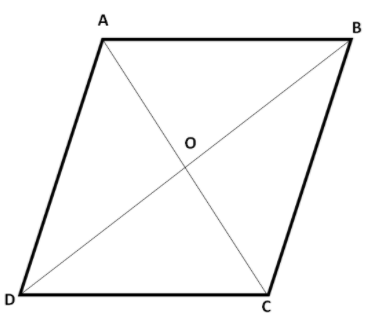
We know that all the sides of rhombus are equal i.e. \[AB = BC = CD = DA\] and also their length of diagonals is not equal but they always intersect each to make \[90^\circ \] .
Now, we will consider $\vartriangle ABC$ and $\vartriangle ADC$.
Therefore, in $\vartriangle ABC$ and $\vartriangle ADC$,
As all sides of rhombus are equal to each other, therefore,
\[\begin{array}{l}AB = DA\\BC = CD\end{array}\]
Also \[AC\] is the common side, so
\[AC = AC\]
Therefore, we can say that $\vartriangle ABC$ and $\vartriangle ADC$ are congruent by SSS rule of congruence. So,
$\vartriangle ABC \cong \vartriangle ADC$
Thus, by corresponding part of congruent triangles, we can say
\[\begin{array}{l}\angle DAC = \angle BAC\\\angle DCA = \angle BCA\end{array}\]
Hence, we can say that diagonal \[AC\] bisects \[\angle A\] as well as \[\angle C\] .
Now, we will consider $\vartriangle DAB$ and $\vartriangle DCB$.
Therefore, in $\vartriangle DAB$ and $\vartriangle DCB$,
As all sides of rhombus are equal to each other, so
\[\begin{array}{l}DA = DC\\AB = CB\end{array}\]
Also \[BD\] is a common side, so
\[BD = BD\]
Therefore, we can say that $\vartriangle DAB$ and $\vartriangle DCB$ are congruent by SSS rule of congruence i.e.
$\vartriangle DAB \cong \vartriangle DCB$
Thus, by corresponding part of congruent triangles, we can say
\[\begin{array}{l}\angle ABD = \angle CBD\\\angle ADB = \angle CDB\end{array}\]
Hence, we can say that diagonal \[BD\] bisects \[\angle B\] as well as \[\angle D\]
Hence, we have proved that the diagonal \[AC\] bisects \[\angle A\] as well as \[\angle C\] and diagonal \[BD\] bisects \[\angle B\] as well as \[\angle D\].
Note:
A rhombus is defined as a type of quadrilateral whose all sides are equal and also the opposite sides of a rhombus are parallel to each other. The two diagonals of rhombus intersect each other at \[90^\circ \] and both the diagonals are unequal in length. We have proved the given question using the SSS congruence rule. It states that if three sides of two triangles are equal and the triangles are congruent to each other.
Here we will draw the figure of rhombus along with their diagonals. We will consider two triangles in the rhombus and will make both the triangles congruent using the properties of rhombus. From there, we will get our required results.
Complete step by step solution:
Here we need to prove that the two diagonals of a rhombus bisect the angles of a rhombus.
We will first draw the figure of rhombus along with their diagonals.
We know that all the sides of rhombus are equal i.e. \[AB = BC = CD = DA\] and also their length of diagonals is not equal but they always intersect each to make \[90^\circ \] .
Now, we will consider $\vartriangle ABC$ and $\vartriangle ADC$.
Therefore, in $\vartriangle ABC$ and $\vartriangle ADC$,
As all sides of rhombus are equal to each other, therefore,
\[\begin{array}{l}AB = DA\\BC = CD\end{array}\]
Also \[AC\] is the common side, so
\[AC = AC\]
Therefore, we can say that $\vartriangle ABC$ and $\vartriangle ADC$ are congruent by SSS rule of congruence. So,
$\vartriangle ABC \cong \vartriangle ADC$
Thus, by corresponding part of congruent triangles, we can say
\[\begin{array}{l}\angle DAC = \angle BAC\\\angle DCA = \angle BCA\end{array}\]
Hence, we can say that diagonal \[AC\] bisects \[\angle A\] as well as \[\angle C\] .
Now, we will consider $\vartriangle DAB$ and $\vartriangle DCB$.
Therefore, in $\vartriangle DAB$ and $\vartriangle DCB$,
As all sides of rhombus are equal to each other, so
\[\begin{array}{l}DA = DC\\AB = CB\end{array}\]
Also \[BD\] is a common side, so
\[BD = BD\]
Therefore, we can say that $\vartriangle DAB$ and $\vartriangle DCB$ are congruent by SSS rule of congruence i.e.
$\vartriangle DAB \cong \vartriangle DCB$
Thus, by corresponding part of congruent triangles, we can say
\[\begin{array}{l}\angle ABD = \angle CBD\\\angle ADB = \angle CDB\end{array}\]
Hence, we can say that diagonal \[BD\] bisects \[\angle B\] as well as \[\angle D\]
Hence, we have proved that the diagonal \[AC\] bisects \[\angle A\] as well as \[\angle C\] and diagonal \[BD\] bisects \[\angle B\] as well as \[\angle D\].
Note:
A rhombus is defined as a type of quadrilateral whose all sides are equal and also the opposite sides of a rhombus are parallel to each other. The two diagonals of rhombus intersect each other at \[90^\circ \] and both the diagonals are unequal in length. We have proved the given question using the SSS congruence rule. It states that if three sides of two triangles are equal and the triangles are congruent to each other.
Recently Updated Pages
Master Class 12 Business Studies: Engaging Questions & Answers for Success

Master Class 12 Biology: Engaging Questions & Answers for Success
Master Class 12 Chemistry: Engaging Questions & Answers for Success
Class 12 Question and Answer - Your Ultimate Solutions Guide
Master Class 11 Social Science: Engaging Questions & Answers for Success
Master Class 11 English: Engaging Questions & Answers for Success
Trending doubts
Find the sum of series 1 + 2 + 3 + 4 + 5 + + 100 class 9 maths CBSE
Fill the blanks with the suitable prepositions 1 The class 9 english CBSE
Difference Between Plant Cell and Animal Cell
How many hours before the closure of election must class 9 social science CBSE
What is pollution? How many types of pollution? Define it
Name 10 Living and Non living things class 9 biology CBSE