




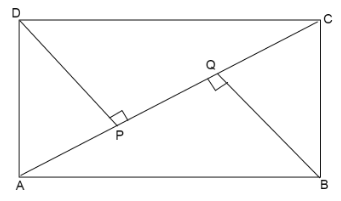
ABCD is a rectangle (Figure 11.31) in which \[\overline {DP} \] and \[\overline {BQ} \] are perpendiculars from D and B respectively on diagonal\[\overline {AC} \]. Show that
(i) \[\vartriangle ADP \cong \vartriangle CBQ\]
(ii) \[\angle ADP = \angle CBQ\]
(iii) \[\overline {DP} = \overline {BQ} \]
Answer
 Verified
612.9k+ views
Hint: We prove the congruence in two triangles using AAS congruence rule. Use the definition of alternate interior angles and sides of the rectangle to find pairs of equal sides and angles. After proving congruence, use the CPCT theorem to prove other two parts.
* AAS congruence rule states that the two angles and non-included angle of one triangle is equal to corresponding two angles and non-included side of another triangle.
Complete step-by-step answer:
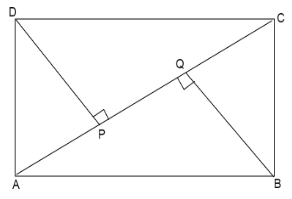
We are given a rectangle ABCD
Since, ABCD is a rectangle, so opposite sides are parallel and equal to each other.
\[ \Rightarrow AD\parallel BC,AD = BC\](As they are opposite sides of rectangle)...............… (1)
As AD and BC are set of parallel lines and AC acts as a transversal cutting the parallel lines, the alternate interior angles formed are \[\angle PAD,\angle QCB\]
\[ \Rightarrow \angle PAD = \angle QCB\]………………. (2)
(i) \[\vartriangle ADP \cong \vartriangle CBQ\]
In \[\vartriangle ADP,\vartriangle CBQ\]
\[\angle PAD = \angle QCB\] {From equation (2)}
\[\angle DPA = \angle BQC\]{As they both are perpendiculars to AC}
\[AD = BC\] {From equation (1)}
So, by AAs congruence rule, \[\vartriangle ADP \cong \vartriangle CBQ\]
(ii) \[\angle ADP = \angle CBQ\]
Since, \[\vartriangle ADP \cong \vartriangle CBQ\]
Using the CPCT theorem, the corresponding parts of two triangles are equal.
\[ \Rightarrow \angle ADP = \angle CBQ\] {As they are corresponding angles of congruent triangle}
(iii) \[\overline {DP} = \overline {BQ} \]
Since, \[\vartriangle ADP \cong \vartriangle CBQ\]
Using the CPCT theorem, the corresponding parts of two triangles are equal.
\[ \Rightarrow \overline {DP} = \overline {BQ} \] {As they are corresponding sides of congruent triangle}
Note: * CPCT theorem: CPCT stands for corresponding parts of congruent triangles. Theorem states that when two triangles are congruent, we can write the corresponding parts of two triangles equal.
* Rectangle is a quadrilateral that has the opposite pair of sides parallel and equal to each other. Also, all interior angles of the rectangle are right angles.
* Alternate interior angles are the set of angles that are formed on the alternate sides of a transversal that cuts a pair of parallel lines.
* AAS congruence rule states that the two angles and non-included angle of one triangle is equal to corresponding two angles and non-included side of another triangle.
Complete step-by-step answer:
We are given a rectangle ABCD
Since, ABCD is a rectangle, so opposite sides are parallel and equal to each other.
\[ \Rightarrow AD\parallel BC,AD = BC\](As they are opposite sides of rectangle)...............… (1)
As AD and BC are set of parallel lines and AC acts as a transversal cutting the parallel lines, the alternate interior angles formed are \[\angle PAD,\angle QCB\]
\[ \Rightarrow \angle PAD = \angle QCB\]………………. (2)
(i) \[\vartriangle ADP \cong \vartriangle CBQ\]
In \[\vartriangle ADP,\vartriangle CBQ\]
\[\angle PAD = \angle QCB\] {From equation (2)}
\[\angle DPA = \angle BQC\]{As they both are perpendiculars to AC}
\[AD = BC\] {From equation (1)}
So, by AAs congruence rule, \[\vartriangle ADP \cong \vartriangle CBQ\]
(ii) \[\angle ADP = \angle CBQ\]
Since, \[\vartriangle ADP \cong \vartriangle CBQ\]
Using the CPCT theorem, the corresponding parts of two triangles are equal.
\[ \Rightarrow \angle ADP = \angle CBQ\] {As they are corresponding angles of congruent triangle}
(iii) \[\overline {DP} = \overline {BQ} \]
Since, \[\vartriangle ADP \cong \vartriangle CBQ\]
Using the CPCT theorem, the corresponding parts of two triangles are equal.
\[ \Rightarrow \overline {DP} = \overline {BQ} \] {As they are corresponding sides of congruent triangle}
Note: * CPCT theorem: CPCT stands for corresponding parts of congruent triangles. Theorem states that when two triangles are congruent, we can write the corresponding parts of two triangles equal.
* Rectangle is a quadrilateral that has the opposite pair of sides parallel and equal to each other. Also, all interior angles of the rectangle are right angles.
* Alternate interior angles are the set of angles that are formed on the alternate sides of a transversal that cuts a pair of parallel lines.
Recently Updated Pages
Master Class 12 Economics: Engaging Questions & Answers for Success

Master Class 12 English: Engaging Questions & Answers for Success
Master Class 12 Social Science: Engaging Questions & Answers for Success
Master Class 12 Maths: Engaging Questions & Answers for Success
Master Class 12 Physics: Engaging Questions & Answers for Success
Master Class 9 General Knowledge: Engaging Questions & Answers for Success
Trending doubts
Find the sum of series 1 + 2 + 3 + 4 + 5 + + 100 class 9 maths CBSE
Difference Between Plant Cell and Animal Cell
Fill the blanks with the suitable prepositions 1 The class 9 english CBSE
What is pollution? How many types of pollution? Define it
Name 10 Living and Non living things class 9 biology CBSE
What is the full form of pH?