




$ABCD$ is a rectangle and $P,Q,R$ and $S$ are the mid points of the sides $AB,BC,CD$ and $DA$ respectively. Show that the quadrilateral $PQRS$ is a rhombus.
Answer
 Verified
639.6k+ views
Hint: Here, we need to prove that quadrilateral $PQRS$ is rhombus so we will draw the diagonals of the rectangle and proceed further. We have to do a construction by joining A to C and B to D to draw its diagonal.
Complete step-by-step answer:
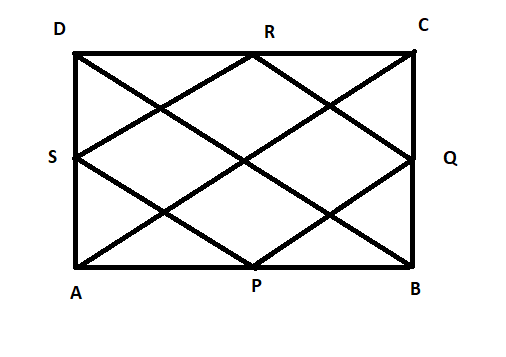
Given that, ABCD is a rectangle and P, O, R and S are the mid-points of the sides AB, BC, CD and DA respectively. We will do a construction from our side to solve the question. We will make the diagonals of the rectangle.
Considering $\vartriangle ABC$, we know P is the midpoint of AB and Q is the midpoint of BC respectively.
We know the property that line segments joining the mid-points of two sides of a triangle are parallel to the third side and are half of it.
$\therefore PQ\parallel AC$ and $PQ = \dfrac{1}{2}AC$ …(1)
Again considering $\vartriangle ADC$, we know R is the mid-point of ACD and S is the midpoint of AD respectively.
We know the property that line segments joining the mid-points of two sides of a triangle are parallel to the third side and are half of it.
$\therefore RS\parallel AC$ and $RS = \dfrac{1}{2}AC$ …(2)
Using equation (1) and (2), we can say that
$PQ\parallel RS$ and $PQ = RS$ …(3)
Similarly, we can prove that $PS\parallel RQ$ and $PS = RQ$…(4) by considering $\vartriangle ABD$ and $\vartriangle BCD$. Also $PQ = QR = RS = SP$ can be proved from equation (1), (2), (3) and (4).
Hence, In PQRS here all sides are equal.
It can be said that all sides are equal and opposite sides are parallel to each other. Hence, PQRS is a rhombus.
Note- For proving any quadrilateral a rhombus, we need to prove that all sides are equal and opposite sides are parallel to each other as explained above. Also, we have used the property that line segments joining the mid-points of two sides of a triangle are parallel to the third side and are half of it.
Complete step-by-step answer:
Given that, ABCD is a rectangle and P, O, R and S are the mid-points of the sides AB, BC, CD and DA respectively. We will do a construction from our side to solve the question. We will make the diagonals of the rectangle.
Considering $\vartriangle ABC$, we know P is the midpoint of AB and Q is the midpoint of BC respectively.
We know the property that line segments joining the mid-points of two sides of a triangle are parallel to the third side and are half of it.
$\therefore PQ\parallel AC$ and $PQ = \dfrac{1}{2}AC$ …(1)
Again considering $\vartriangle ADC$, we know R is the mid-point of ACD and S is the midpoint of AD respectively.
We know the property that line segments joining the mid-points of two sides of a triangle are parallel to the third side and are half of it.
$\therefore RS\parallel AC$ and $RS = \dfrac{1}{2}AC$ …(2)
Using equation (1) and (2), we can say that
$PQ\parallel RS$ and $PQ = RS$ …(3)
Similarly, we can prove that $PS\parallel RQ$ and $PS = RQ$…(4) by considering $\vartriangle ABD$ and $\vartriangle BCD$. Also $PQ = QR = RS = SP$ can be proved from equation (1), (2), (3) and (4).
Hence, In PQRS here all sides are equal.
It can be said that all sides are equal and opposite sides are parallel to each other. Hence, PQRS is a rhombus.
Note- For proving any quadrilateral a rhombus, we need to prove that all sides are equal and opposite sides are parallel to each other as explained above. Also, we have used the property that line segments joining the mid-points of two sides of a triangle are parallel to the third side and are half of it.
Recently Updated Pages
Master Class 12 Business Studies: Engaging Questions & Answers for Success

Master Class 12 Biology: Engaging Questions & Answers for Success
Master Class 12 Chemistry: Engaging Questions & Answers for Success
Class 12 Question and Answer - Your Ultimate Solutions Guide
Master Class 11 Social Science: Engaging Questions & Answers for Success
Master Class 11 English: Engaging Questions & Answers for Success
Trending doubts
Explain the Treaty of Vienna of 1815 class 10 social science CBSE
Which Indian city is known as the "City of Victory"?
Which instrument is used to measure the Blood Pressure?
Who Won 36 Oscar Awards? Record Holder Revealed
What is the median of the first 10 natural numbers class 10 maths CBSE
Why is it 530 pm in india when it is 1200 afternoon class 10 social science CBSE