




ABCD is a rectangle and P, Q, R, and S are the mid-points of the sides AB, BC, CD, and DA respectively. Show that the quadrilateral PQRS is a rhombus.
Answer
 Verified
645k+ views
Hint: First of all, dawn the diagram to visualize the question. Now join A to C. Now, to prove PQRS is rhombus, first prove PQRS is parallelogram then prove that all its sides are equal. Use the midpoint theorem to prove PQRS is a parallelogram and then prove \[\Delta APS\] and \[\Delta BPQ\] congruent to prove all the sides are equal.
Complete step-by-step answer:
Here, we are given that ABCD is a rectangle, and P, Q, R, and S are the mid-points of the sides AB, BC, CD, and DA respectively. We have to show that the quadrilateral PQRS is a rhombus.
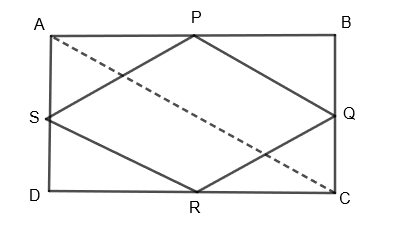
First of all, we will join A and C as in the above diagram.
We know that a rhombus is a parallelogram with all sides equal. So, first of all, we will prove PQRS is a parallelogram and then prove all sides are equal. We know that according to the midpoint theorem, the line segment joining the midpoints of two sides of the triangle is parallel to the third side and half of it.
So, in \[\Delta ABC\], P is the midpoint of AB and Q is the midpoint of BC. So according to the midpoint theorem, we get,
\[PQ||AC\]
\[PQ=\dfrac{1}{2}AC....\left( i \right)\]
Also, in \[\Delta ADC\], R is the midpoint of CD and S is the midpoint of AC. So according to the midpoint theorem, we get,
\[RS||AC\]
\[RS=\dfrac{1}{2}AC....\left( ii \right)\]
From equation (i) and (ii), we get,
\[\begin{align}
& PQ||RS \\
& PQ=RS \\
\end{align}\]
In PQRS, one pair of opposite sides are equal and parallel. Hence, PQRS is a parallelogram. Now, we will prove that all sides of the parallelogram are equal to prove it is a rhombus.
In \[\Delta APS\] and \[\Delta BPQ\], we know that P is the midpoint of AB. So, AP = BP. We know that all angles of the rectangle are \[{{90}^{o}}\]. So,
\[\angle PAS=\angle PBQ\]
Also, in the rectangle, opposite sides are equal. So, AD = BC. Therefore,
\[\dfrac{AD}{2}=\dfrac{BC}{2}\]
So, AS = BQ
Hence, \[\Delta APS\] is congruent to \[\Delta BPQ\] by SAS congruence criteria. We know that corresponding pairs of congruent triangles are equal. So, we get,
\[PS=PQ.....\left( iii \right)\]
Also, since PQRS is a parallelogram, therefore its opposite sides are equal, i.e.
\[\begin{align}
& PS=RQ \\
& PQ=RS.....\left( iv \right) \\
\end{align}\]
So, from equation (iii) and (iv), we get,
PQ = RS = PS = RQ
Hence, all the sides of PQRS are equal.
Thus, PQRS is a parallelogram with all sides equal. So, PQRS is a rhombus.
Hence Proved.
Note: Students often make mistakes while writing corresponding parts of the congruent triangles. That is sometimes they may write BD = DE which is wrong. So, they must properly examine and then only write to get the correct answer. Also, students must remember that angles opposite to equal sides are equal and its converse is true. Students should always draw the diagram first to visualize the question and always do construction in further steps.
Complete step-by-step answer:
Here, we are given that ABCD is a rectangle, and P, Q, R, and S are the mid-points of the sides AB, BC, CD, and DA respectively. We have to show that the quadrilateral PQRS is a rhombus.
First of all, we will join A and C as in the above diagram.
We know that a rhombus is a parallelogram with all sides equal. So, first of all, we will prove PQRS is a parallelogram and then prove all sides are equal. We know that according to the midpoint theorem, the line segment joining the midpoints of two sides of the triangle is parallel to the third side and half of it.
So, in \[\Delta ABC\], P is the midpoint of AB and Q is the midpoint of BC. So according to the midpoint theorem, we get,
\[PQ||AC\]
\[PQ=\dfrac{1}{2}AC....\left( i \right)\]
Also, in \[\Delta ADC\], R is the midpoint of CD and S is the midpoint of AC. So according to the midpoint theorem, we get,
\[RS||AC\]
\[RS=\dfrac{1}{2}AC....\left( ii \right)\]
From equation (i) and (ii), we get,
\[\begin{align}
& PQ||RS \\
& PQ=RS \\
\end{align}\]
In PQRS, one pair of opposite sides are equal and parallel. Hence, PQRS is a parallelogram. Now, we will prove that all sides of the parallelogram are equal to prove it is a rhombus.
In \[\Delta APS\] and \[\Delta BPQ\], we know that P is the midpoint of AB. So, AP = BP. We know that all angles of the rectangle are \[{{90}^{o}}\]. So,
\[\angle PAS=\angle PBQ\]
Also, in the rectangle, opposite sides are equal. So, AD = BC. Therefore,
\[\dfrac{AD}{2}=\dfrac{BC}{2}\]
So, AS = BQ
Hence, \[\Delta APS\] is congruent to \[\Delta BPQ\] by SAS congruence criteria. We know that corresponding pairs of congruent triangles are equal. So, we get,
\[PS=PQ.....\left( iii \right)\]
Also, since PQRS is a parallelogram, therefore its opposite sides are equal, i.e.
\[\begin{align}
& PS=RQ \\
& PQ=RS.....\left( iv \right) \\
\end{align}\]
So, from equation (iii) and (iv), we get,
PQ = RS = PS = RQ
Hence, all the sides of PQRS are equal.
Thus, PQRS is a parallelogram with all sides equal. So, PQRS is a rhombus.
Hence Proved.
Note: Students often make mistakes while writing corresponding parts of the congruent triangles. That is sometimes they may write BD = DE which is wrong. So, they must properly examine and then only write to get the correct answer. Also, students must remember that angles opposite to equal sides are equal and its converse is true. Students should always draw the diagram first to visualize the question and always do construction in further steps.
Recently Updated Pages
Master Class 10 English: Engaging Questions & Answers for Success

Master Class 10 Social Science: Engaging Questions & Answers for Success
Master Class 10 Computer Science: Engaging Questions & Answers for Success
Class 10 Question and Answer - Your Ultimate Solutions Guide
Master Class 10 General Knowledge: Engaging Questions & Answers for Success
Master Class 10 Maths: Engaging Questions & Answers for Success
Trending doubts
What is the full form of NDA a National Democratic class 10 social science CBSE
Explain the Treaty of Vienna of 1815 class 10 social science CBSE
Who Won 36 Oscar Awards? Record Holder Revealed
Bharatiya Janata Party was founded in the year A 1979 class 10 social science CBSE
What is the median of the first 10 natural numbers class 10 maths CBSE
Why is it 530 pm in india when it is 1200 afternoon class 10 social science CBSE