



ABCD is a quadrilateral. Then which of the following is true>
A. \[AC + BC < (AB + BC + CD + DA)\]
B. \[AC + BD < \dfrac{1}{2}(AB + BC + CD + DA)\]
C. \[AC + BD > \dfrac{1}{4}(AB + BC + CD + DA)\]
D. \[AC + BD < \dfrac{1}{4}(AB + BC + CD + DA)\]
Answer
 Verified
626.7k+ views
Hint: We can solve this by drawing a parallelogram diagram with diagonals. We know that in a triangle there are three sides, three vertices and three angels. The sum of the length of two sides of a triangle is always greater than the length of the third side. Using this we will obtain the required solution of the given problem.
Complete step-by-step answer:
Let’s draw a parallelogram ABCD, with AC and BD as s diagonals.
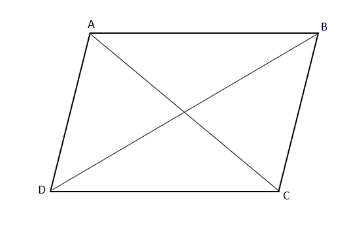
In the above figure,
We take, \[\Delta ACB\]
We know that the sum of the length of two sides of a triangle is always greater than the length of the third side. That is,
\[ \Rightarrow AB + BC > AC{\text{ - - - - - - - (1)}}\]
Now take, \[\Delta BCD\]
Applying the property of a triangle as done above, we have:
\[ \Rightarrow BC + CD > BD{\text{ - - - - - - - - (2)}}\]
Now take, \[\Delta ABD\]
Applying the property of a triangles, we have:
\[ \Rightarrow AB + AD > BD{\text{ - - - - - - - (3)}}\]
Now take, \[\Delta ACD\] . Similarly we have,
\[ \Rightarrow AD + DC > AC{\text{ - - - - - - - - (4)}}\]
Now adding all the four inequality we have,
\[ \Rightarrow AB + BC + BC + CD + AB + AD + AD + DC > AC + BD + BD + AC\]
Adding the same sides we have,
\[ \Rightarrow 2AB + 2BC + 2CD + 2AD > 2AC + 2BD\]
Taking 2 common on both sides we have,
\[2(AB + BC + CD + AD) > 2(AC + BD)\]
Cancelling 2 we have,
\[(AB + BC + CD + AD) > (AC + BD)\]
Rearranging we have,
\[(AC + BD) < (AB + BC + CD + AD)\]
So, the correct answer is “Option A”.
Note: We name the vertices in the clockwise direction. We draw the diagonals in the above figure because in the given options we have AC and BD which are diagonals. After drawing the diagram we took all possible triangles in the parallelogram and applied the properties of sides of a triangles. Here we took the third sides of triangles as diagonals of parallelogram so that we will get the answer quickly.
Complete step-by-step answer:
Let’s draw a parallelogram ABCD, with AC and BD as s diagonals.
In the above figure,
We take, \[\Delta ACB\]
We know that the sum of the length of two sides of a triangle is always greater than the length of the third side. That is,
\[ \Rightarrow AB + BC > AC{\text{ - - - - - - - (1)}}\]
Now take, \[\Delta BCD\]
Applying the property of a triangle as done above, we have:
\[ \Rightarrow BC + CD > BD{\text{ - - - - - - - - (2)}}\]
Now take, \[\Delta ABD\]
Applying the property of a triangles, we have:
\[ \Rightarrow AB + AD > BD{\text{ - - - - - - - (3)}}\]
Now take, \[\Delta ACD\] . Similarly we have,
\[ \Rightarrow AD + DC > AC{\text{ - - - - - - - - (4)}}\]
Now adding all the four inequality we have,
\[ \Rightarrow AB + BC + BC + CD + AB + AD + AD + DC > AC + BD + BD + AC\]
Adding the same sides we have,
\[ \Rightarrow 2AB + 2BC + 2CD + 2AD > 2AC + 2BD\]
Taking 2 common on both sides we have,
\[2(AB + BC + CD + AD) > 2(AC + BD)\]
Cancelling 2 we have,
\[(AB + BC + CD + AD) > (AC + BD)\]
Rearranging we have,
\[(AC + BD) < (AB + BC + CD + AD)\]
So, the correct answer is “Option A”.
Note: We name the vertices in the clockwise direction. We draw the diagonals in the above figure because in the given options we have AC and BD which are diagonals. After drawing the diagram we took all possible triangles in the parallelogram and applied the properties of sides of a triangles. Here we took the third sides of triangles as diagonals of parallelogram so that we will get the answer quickly.

Recently Updated Pages
Master Class 12 Economics: Engaging Questions & Answers for Success

Master Class 12 Social Science: Engaging Questions & Answers for Success
Master Class 12 English: Engaging Questions & Answers for Success
Master Class 12 Maths: Engaging Questions & Answers for Success
Master Class 12 Physics: Engaging Questions & Answers for Success
Master Class 12 Biology: Engaging Questions & Answers for Success
Trending doubts
Difference Between Plant Cell and Animal Cell
Fill the blanks with the suitable prepositions 1 The class 9 english CBSE
What is the full form of pH?
What is the Full Form of ICSE, CBSE and SSC
On an outline map of India show its neighbouring c class 9 social science CBSE
What is pollution? How many types of pollution? Define it